The Canadianist | Blog
Public Trust, Part Two: What Exactly Are “Plans in Italy”?

Nine days ago, I wrote about public trust in government and the growing problem governments create for themselves when they don’t give Canadians enough information to understand what they’re doing.
I didn’t expect to have such a tidy example quite so quickly.
The Prime Minister’s Office says Mark Carney will be working reduced hours for a week beginning Monday because he had previously committed to “plans in Italy.”
Plans in Italy.
That’s the explanation.
According to a Canadian Press report published Saturday, Carney will remain in close contact with his team and government officials, particularly as Canada continues trade negotiations with the United States. The PMO also said the federal ethics commissioner has identified no concerns or inconsistencies with the reduced schedule.
But nowhere in the explanation are Canadians actually told what kind of plans these are.
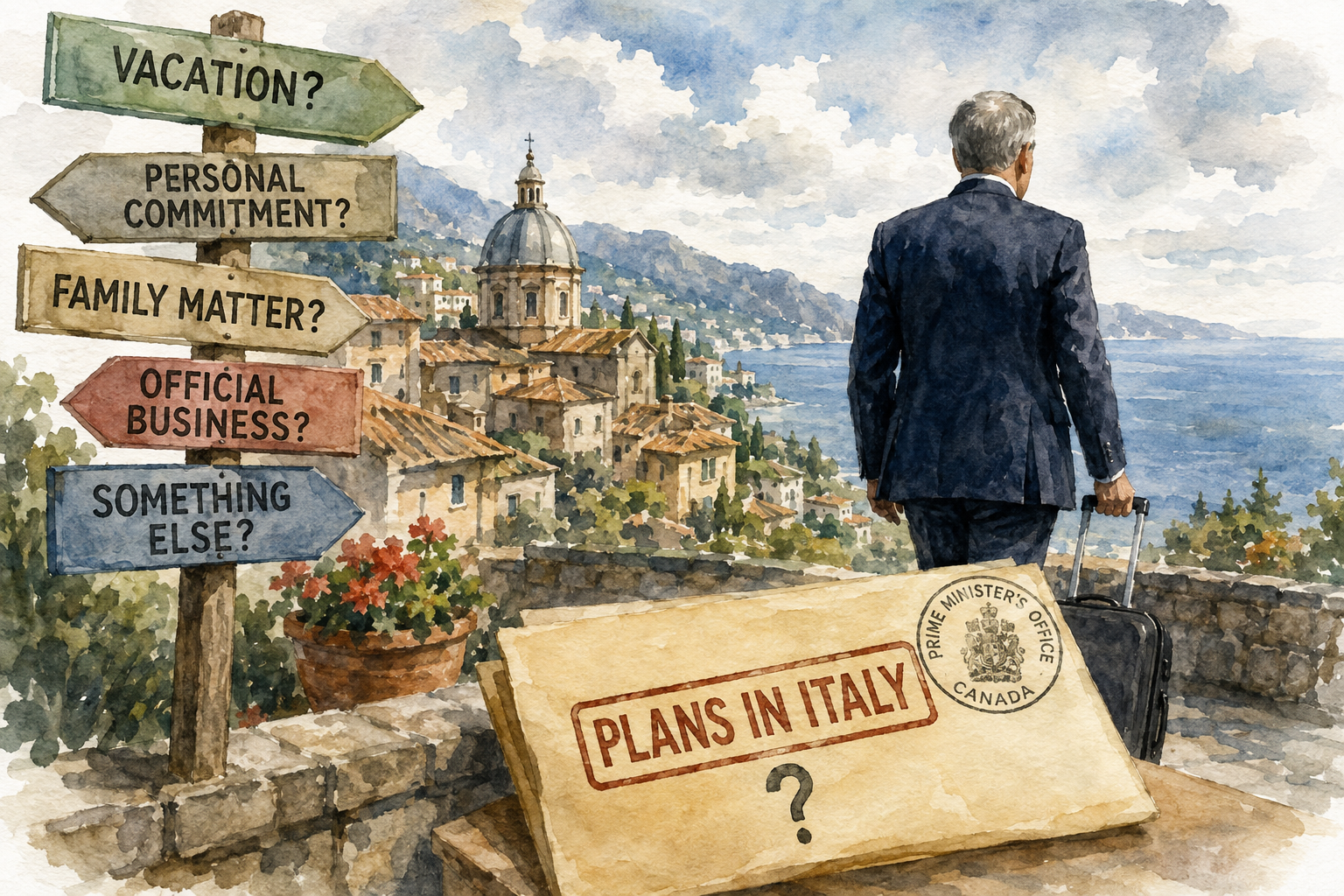
Is the Prime Minister taking a vacation? If so, say he’s taking a vacation.
Is this a personal or family commitment? That’s perfectly reasonable too. Say it’s a previously scheduled private commitment. No one needs to know who’s involved, where he’s staying or what he’s doing every afternoon.
Is it official government business? Then presumably Canadians should know what their prime minister is doing on their behalf in Italy.
Is it connected in some way to a previous professional or business commitment? We have absolutely no evidence that it is, and I’m not suggesting otherwise. But when the PMO itself goes out of its way to tell Canadians that the ethics commissioner has identified no concerns, it’s reasonable to wonder why an ethics assurance was considered relevant to the announcement in the first place.
There may be a completely mundane explanation for all of this. In fact, there probably is.
That’s what makes the wording so frustrating.
Privacy Isn’t the Issue
Prime ministers are human beings. They take vacations. They attend weddings. They visit friends and family. They have personal commitments that were made before becoming prime minister. They don’t surrender every element of their private lives when they take office, and Canadians aren’t entitled to know every detail.
There is an enormous difference, however, between privacy and unnecessary vagueness.
The PMO doesn’t have to tell Canadians what Carney will be doing in Italy every day. It doesn’t have to identify the people he’ll be with. It doesn’t have to provide an itinerary.
It could simply tell Canadians the nature of the commitment.
Instead, we’re told he has “plans in Italy.”
That wording practically begs people to ask questions.
And this is precisely the problem I wrote about in The Long Game Still Requires Public Trust.
Governments regularly complain about misinformation, conspiracy theories, declining confidence in institutions and the increasingly cynical way Canadians interpret almost everything coming out of Ottawa. Some of that criticism is entirely justified. Social media can turn an innocent event into a conspiracy theory before breakfast.
Government communication like this doesn’t help.
When information is withheld unnecessarily, people fill in the blanks themselves.
Don’t Create a Mystery Where None Needs to Exist
Suppose Carney is simply taking a few days of vacation in Italy.
Who cares?
He’s the Prime Minister of Canada, not a prisoner of the Langevin Block. He can take a vacation. Provided the government continues functioning and he’s available if circumstances require him, there’s nothing inherently controversial about that.
So why not say it?
The PMO has done exactly that before. When Carney worked a reduced schedule during a brief period last summer, his office described it publicly as a “brief period of local vacation.”
Clear. Simple. Nothing to speculate about.
“Plans in Italy” is different.
It provides geographic information without providing contextual information. We know where, but we don’t know why. Then the PMO adds an assurance involving the ethics commissioner without explaining why that assurance was necessary.
Perhaps there’s an entirely reasonable reason for that as well.
Tell us.
This isn’t a demand for intimate details about the Prime Minister’s private life. It’s a request for basic clarity from the office responsible for communicating on behalf of Canada’s head of government.
And the timing doesn’t exactly improve the optics.
The Canadian Press report was published at 1:14 p.m. Saturday, August 8, less than two days before Carney’s reduced schedule was set to begin Monday. His office said Canadians would be notified of any public events that arise during the week through media advisories sent to journalists. Yet the nature of the commitment that took the Prime Minister to Italy in the first place remained unexplained.
To be clear, we don’t know when the PMO provided this information to Canadian Press, so it would be unfair to characterize this as a deliberate weekend news dump. But we do know when Canadians learned about it: Saturday afternoon, with the reduced schedule beginning Monday.
Again, why?
If these plans were previously committed to, presumably they weren’t arranged Friday night. The Prime Minister’s Office knew about them. So why did the public receive this vague explanation less than two days before the reduced schedule was set to begin?
Maybe there’s a perfectly good answer.
That’s becoming something of a theme.
Public Trust Isn’t Automatic
In Part One, I argued that governments can’t demand public trust while withholding the information people need to decide whether that trust is deserved.
That standard doesn’t change depending on who’s governing.
If Pierre Poilievre were prime minister and his office announced that he would work reduced hours because of unspecified “plans in Italy,” I’d ask exactly the same question. If it were Jagmeet Singh, Yves-François Blanchet or anyone else occupying the office, the standard should remain the same.
What are the plans?
Not the private details. Not the guest list. Not the hotel.
Just tell Canadians what category we’re talking about.
Vacation. Personal commitment. Family matter. Official business. Something else.
That’s enough.
Transparency doesn’t require governments to publish every detail of everything they do. It requires them to provide enough information that reasonable people don’t have to speculate about basic facts.
The irony is that excessive secrecy can make perfectly innocent circumstances look suspicious. Governments create an information vacuum and then seem surprised when someone fills it.
That’s avoidable.
Nine Days Later, We’re Back Here
When I wrote Part One, the larger question was whether Canadians could trust a government asking them to accept short-term uncertainty in exchange for a longer-term plan.
My argument wasn’t that the government was necessarily doing something wrong. It was that trust requires transparency, particularly when you’re asking people to be patient.
Every unclear explanation, withheld detail, closed process and unanswered question chips away at that relationship.
Now we’re being told the Prime Minister will reduce his working hours because he has “plans in Italy.”
Maybe there’s nothing more interesting behind those four words than a few days off.
If that’s the case, wonderful.
Say so.
Because public trust isn’t strengthened by making Canadians guess. It isn’t strengthened by carefully worded statements that technically provide information while leaving the obvious question unanswered.
And it certainly isn’t strengthened when the government creates a mystery where there may never have been one in the first place.
This is Public Trust, Part Two.
I’d prefer not to have enough material for Part Three quite so soon.