


The Canadianist | Blog
Tim Hortons Sales Just Stalled. Are Canadians Falling Out of Love With Canada’s Coffee Shop?

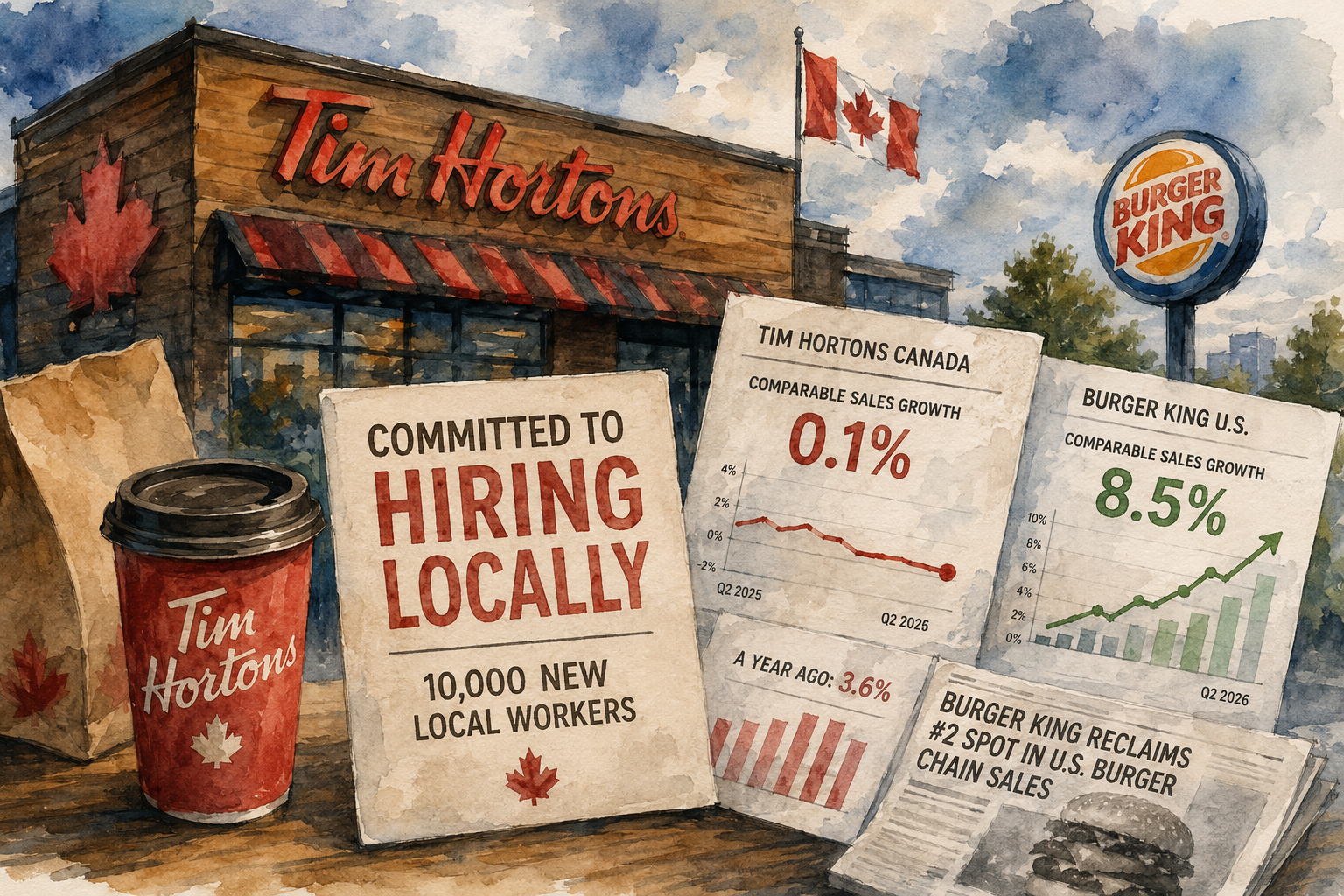
There was a number buried in Restaurant Brands International’s latest earnings report that should get Tim Hortons’ attention. Comparable sales at Tim Hortons Canada grew just 0.1 per cent in the second quarter, essentially flat. A year ago, the same number was 3.6 per cent, and analysts were expecting about 1.5 per cent this time around. Tim Hortons didn’t just slow down. It substantially underperformed expectations.
RBI CEO Josh Kobza offered an explanation. The advertising calendar, he said, didn’t produce the growth the company has come to expect from Tim Hortons. Fair enough. Sometimes a marketing campaign doesn’t work.
But there’s another number in the same corporate family that’s difficult to ignore.
Burger King U.S. comparable sales grew 8.5 per cent in the quarter, dramatically ahead of expectations. The chain has been investing in its restaurants, sharpening its value offers and putting renewed emphasis on the Whopper and its core menu. The turnaround has become significant enough that Burger King has now overtaken Wendy’s to reclaim its position as the second-largest burger chain in the United States by systemwide sales, behind McDonald’s.
One RBI brand is staging a comeback while another barely moved. That doesn’t prove anything about why Canadians aren’t responding to Tim Hortons the way the company expected, but it makes the Tim Hortons result considerably more interesting, especially when you go back a couple of months.
The Promise to Hire Local
On May 25, Tim Hortons launched a national campaign announcing that its restaurant owners intended to hire 10,000 new local workers. This wasn’t a footnote buried in an annual report. Tim Hortons put the campaign on television, digital platforms, social media and inside its restaurants.
The company emphasized its record as an employer of young Canadians, saying about 45 per cent of its restaurant employees were between 15 and 24 years old. Franchise owners had already conducted approximately 400 local hiring events during March and April, with more planned throughout the year.
Tim Hortons also disclosed something Canadians had increasingly been talking about. Of approximately 110,000 people working at Tim Hortons restaurants across Canada, about 4,000 had been hired through the Temporary Foreign Worker Program. The company said that number had been declining steadily since 2024.
The message couldn’t have been much clearer. Tim Hortons was making a renewed commitment to hiring locally, and with young Canadians struggling to find work, that’s precisely what you’d hope a company with Tim Hortons’ enormous footprint would do.
Then comes the awkward part.
Tim Hortons and the LMIA System
The federal government’s Job Bank allows Canadians to see positions for which employers have requested a Labour Market Impact Assessment, or LMIA. An LMIA is part of the process employers generally use when seeking permission to hire through the Temporary Foreign Worker Program. A positive assessment essentially requires demonstrating that hiring a foreign worker won’t negatively affect Canada’s labour market.
Search those federal records and Tim Hortons-branded employers appear. This wasn’t exclusively happening months or years before the local-hiring announcement, either. Federal Job Bank results captured Tim Hortons positions marked “LMIA requested” in May, including restaurant managers, food-service supervisors and counter attendants. Other Tim Hortons-branded LMIA-requested positions appeared in June, after the May 25 local-hiring campaign had begun.
That requires some important context. Tim Hortons restaurants are overwhelmingly operated by franchisees. Corporate headquarters doesn’t sit in an office somewhere deciding who gets hired behind the counter at every restaurant in Canada. Individual restaurant owners have their own staffing requirements and make their own employment decisions. An LMIA request also doesn’t mean a temporary foreign worker was ultimately hired, and Tim Hortons never promised that not another temporary foreign worker would ever work at one of its restaurants. Its stated commitment was to hire locally whenever possible and reduce its reliance on the program.
Those are meaningful distinctions, but they don’t make the federal records irrelevant. If you’re going to spend money on a national advertising campaign telling Canadians you’re committed to hiring locally, Canadians have every right to ask how that commitment is working across the restaurants carrying your name.
There’s Another Piece to This
Tim Hortons’ relationship with the federal government deserves some scrutiny too. Restaurant Brands International remains registered with the federal lobbying registry, with CEO Josh Kobza listed as the responsible officer. The registration covering the period through May 18 included lobbying interests concerning employment, training, labour, small business, taxation and workforce development.
Importantly, the current registry also says RBI reported no monthly lobbying communications during the previous six months. That’s a distinction worth making because there’s a much stronger accusation circulating online: that Tim Hortons was publicly promising to hire Canadians while its CEO was simultaneously lobbying Ottawa to keep immigration rules loose.
The public record we’ve reviewed doesn’t establish that. Being registered to lobby isn’t the same thing as actually lobbying a government official on a particular day, and there are enough legitimate questions here without manufacturing another one.
Did Canadians Stop Buying?
This is where the story gets tempting. Tim Hortons announces its local-hiring campaign in May. Canadians discover Tim Hortons-branded employers are still appearing in the LMIA system. Two months later, Tim Hortons reports virtually no comparable-sales growth. Connect the dots and you’ve got a terrific headline, but you’ve also got a problem: there’s no evidence yet that those dots connect.
We haven’t seen consumer research showing Canadians abandoned Tim Hortons because of its employment practices. RBI hasn’t reported such a connection, and a collection of angry social-media posts doesn’t establish one either. Maybe Canadians did react and maybe they didn’t. The 0.1 per cent number can’t answer that question.
Tim Hortons says its advertising calendar didn’t perform as expected. Pricing, competition, menu decisions and changing consumer habits could all be involved. Burger King’s resurgence illustrates the point nicely. Its 8.5 per cent growth didn’t materialize out of nowhere. RBI has spent years working on the brand, renovating restaurants, pushing value promotions and returning attention to the product that made Burger King famous in the first place.
Customers responded, while Tim Hortons now has to figure out why its customers didn’t respond nearly as enthusiastically. Part of that conversation should involve something that doesn’t appear neatly on an earnings statement: trust.
Tim Hortons Isn’t Just Another Restaurant
There are plenty of foreign-owned restaurant chains operating in Canada, but Tim Hortons occupies a different space. For decades, the company has deliberately attached itself to Canadian identity. Hockey arenas, early mornings, road trips, small towns, Timbits after practice and the double-double aren’t accidental pieces of Tim Hortons advertising. They’re the brand.
Tim Hortons has spent enormous amounts of money convincing Canadians that walking into one of its restaurants is somehow a small Canadian ritual. It’s been brilliant marketing, but there’s a trade-off when you build a business around national identity. Canadians start treating you differently from the burger place down the street. When a company sells Canadiana along with its coffee, what it does in Canada becomes part of the product.
That’s why the employment issue has resonated, and it’s also why Tim Hortons’ May announcement was significant. The company clearly recognized that Canadians cared about who was getting these jobs. It responded by publicly committing to 10,000 local hires and emphasizing its role as an employer of Canadian youth.
Now show us the results.
How many of those 10,000 local workers have actually been hired? Has the approximately 4,000-person Temporary Foreign Worker figure declined since May? How many Tim Hortons franchisees have requested LMIAs since the campaign began, how many were approved, and how does that compare with the same period last year? Most importantly, what exactly does “hire locally whenever possible” mean across thousands of independently operated restaurants?
Those aren’t gotcha questions. They’re precisely the kind of questions a company should expect after making the issue part of its own national advertising campaign.
Then There’s That 0.1 Per Cent
Tim Hortons remains an enormously successful business, and one weak quarter doesn’t suddenly change that. But 0.1 per cent is still 0.1 per cent, and it’s arriving while another major RBI brand is demonstrating what a genuine turnaround looks like. Burger King has fought its way back to the number-two position among U.S. burger chains by systemwide sales and just delivered 8.5 per cent comparable-sales growth. Tim Hortons, meanwhile, barely grew at all.
Perhaps Kobza is right and Tim Hortons simply had a lousy advertising calendar. We’ll find out. But corporations sometimes make the mistake of assuming customers experience a brand the same way executives see it on a spreadsheet.
People don’t experience brands that way. Their opinion builds over time through service, prices, quality and whether the company appears to behave consistently with what it tells them. Eventually those impressions can affect where people spend their money. We can’t say that’s what happened to Tim Hortons this quarter, because the evidence isn’t there.
What we can say is much simpler. In May, Tim Hortons made a very public commitment to hire locally. Federal records show Tim Hortons-branded employers continued to seek LMIAs around and after that announcement. In August, the company reported virtually no comparable-sales growth.
Tim Hortons owes its investors an explanation for that last number, and Canadians deserve some answers about the first two. For a company that has spent decades selling itself as part of Canada, answering them clearly would be a pretty good place to start.