The Canadianist | Blog
The Greatest Finance and Industry Minister Canada Never Had

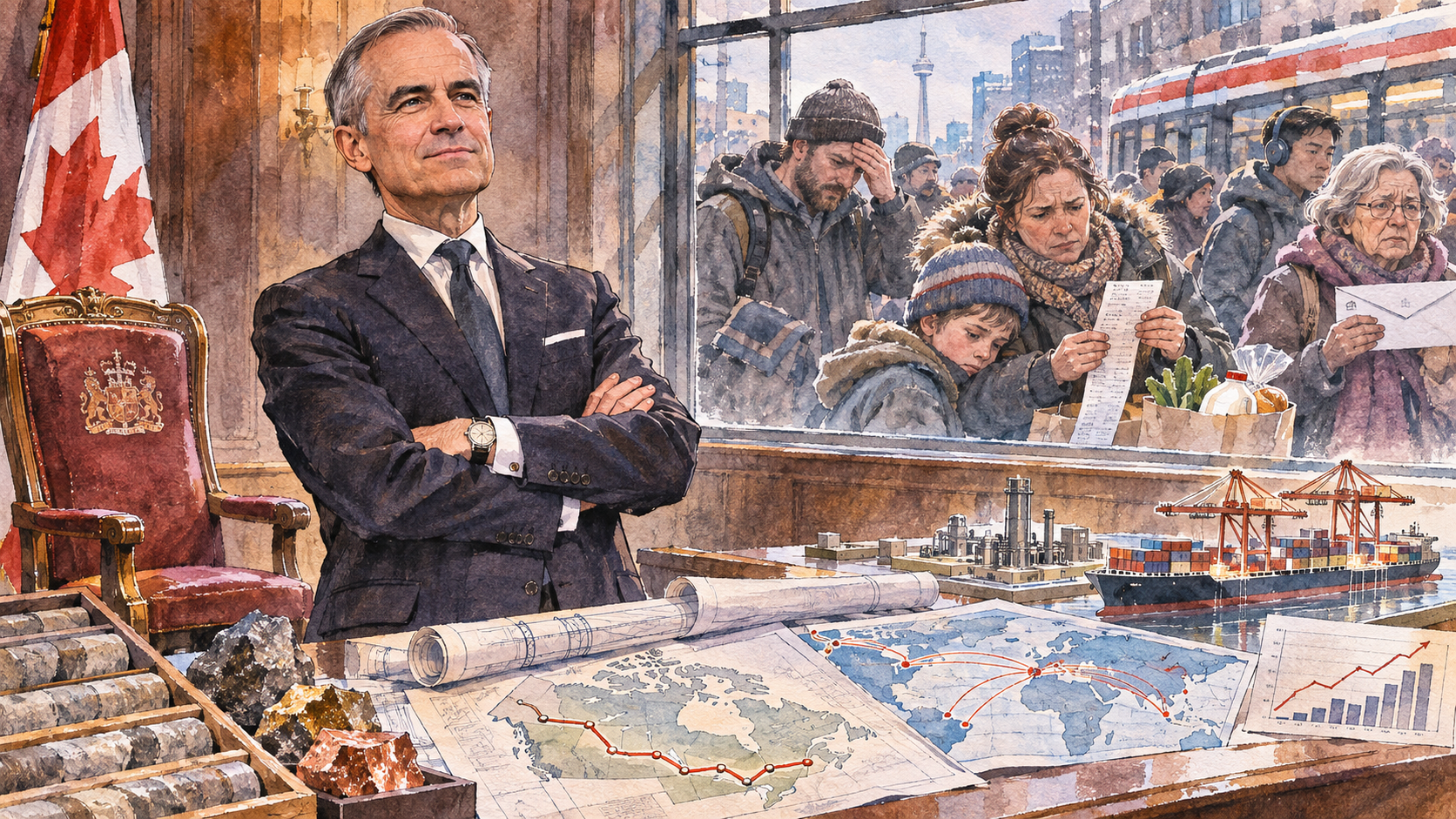
I’ve spent the better part of a year and a half watching Mark Carney lead this country, and I think I’ve made up my mind.
He may very well turn out to be the greatest finance and industry minister Canada never had. He understands international markets, has relationships with some of the most influential economic figures in the world, and appears entirely comfortable negotiating the kinds of agreements that could shape Canada’s economic future for decades.
Those are valuable qualifications. I would want someone with that expertise advising any Canadian government.
But I’m increasingly convinced that they aren’t enough to make him the prime minister Canada needs.
On Thursday, November 5, Carney’s government will deliver its second federal budget. The signals coming out of Ottawa suggest another ambitious effort to attract investment, accelerate development and make Canada a more competitive place to do business.
There’s plenty to appreciate in that approach. Canada needs investment. We need industrial growth, infrastructure, better productivity and opportunities that will provide employment and prosperity for generations to come. A country that doesn’t invest in its future eventually finds itself without much of one.
The government’s proposed $36-billion Productivity Mega Deduction, designed to encourage business investment over five years, is one example. The broader strategy has elements of an American-style, business-first approach to economic growth. There’s nothing inherently wrong with encouraging companies to invest, expand and hire.
I’m not an economist, and I won’t pretend to be one. I would expect a responsible prime minister to surround himself with economists and policy specialists representing a broad spectrum of perspectives, listen carefully to competing arguments and arrive at decisions that serve the country.
But while Ottawa talks about ports, pipelines, mines, international investment and future prosperity, I’m standing in a grocery store wondering how a pound of coffee, a piece of cheese, some butter and a carton of cream can cost me nearly forty dollars.
And I’m hardly alone.
Canadians are worried about groceries, rent, mortgages, employment and what life will cost them next month. They’re looking at an increasingly uncertain world, strained relationships with our largest trading partner and an economy that seems to demand more from households while offering less security in return.
The government has introduced affordability measures, including an expanded groceries and essentials benefit, and has announced a national food security strategy. Those measures deserve to be acknowledged and judged on their results. Yet grocery prices remain painfully high, and the government’s public agenda continues to be dominated by investment, economic expansion and what Canada might become in the future.
I want Canada to become an economic powerhouse. I also want to know when ordinary Canadians can expect to feel some of that prosperity.
A prime minister has to govern in both directions, addressing tomorrow’s opportunities while remaining visibly engaged with today’s difficulties.
And it’s that second responsibility where I believe Carney has repeatedly fallen short.
The Missing Political Instinct
There’s something to be said for a leader who knows when to put aside the briefing books, leave the boardroom and walk among the people he’s governing.
Let me be clear. I’m no admirer of Justin Trudeau’s record in government, and I have plenty of disagreements with Doug Ford. I’m not looking back at either of them with rose-coloured glasses.
But I’m perfectly capable of recognizing something a politician does well, even when I disagree with much of what they stand for.
Trudeau understood the value of being seen among ordinary Canadians. Ford understands it too. When a major snowstorm hits, he’s been known to get out with a shovel. Nobody seriously believes the premier is going to personally clear Toronto’s streets. It’s a symbolic gesture, and everybody knows it.
But symbols are part of leadership.
Neither man’s policies become better because he rides a subway or shovels a sidewalk. Their public appearances don’t erase their political mistakes. They simply demonstrate an understanding of something that Carney’s government seems remarkably reluctant to embrace: Canadians need to see their leaders standing alongside them when circumstances become difficult.
Carney strikes me as a man who would rather explain the economic benefits of investing in snow-removal equipment than pick up a shovel.
Perhaps that’s unfair. But after watching him for nearly twenty months, it’s the impression I’ve been left with.
And where are his advisers?
Surely somebody in the Prime Minister’s Office should recognize that Canadians are frightened by what they’re experiencing. Somebody ought to be telling him to spend a day walking through Toronto or Ottawa, visiting grocery stores, speaking to people about their rent, their jobs and their uncertainty.
It could be a carefully planned public appearance. I wouldn’t care. Political leadership has always involved public gestures, and Canadians are perfectly capable of recognizing one.
The value is in the message being communicated. Your government sees what you’re going through. Your difficulties have its attention. You haven’t been forgotten while Ottawa pursues its grand economic ambitions.
I don’t need to know what Mark Carney privately feels about Canadians who are struggling. His private feelings are his business.
I need to see a government that recognizes the importance of demonstrating solidarity with the people it serves.
And with every opportunity he misses, he strengthens my belief that he may be exceptionally suited to managing Canada’s economic development while lacking the broader political instincts I expect from the person leading the country.
There’s More to Leadership Than Expertise
I keep returning to a rather unlikely analogy from my younger years: the bridge of the Starship Enterprise.
Captain James T. Kirk wasn’t the ship’s greatest scientist. That was Spock. He wasn’t a doctor. He had McCoy. And when something went wrong with the engines, he wasn’t about to climb into the machinery and replace Scotty.
He surrounded himself with people who understood their responsibilities better than he did, listened to their assessments and made the decisions.
Sometimes Spock’s logic prevailed. Sometimes McCoy’s human perspective carried the day. Kirk had to consider both, along with the safety of his crew, the mission and circumstances that could change without warning.
That’s leadership.
A prime minister doesn’t need to be Canada’s foremost economist, its greatest military strategist or its most knowledgeable constitutional scholar. We have people who spend their lives developing those specialties.
The prime minister has to bring them together, understand the competing priorities and make judgments on behalf of the entire country.
When the crew is frightened and the ship is in trouble, the captain has to recognize that too.
Canada has no shortage of talented people capable of helping us navigate the economic challenges ahead. What I believe we’re missing is a stronger sense of national solidarity from the people commanding the bridge.
And the Conservatives Aren’t Off the Hook
Pierre Poilievre and the Conservative Party have been relentless in their criticism of the government’s handling of affordability. To their credit, they’ve kept the cost of living near the centre of the political conversation.
But criticizing the government is considerably easier than demonstrating the judgment necessary to lead one.
I continue to look at the 2025 federal election as a revealing example.
Poilievre had spent years preparing to defeat Justin Trudeau. His party had enjoyed an extraordinary advantage in the polls, and the political environment appeared almost perfectly suited to his message.
Then Trudeau resigned, Carney arrived, Donald Trump upended the Canada-U.S. relationship, and the political landscape changed dramatically.
Poilievre needed to recognize that the mission had changed. He needed to adjust his approach, broaden his appeal and find a way to address a country whose immediate concerns had shifted.
Instead, he appeared too attached to the strategy that had worked against Trudeau.
The Conservatives increased their vote share and seat count, but they failed to form government. I don’t regard that defeat as proof Poilievre could never govern. I regard his response to changing circumstances as a legitimate question about political judgment.
And I continue to see the same problem.
Poilievre can be an effective critic. He can identify failures, deliver sharp attacks and make an argument for lower taxes and reduced government spending. Yet his approach repeatedly returns to confrontation, even when there may be greater opportunities in cooperation.
Conservatives accuse the Liberals of being irresponsible with public finances while proposing an assortment of tax reductions and other forms of relief. Some of those ideas may be worthwhile, but reduced government revenue has fiscal consequences too. A serious alternative must explain how its numbers work, what it would prioritize and what Canadians should expect in return.
I’d also like to see something much more ambitious from the opposition right now.
Imagine Poilievre standing before Canadians and addressing the prime minister directly:
Mr. Prime Minister, we’re your opposition, and we’ll continue to hold your government accountable. But we’re Canadians first. Our country is facing extraordinary challenges, and people are hurting. We want Canada to succeed, and where your government can help Canadians, we want you to succeed too.
We’re asking you to listen to the millions of Canadians who voted for another party. Let’s bring the parties together, sit down and identify what we can accomplish in the national interest. We can disagree tomorrow about the things that divide us. Today, let’s find the things we can do together.
Imagine the response to that.
It would require Poilievre to put aside the attack lines long enough to demonstrate another dimension of leadership. He wouldn’t have to surrender a single Conservative principle or abandon his responsibility to oppose the government.
He would be offering Canadians something that has become increasingly rare in federal politics: a public demonstration that the country’s interests come before the perpetual political campaign.
That’s the kind of approach I’ve argued for through the United Canadian Centrists. A Parliament in which disagreement is expected, scrutiny is rigorous and cooperation remains possible. Where political parties recognize that none of them has a monopoly on good ideas or an exclusive claim to representing Canada.
National unity doesn’t require everyone to agree. It requires a willingness to work together despite disagreement.
Canadians Need Solidarity Now
I don’t expect Thursday’s budget to solve every economic difficulty Canadians face. Nobody seriously involved in public policy should pretend that a federal budget can simply order grocery prices down or reverse years of accumulated housing costs.
And I’m prepared to acknowledge that Carney’s investment strategy could prove beneficial. We may look back in a decade and discover that some of the decisions being made today helped secure Canada’s economic independence and prosperity.
I’d welcome that outcome.
But I can’t pay for groceries with the promise of a stronger economy ten years from now. Neither can the millions of Canadians struggling to make their household budgets work today.
There’s an obligation here that reaches beyond economic policy. Canadians need national unity and solidarity from their government, especially during an extraordinary period of uncertainty. They need to see that the people making decisions in Ottawa understand the conditions in which those decisions will be lived.
The Conservatives have a responsibility to contribute to that solidarity too. Their job is to provide an alternative government, challenge bad decisions and hold the Liberals accountable. But there’s nothing preventing them from also demonstrating a willingness to work for the national good.
As for Carney, I no longer think the question is simply whether his economic policies will succeed. I’ve watched enough to form an opinion about the leadership qualities he has demonstrated so far.
I see an exceptionally accomplished financial mind, a capable international negotiator and someone who may possess precisely the expertise Canada needs to strengthen its economy.
I haven’t seen the same ability to connect those ambitions with the immediate needs and anxieties of the people he governs.
There’s still a budget to be delivered on Thursday, and I’ll judge its contents fairly. If it contains serious, practical measures to address the pressures Canadians are experiencing, I’ll acknowledge them.
But a budget alone won’t settle my concerns about leadership.
Carney may be exceptionally qualified for the job of rebuilding Canada’s economic strength. We’ve put him in the wrong job, however, and he may very well turn out to be the greatest finance and industry minister Canada never had.