

National | Housing
Ottawa Isn’t Fixing Housing. It’s Managing the Decline
There’s a familiar rhythm to housing policy in Canada now. Costs rise, affordability worsens, pressure builds, and governments respond with money. This latest deal follows that pattern almost exactly. It promises to lower the cost of building homes by reducing fees and injecting public funding, with the expectation that supply will increase and prices will ease. On paper, it makes sense. In practice, even the experts aren’t convinced it goes far enough.


Economists say the new housing deal may help at the margins. That’s exactly the problem.
There’s a familiar rhythm to housing policy in Canada now. Costs rise, affordability worsens, pressure builds, and governments respond with money. This latest deal follows that pattern almost exactly. It promises to lower the cost of building homes by reducing fees and injecting public funding, with the expectation that supply will increase and prices will ease. On paper, it makes sense. In practice, even the experts aren’t convinced it goes far enough.
The federal government, working alongside the Canada Mortgage and Housing Corporation, is trying to ease the financial burden on builders. Economists broadly agree that lowering development costs can help. It may keep some projects viable. It may prevent cancellations. It may even support a modest increase in activity over time. But that’s where the agreement ends, because the same economists are also clear about what this policy does not do.
It does not solve the structural constraints that are actually limiting supply.
Analysts from institutions like Royal Bank of Canada, Scotiabank, and TD Bank continue to point to the same underlying issues. Municipal zoning restrictions, slow approval timelines, labour shortages in the skilled trades, infrastructure limitations, and tight financing conditions remain the dominant barriers. Reducing costs helps at the edges, but it doesn’t change the capacity of the system to build more homes at the pace required.
That’s why the consensus view is cautious. The policy is seen as positive, but limited. Helpful, but not transformative.
The timing only reinforces that reality. CMHC’s own outlook points to a near-term decline in housing starts before any gradual recovery takes hold. Private-sector forecasts suggest construction could remain subdued for some time, as projects struggle to pencil out under current conditions. In that environment, policies like this are less about accelerating growth and more about preventing further contraction.
Even economists who support the direction of the policy acknowledge a second problem, there is no guarantee the benefits reach buyers. Home prices are driven by demand as much as cost. In tight markets, lower construction costs do not automatically translate into lower prices. They can just as easily be absorbed into margins or offset by other pressures. The transmission from policy to affordability is indirect at best.
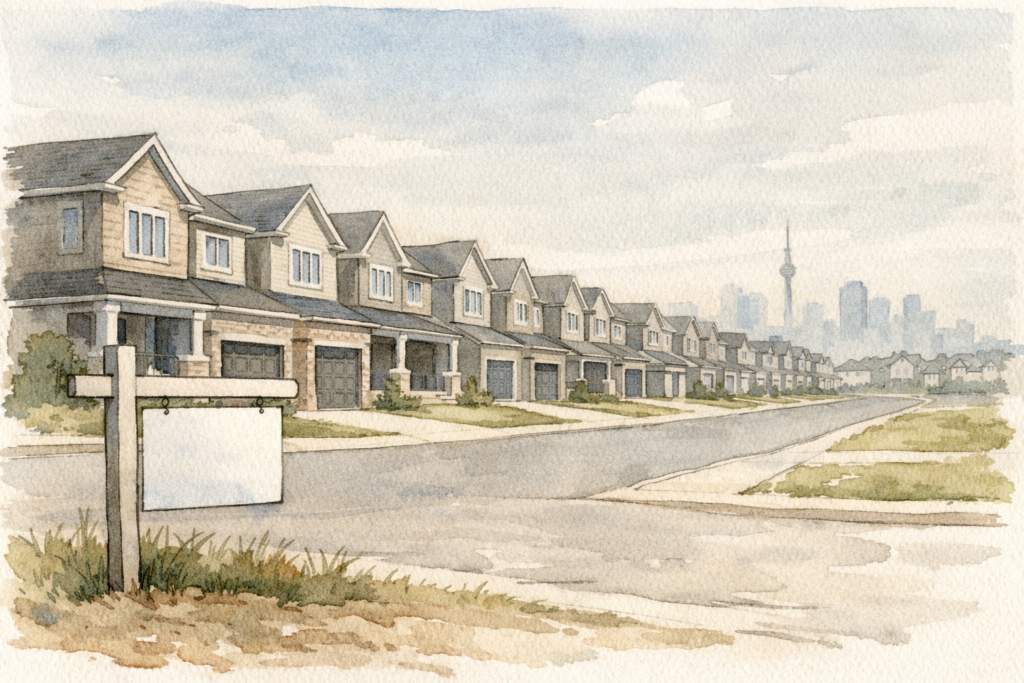
Put all of that together, and a clearer picture emerges. This is not a policy designed to meaningfully increase supply in the short term. It is a policy designed to stabilize a system that is already under strain.
And that brings us back to the larger issue. Canada’s housing crisis is not the result of a single factor that can be addressed with a single intervention. It is the product of years of accumulated constraints across multiple levels of government and the private sector. Fixing it requires structural reform, faster approvals, better coordination, more labour capacity, and infrastructure that can support growth. Those are difficult changes. They take time. They also carry political risk.
Spending money is easier. It produces immediate action and immediate headlines. It signals responsiveness, even when the underlying conditions remain unchanged.
So the cycle continues. Governments intervene financially, the system stabilizes temporarily, and the deeper problems persist. The next intervention becomes inevitable, not because the previous one failed outright, but because it was never designed to solve the problem in the first place.
Even in the best-case scenario, this latest approach may bring housing activity back toward where it should already be. It does not move the country meaningfully closer to where it needs to be. That’s not a solution, it’s a holding pattern.
If economists are right that this policy helps at the margins, then Canadians should be asking a bigger question. Where is the plan that goes beyond the margins and actually expands the system’s capacity to build?
Until that question is answered, housing policy in Canada will continue to feel less like progress and more like delay.