

National | Global Affairs
Polling Trends: Federal Liberal Lead Widens Amid Global Volatility

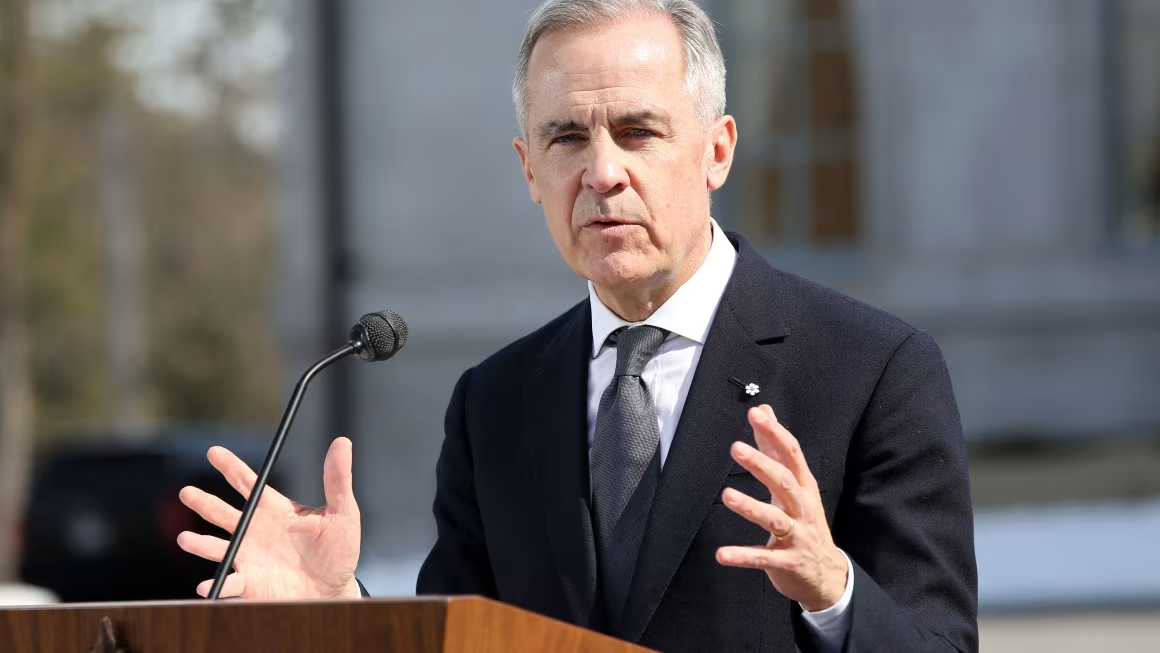
A series of new public opinion surveys released in mid-March 2026 indicates a significant widening of the support gap between the governing Liberal Party and the Conservative opposition. Data from Abacus Data, released on Sunday, March 15, places the Liberals 11 points ahead of the Conservatives, a margin that reflects a broader national trend toward seeking stability during a period of heightened international uncertainty.
The shift in public sentiment comes as Canada navigates a complex global landscape defined by energy market volatility, shifting trade relations with the United States, and ongoing geopolitical tensions in the Middle East. According to the latest figures, the Liberal government, led by Prime Minister Mark Carney, has seen its support solidify in key battlegrounds, while the Conservative Party, led by Pierre Poilievre, faces challenges in converting economic anxiety into sustained political momentum.
Statistical Breakdown of the Current Landscape
The 11-point lead reported by Abacus Data is part of a consistent pattern observed across multiple major polling firms in early 2026. While methodologies vary, the consensus points to a government that is currently benefiting from a "stability premium."
Detailed results from the most recent surveys include:
- Abacus Data (March 15, 2026): Liberals at 45%, Conservatives at 34%.
- Leger (March 2, 2026): Liberals at 49%, Conservatives at 35%, representing a 14-point advantage.
- Liaison Strategies (March 2, 2026): Liberals at 43%, Conservatives at 33%.
- Nanos Research (February 25, 2026): Confirmed the widest lead for the Liberals in the current mandate.
The Leger data specifically notes that Liberal support has climbed by two percentage points since January, while Conservative support has retracted by three points over the same period. This suggests that the "undecided" block and some "soft" Conservative voters may be gravitating toward the governing party as global headlines become more volatile.
Regional and Demographic Shifts
The Liberal lead is largely anchored in Central and Eastern Canada, while the Conservatives maintain their traditional strongholds in the Prairies. However, the depth of the Liberal advantage in Ontario and Quebec is a primary driver of the current national gap.
In Atlantic Canada, Liberal support sits at 53%, a dominant position that suggests a high level of satisfaction with regional federal initiatives. In Ontario, the party holds 47%, and in Quebec, it maintains a comfortable 40%. The Conservative Party continues to lead in Alberta and Saskatchewan, but the margins there have not been sufficient to offset losses in the high-density urban centers of the East.

Demographically, a stark gender and age divide persists. Female voters show a 17-point preference for the Liberals over the Conservatives. Support is highest among the 50–64 age demographic, where 50% of respondents favor the current government. Conversely, the 18–34 age group remains the most competitive segment of the electorate; in this bracket, the Conservatives hold a narrow three-point lead over the Liberals. Analysts suggest this younger demographic is most acutely affected by the housing affordability crisis and is more receptive to the Conservative platform's focus on deregulation and housing supply.
Leadership Approval Ratings
The personal popularity of the party leaders remains a critical factor in the polling trajectory. Prime Minister Mark Carney currently maintains a 61% national approval rating. According to the data, 59% of Canadians express overall satisfaction with the direction of the government, suggesting that the leadership's professional approach to economic management is resonating with a majority of the public.
In contrast, Conservative Leader Pierre Poilievre faces a significant favorability deficit. His unfavorable rating currently stands at 55%, with only 35% of respondents viewing his leadership favorably. This 20-point negative gap has proven difficult for the opposition to overcome, particularly as the government pivots its messaging toward international diplomacy and institutional stability.
Public sentiment regarding the timing of the next federal election also reflects a desire for continuity. Despite calls from some opposition corners for an earlier vote, 49% of Canadians prefer to wait until the fixed election date in 2029. Only 10% of the population supports the idea of an immediate election, indicating that the appetite for political upheaval is low.
The Impact of Global Volatility
A key takeaway from the Abacus Data report is the divergence between "domestic optimism" and "global pessimism." While Canadians express deep concern regarding international conflicts and the stability of global supply chains, there is a measurable sense of resilience regarding the domestic situation.
The recent decision by the Canadian government to join the International Energy Agency’s release of 400 million barrels of oil reserves has been viewed by many as a proactive step to mitigate the impact of the Strait of Hormuz disruptions. This move, coupled with the Bank of Canada’s anticipated decision to hold interest rates steady at 2.25%, has contributed to a perception of steady-handed economic management.
Voters are increasingly prioritizing the cost of living above all other issues. While high borrowing costs have led to a 31% surge in mortgage delinquencies among "mid-tier" and "prime" credit borrowers in markets like Toronto and Vancouver, the polling suggests that voters are not necessarily blaming the federal government for these global inflationary pressures. Instead, there appears to be a preference for the current administration’s fiscal policies over the more radical trade and economic shifts proposed by the opposition.
Economic Prioritization and Trade
The Conservative strategy has recently shifted toward industrial revitalization, as seen in the proposal for a "dollar-for-dollar" trade rule for the auto industry. This plan aims to ensure that every Canadian-made vehicle sold in the U.S. allows for a duty-free import back to Canada, a move intended to counter U.S. protectionist measures.
While this policy has seen some support in manufacturing hubs, it has yet to shift the national needle. The Liberal government has countered with its own focus on the "green economy" and high-tech manufacturing, leveraging Prime Minister Carney’s background in international finance to reassure markets.
For more updates on economic policy and trade developments, readers can visit our Latest News section or explore our specialized coverage in the Category Sitemap.
Housing and Healthcare: The New Crossover
Beyond the headline polling numbers, the data reveals a growing intersection between housing affordability and public health. In cities like Edmonton and Calgary, the strain of housing costs is increasingly cited as a primary driver of mental health challenges and community instability.
The government’s ability to manage these domestic stressors while navigating a precarious international environment will likely determine if the current 11-point lead is a temporary "rally 'round the flag" effect or a long-term shift in the Canadian political landscape. As it stands, the prioritization of the cost of living remains the central pillar of voter concern, and the party that can most convincingly demonstrate a path to affordability, without sacrificing national stability, will hold the advantage.
Conclusion of the Current Reporting Cycle
The current data suggests that the Liberal government has successfully framed itself as a bulwark against global chaos. As the Parliament Buildings in Ottawa become the site of intensified debates over energy security and trade, the public appears inclined toward a cautious, balanced approach.
The Canadianist News will continue to monitor these polling trends as the spring legislative session continues. For those interested in a deeper dive into these topics, our team provides ongoing analysis on The Canadianist Podcast.
For information on our editorial standards and data usage, please refer to our Privacy Policy and Terms of Service. To learn more about our reporting staff, you can Meet the Team.