

National | Health
Federal Funding vs. Provincial Autonomy: Resolving the Healthcare Accountability Deadlock

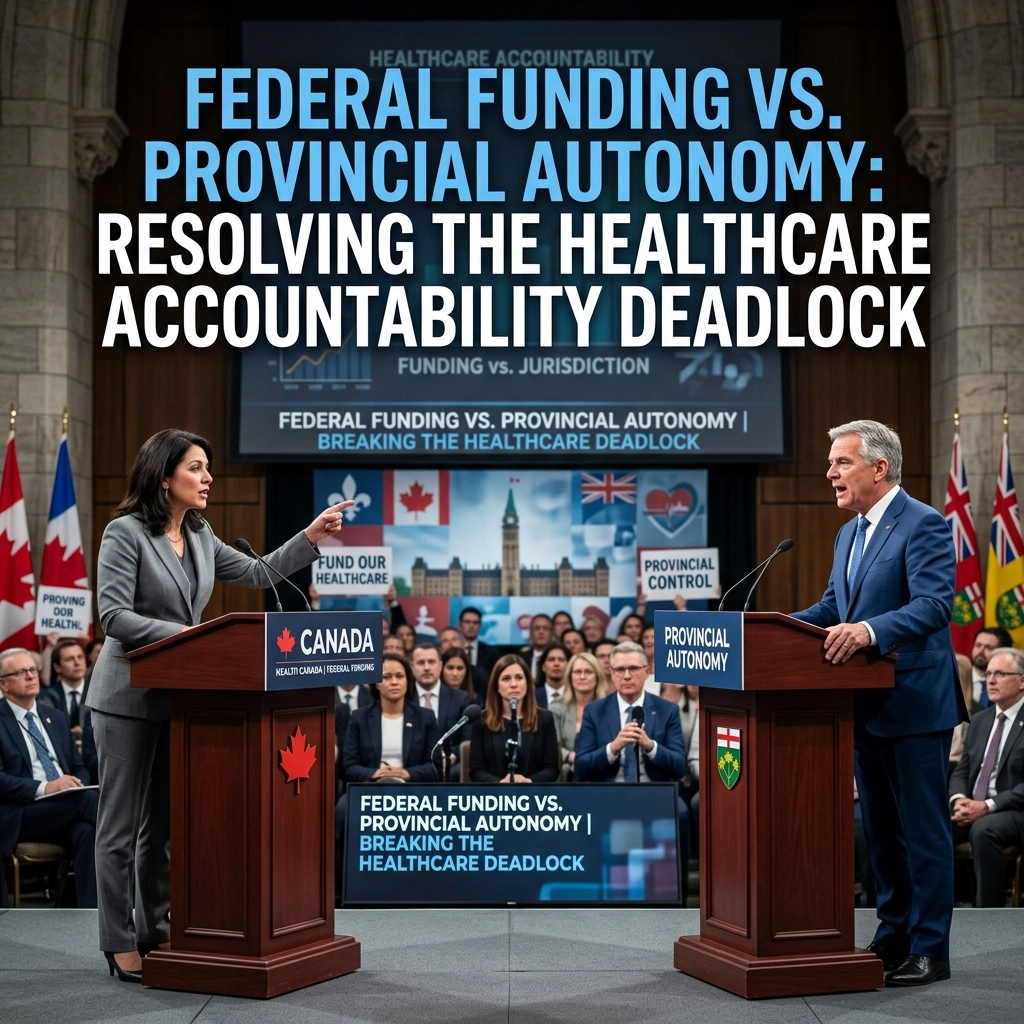
The Canadian healthcare system is currently defined by a structural paradox. While the delivery of care is a provincial responsibility under the Constitution, the fiscal capacity to sustain that delivery is increasingly dependent on federal transfers. This tension has created a perennial state of friction between Ottawa and the provinces, often referred to as the "intergovernmental blame game." At the center of this deadlock is the Canada Health Transfer (CHT), a mechanism intended to ensure national standards but which frequently serves as a lightning rod for debates over jurisdictional overreach and fiscal inadequacy.
The current fiscal imbalance is stark. Provincial and territorial governments are responsible for approximately 78% to 80% of health spending revenues. The federal government contributes the remaining 20% to 24% through the CHT. Despite this minority share in funding, the federal government maintains significant leverage through the Canada Health Act (CHA). By tying funding to the five pillars: public administration, comprehensiveness, universality, portability, and accessibility: the federal government dictates the terms of engagement for systems it does not manage. This separation of funding from implementation creates a vacuum of accountability. When wait times fluctuate or emergency rooms close, the provincial response often points to insufficient federal funding, while the federal narrative focuses on provincial mismanagement of existing resources.
The Fiscal Reality and the Productivity Gap
The demand for a resolution is not merely political; it is economic. Health care consumption now accounts for 30% to 40% of provincial budgets. Projections indicate that health costs will rise at an average annual rate of 5.2% over the next decade. This growth rate consistently outpaces projected revenue increases, creating a structural deficit that threatens the long-term viability of the Canadian healthcare system. In 2020, provincial leaders requested a permanent increase in the federal share of funding to 35%, representing an additional $28 billion annually. The rejection of this proposal underscored the fundamental disagreement regarding the role of the federal government: is it a silent partner providing unconditional support, or an active overseer of national outcomes?

The economic consequences of this deadlock are substantial. Inefficiency in healthcare delivery translates directly to a loss in national productivity. When citizens cannot access primary care or remain on surgical waitlists for months, the labor market suffers. This "productivity gap" is exacerbated by the lack of standardized data sharing between provinces. Without a unified approach to tracking patient outcomes and system performance, it remains impossible to determine which provincial models are yielding the highest return on investment. The absence of a national data framework prevents the scaling of successful regional innovations, leaving each province to solve systemic issues in isolation.
Analysis: The Failure of Oversight and Outcome Tracking
The primary failure of the current funding model is its focus on inputs rather than outputs. The CHT is largely a per-capita transfer with few strings attached, provided the provinces adhere to the broad principles of the CHA. This "block grant" approach lacks the necessary mechanisms for outcome tracking. While it respects provincial autonomy, it fails to provide the federal government: and by extension, the Canadian taxpayer: with a clear understanding of how these billions are improving frontline care.
Recent attempts to bridge this gap have moved toward bilateral agreements. The 2023 federal budget included a $46.2 billion increase in funding over ten years, but with a strategic shift: a significant portion of this funding was tied to specific, negotiated agreements with individual provinces. These agreements target priority areas such as primary care, mental health, and health human resources. By moving away from a one-size-fits-all transfer, the federal government is attempting to establish a "payer for performance" relationship.

However, bilateralism also presents risks. It can lead to an "asymmetrical federation" where healthcare quality varies significantly by postal code, undermining the principle of portability. Furthermore, these agreements often lack rigorous enforcement mechanisms. If a province fails to meet the targets set out in a bilateral deal, the federal government faces a political dilemma: withholding funds risks further destabilizing the healthcare system and alienating voters, while continuing to pay ignores the lack of progress. The result is an accountability deadlock where neither level of government is fully incentivized to take ownership of systemic failures.
The Capacity Myth and Systemic Design
A common refrain in the healthcare debate is the need for "more capacity": more beds, more hospitals, and more staff. While infrastructure is necessary, an analytical view suggests that capacity alone is not the solution. Canada’s doctor shortage, for instance, is often framed as a lack of residency slots. In reality, it is a systemic design flaw involving the integration of foreign-trained professionals and the optimization of existing scope-of-practice for nurses and pharmacists.
The federal government’s recent clarification of the Canada Health Act in January 2024 to expand coverage for health professionals beyond physicians is a step in the right direction. It signals a move toward a more flexible, multidisciplinary model of care. Yet, without a coordinated national strategy, these changes remain fragmented. A provincial government may expand the scope of practice for pharmacists, but if the federal funding formula does not adapt to support this shift in service delivery, the initiative may stall.

Direction: A Framework for National Standards and Local Delivery
Resolving the deadlock requires a new social contract between the federal government and the provinces. This framework must balance two competing needs: the federal requirement for accountability and the provincial requirement for administrative flexibility. This can be achieved through three specific policy shifts.
First, the transition from block transfers to outcome-based funding must be formalized. National standards should not dictate how a province delivers care, but they should dictate the outcomes that care must achieve. Metrics such as maximum wait times for essential surgeries, patient-to-doctor ratios in rural areas, and the integration of digital health records should be standardized across the country. Provinces that meet or exceed these benchmarks should be rewarded with increased fiscal transfers, while those that fall short should be subject to mandatory independent audits.
Second, a national health data agency must be empowered to provide transparent, real-time reporting on system performance. Currently, data collection is siloed and often lagging by years. For healthcare funding Canada to be effective, policymakers need to know exactly where bottlenecks are occurring. This agency would act as a neutral third party, removing the political bias from performance reporting and providing voters with the information they need to hold their respective governments accountable.

Third, the federal government must provide long-term funding predictability in exchange for provincial transparency. The current "stop-and-go" nature of federal transfers prevents provinces from engaging in long-term human resource planning. By committing to a stable, inflation-indexed funding floor that is decoupled from political cycles, the federal government can remove the "funding uncertainty" excuse from the provincial narrative. In return, provinces must agree to a "single-window" reporting system for all health expenditures, ensuring that federal dollars are not diverted to general revenue or other provincial priorities.
Conclusion: Toward Functional Federalism
The healthcare accountability deadlock is a product of an outdated 20th-century model trying to address 21st-century demographic and economic challenges. The aging population and the rising cost of medical technology mean that the status quo is no longer an option. A "government-in-waiting" approach to healthcare policy must prioritize functional federalism over jurisdictional posturing.
The resolution lies in a middle path: federal oversight of national standards and provincial management of delivery. This is not a loss of autonomy for the provinces, nor is it a surrender of fiscal authority for the federal government. It is a rationalization of roles. By focusing on measurable outcomes and transparent data, Canada can move past the current impasse and build a healthcare system that is fiscally sustainable and patient-centered.
For more detailed analysis on the intersection of policy and the Canadian economy, visit The Canadianist or explore our featured content. To understand the broader framework for the country's future, consider the insights in The Case for Canadianism.
Connect with us.