Justice
Quebec Secularism: Supreme Court to Hear Challenge Against Bill 21

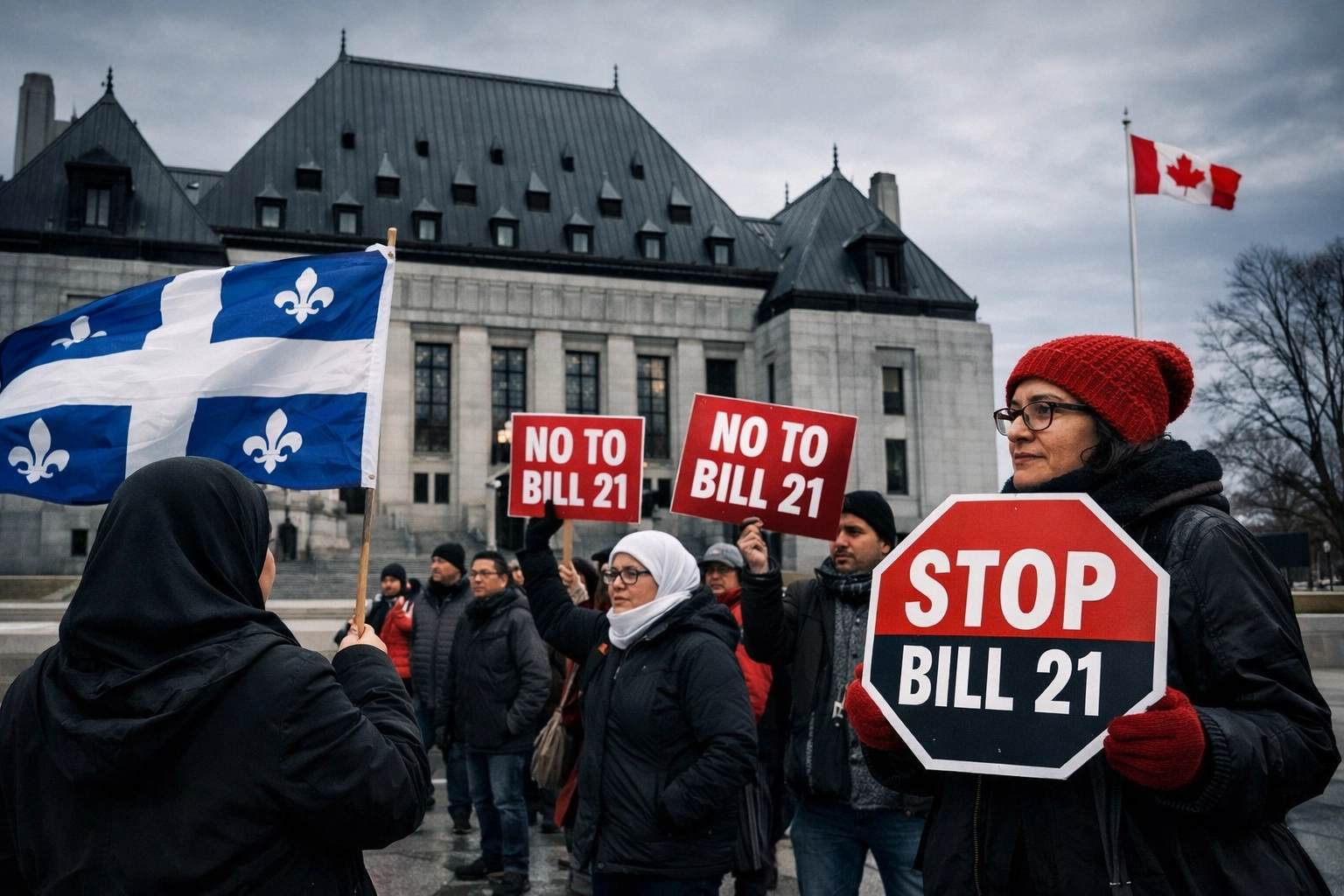
The Supreme Court of Canada has finalized its schedule for one of the most significant constitutional cases in recent decades. On March 23, 2026, the country’s highest court will begin hearing oral arguments regarding the validity of Quebec’s State Secularism Act, commonly known as Bill 21.
The hearing marks the culmination of a seven-year legal battle that has divided public opinion and raised fundamental questions about the balance between provincial autonomy and individual rights protected under the Canadian Charter of Rights and Freedoms. At the heart of the proceedings is not only the content of the law itself but the Quebec government’s preemptive use of the "notwithstanding clause" to shield the legislation from judicial review.
The Legislative Framework of Bill 21
Passed in June 2019 by the Coalition Avenir Québec (CAQ) government, Bill 21 prohibits certain public sector employees in positions of authority from wearing religious symbols while performing their duties. The ban applies to a broad range of civil servants, including police officers, Crown prosecutors, judges, and, most controversially, public school teachers.
The law defines religious symbols as any object: including clothing, jewelry, or headgear: that is worn in connection with a religious belief or is reasonably considered as such. This includes the hijab worn by some Muslim women, the turban worn by Sikh men, the kippah worn by Jewish men, and visible crucifixes.
Proponents of the law, led by the Quebec government, argue that the measures are necessary to ensure the religious neutrality of the state. They contend that secularism (laïcité) is a foundational value of Quebec society, ensuring that the state neither favors nor hinders any particular religion.
However, opponents argue the law disproportionately targets religious minorities, particularly women. Critics have presented evidence in lower courts suggesting the law has led to marginalized groups being excluded from career opportunities in the public sector. While the law included a "grandfather clause" allowing employees who held their positions before March 27, 2019, to continue wearing their symbols, they lose this right if they change roles or move to a different school board.
The Central Legal Question: Section 33
The Supreme Court’s review will focus heavily on Section 33 of the Charter, known as the notwithstanding clause. This provision allows provincial legislatures or Parliament to override specific sections of the Charter: namely Section 2 (fundamental freedoms) and Sections 7 through 15 (legal and equality rights): for a renewable period of five years.
The Quebec government invoked Section 33 at the time of Bill 21’s passage, effectively preventing courts from striking down the law based on those specific Charter rights. In early 2024, the Quebec Court of Appeal upheld the majority of the law, ruling that the use of the notwithstanding clause was constitutionally valid even when used preemptively.

The upcoming Supreme Court challenge will determine whether there are limits to how and when a government can invoke Section 33. Legal teams representing civil liberties groups, national organizations, and affected individuals are expected to argue that the clause should not be used to "blanket" legislation before a court has had the opportunity to identify which rights are being infringed.
The federal government has also signaled its intent to participate in the hearing. Federal lawyers are expected to argue that the notwithstanding clause should only be used after a court has found a law to be unconstitutional, rather than as a preemptive measure to bypass the judicial process entirely.
A Record Number of Interveners
The scale of the case is reflected in the unprecedented number of interveners granted standing by the Supreme Court. A total of 61 non-governmental organizations, civil rights groups, and professional associations will participate in the hearings.
This list includes the Canadian Civil Liberties Association (CCLA), the National Council of Canadian Muslims (NCCM), and various labour unions. A significant number of these interveners are expected to urge the court to place new restrictions on the use of the notwithstanding clause.
Conversely, groups supporting the Quebec government’s position argue that the court must respect the constitutional architecture of Canada, which includes the right of provinces to use the notwithstanding clause to reflect the specific social and cultural values of their populations.
The sheer volume of participants has led the court to allocate multiple days for oral arguments, a rarity for the Supreme Court. The outcome will likely serve as a definitive precedent for other provinces that have recently utilized or threatened to use the notwithstanding clause in relation to education and social policy.
Impact on Subsequent Legislation
The Supreme Court’s decision will have immediate consequences for subsequent Quebec laws that relied on the same legal framework as Bill 21. Specifically, the ruling will impact Bill 94, a stricter secularism law adopted in 2025.
Bill 94 expanded the scope of the original legislation and similarly utilized the notwithstanding clause to prevent Charter-based challenges. Legal analysts suggest that if the Supreme Court rules that the preemptive use of Section 33 is unconstitutional or requires more stringent justification, Bill 94 could become vulnerable to immediate legal suspension.
More information on the regional impact of these legislative changes can be found in our coverage of Quebec provincial affairs.
Historical Context and Lower Court Rulings
The path to the Supreme Court began almost immediately after Bill 21 was signed into law in 2019. In 2021, the Quebec Superior Court issued a 240-page ruling that largely upheld the law due to the notwithstanding clause, though it did carve out an exception for English-language school boards. The court ruled that Section 23 of the Charter, which protects minority language education rights, is not covered by the notwithstanding clause.
However, in February 2024, the Quebec Court of Appeal overturned that exception, stating that the law must apply uniformly across all school boards in the province. The Court of Appeal emphasized that while the law clearly infringes on fundamental freedoms, the use of Section 33 makes those infringements "legally unshakeable" under current Canadian law.
The Supreme Court will now have the final word on whether that interpretation holds. The justices will be tasked with reconciling the "parliamentary sovereignty" intended by the authors of the 1982 Constitution with the protection of minority rights.
Political and Social Implications
The case comes at a time of heightened political sensitivity regarding provincial rights and federal oversight. The Quebec government has maintained that any interference by the Supreme Court would be seen as an affront to the will of the National Assembly. Premier François Legault has repeatedly stated that Bill 21 is supported by a majority of Quebecers and is essential to the province's distinct identity.
In contrast, federal leaders have faced pressure to intervene more directly. While the Prime Minister’s Office has expressed disagreement with the law, it has largely waited for the judicial process to reach the Supreme Court before taking a definitive legal stance.
For residents of Montreal and the surrounding areas, the daily impact of the law remains a point of contention. Stories of teachers leaving the province to practice elsewhere or changing careers have been documented by various advocacy groups. Ongoing updates on local responses to the law can be found in our Montreal daily roundup.
What to Expect Next
The hearings beginning on March 23 are expected to last at least one week. Given the complexity and the constitutional weight of the arguments, the Supreme Court is not expected to issue a ruling immediately. Most legal experts anticipate a reserved judgment, with a final written decision likely being released in late 2026 or early 2027.
The decision could result in one of three major outcomes:
- Status Quo: The court upholds the Court of Appeal's decision, confirming that the preemptive use of the notwithstanding clause is valid and Bill 21 remains fully in effect.
- Limitations on Section 33: The court rules that the notwithstanding clause cannot be used preemptively or requires a specific "manner and form" that the Quebec government failed to follow.
- Specific Exceptions: The court could restore exceptions for specific groups, such as English-language school boards, or narrow the definition of "positions of authority."
As the March 23 date approaches, both the provincial and federal governments are finalizing their written submissions. The Canadianist News will provide detailed coverage of the oral arguments as they unfold in Ottawa.
For further background on Canadian legal structures and the Charter, readers can refer to the official archives or explore our national news section.