
The Canadianist | Blog
Canada Probably Shouldn’t Expel Pete Hoekstra. But Washington Has a Pete Hoekstra Problem.

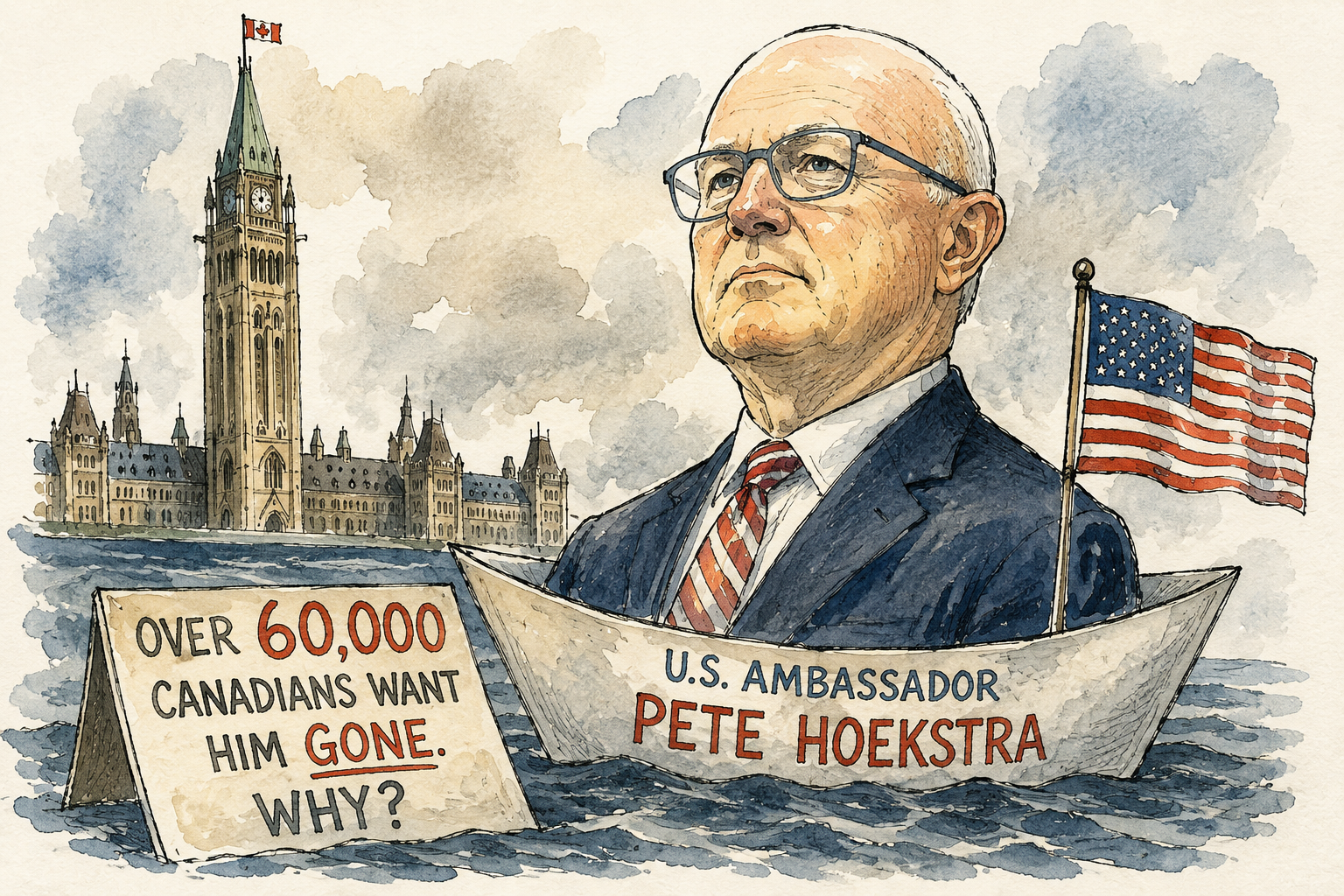
More than 29,000 Canadians have signed a parliamentary petition calling on the federal government to expel U.S. Ambassador Pete Hoekstra from Canada.
Depending on when you read this, that number may already be badly out of date.
The petition has been gaining signatures rapidly since receiving national attention, with international reports Wednesday putting the total above 60,000. It asks the federal government to declare Hoekstra persona non grata, the diplomatic term for formally telling a foreign government that one of its representatives is no longer welcome in the country.
That’s a very big hammer.
Canada probably shouldn’t use it.
But Washington would be making a mistake if it concluded from that that there isn’t a problem.
The petition was launched by a Calgary woman and is expected to be presented in the House of Commons by Green Party Leader Elizabeth May. It accuses Hoekstra of repeatedly stepping beyond the normal boundaries of diplomacy and inserting himself into Canadian political affairs. Among the grievances are his description of Canada’s 2025 federal election campaign as “anti-American,” his response to Donald Trump’s repeated references to Canada becoming the 51st state, and questions surrounding American contacts with the Alberta separatist movement.
Some of those allegations are more serious than others, and signing a petition isn’t the same thing as proving its case.
But Hoekstra hasn’t exactly gone out of his way to make himself a reassuring presence.
Last year, he publicly complained that Canada’s federal election campaign had become anti-American. More recently, when Trump again referred to Canada as the 51st state, Hoekstra amplified the president’s remarks rather than putting some diplomatic distance between Washington’s rhetoric and his role as ambassador in Ottawa.
Prime Minister Mark Carney was asked in June whether Canada should expel Hoekstra over the controversy. He said no, noting that the United States is an administration Canada has to work with.
Carney was right.
The United States isn’t simply another foreign country to Canada. It is our largest trading partner, our closest military ally and the country with which our economy is most deeply integrated. At a moment when tariffs, trade negotiations, defence, energy and continental security are all in play, ejecting the American ambassador would turn an already difficult relationship into a diplomatic crisis.
It would also almost certainly invite retaliation from Washington.
That doesn’t mean Canadians are required to smile politely while an American ambassador comments on our elections, our politics and the sovereignty of the country he’s been sent here to represent.
Diplomats advocate for their governments. Of course they do. Hoekstra isn’t Canada’s ambassador to the United States. He’s America’s ambassador to Canada, appointed by Donald Trump to advance American interests.
There is still a line.
An ambassador can defend his country’s trade policies. He can explain his president’s position. He can argue for greater cooperation and push Canada on issues important to Washington.
Once an ambassador becomes a recurring participant in the domestic political conversation of the host country, however, the relationship starts to change. Canadians are no longer simply hearing from the representative of the United States government. They’re being asked to listen to an American official offer judgments about Canadian elections and Canadian political behaviour.
That’s where Hoekstra has created a problem for himself.
The 51st-state business makes it considerably worse.
Canadians understand that Donald Trump likes provocation. We’ve had enough experience with him by now. But an American president repeatedly joking or talking about absorbing Canada isn’t normal political banter between two allied countries.
Canada is a sovereign country.
There really isn’t much nuance required there.
An American ambassador stationed in Ottawa should understand why Canadians don’t find jokes about ending their country’s sovereignty particularly charming, regardless of how they’re intended in Washington.
Hoekstra’s job isn’t to agree with Canadian objections. It is reasonable, however, to expect the chief American diplomat in this country to understand them.
Instead, he has too often sounded like another voice in the argument.
That isn’t helping either country.
There is also something revealing in the speed with which this petition has grown. Twenty-nine thousand signatures isn’t a national uprising in a country of more than 40 million people. Even 60,000 isn’t evidence that Canadians collectively want Hoekstra packed onto the next flight to Washington.
It does show that the irritation isn’t confined to a handful of political activists.
The Canada-U.S. relationship has been battered over the past eighteen months by tariffs, threats, boycotts and increasingly sour rhetoric. Hoekstra himself acknowledged last month that almost every aspect of the bilateral relationship was under review or negotiation, while still describing the potential for Canadian-American cooperation as essentially unlimited.
He’s right about the potential.
Which is precisely why this matters.
Canada and the United States are going to have disagreements. Sometimes serious ones. The relationship is too large and the interests of the two countries aren’t always identical.
An ambassador can help manage those disagreements or become another source of them.
Expelling Pete Hoekstra would satisfy some angry Canadians for about five minutes and create a diplomatic mess that could last considerably longer.
Keeping him here doesn’t require pretending everything is fine.
Washington should look at tens of thousands of Canadians signing a petition to throw its ambassador out of the country and ask a fairly simple question.
How did we get here?
The answer isn’t entirely Pete Hoekstra.
But he hasn’t helped.