
The Canadianist | Blog
Toronto Needs 5,600 New Rentals. The People Already Living There Have Some Questions.
Toronto has a housing problem that almost everyone agrees requires building more homes.
Then we get to the part where those homes actually have to be built.
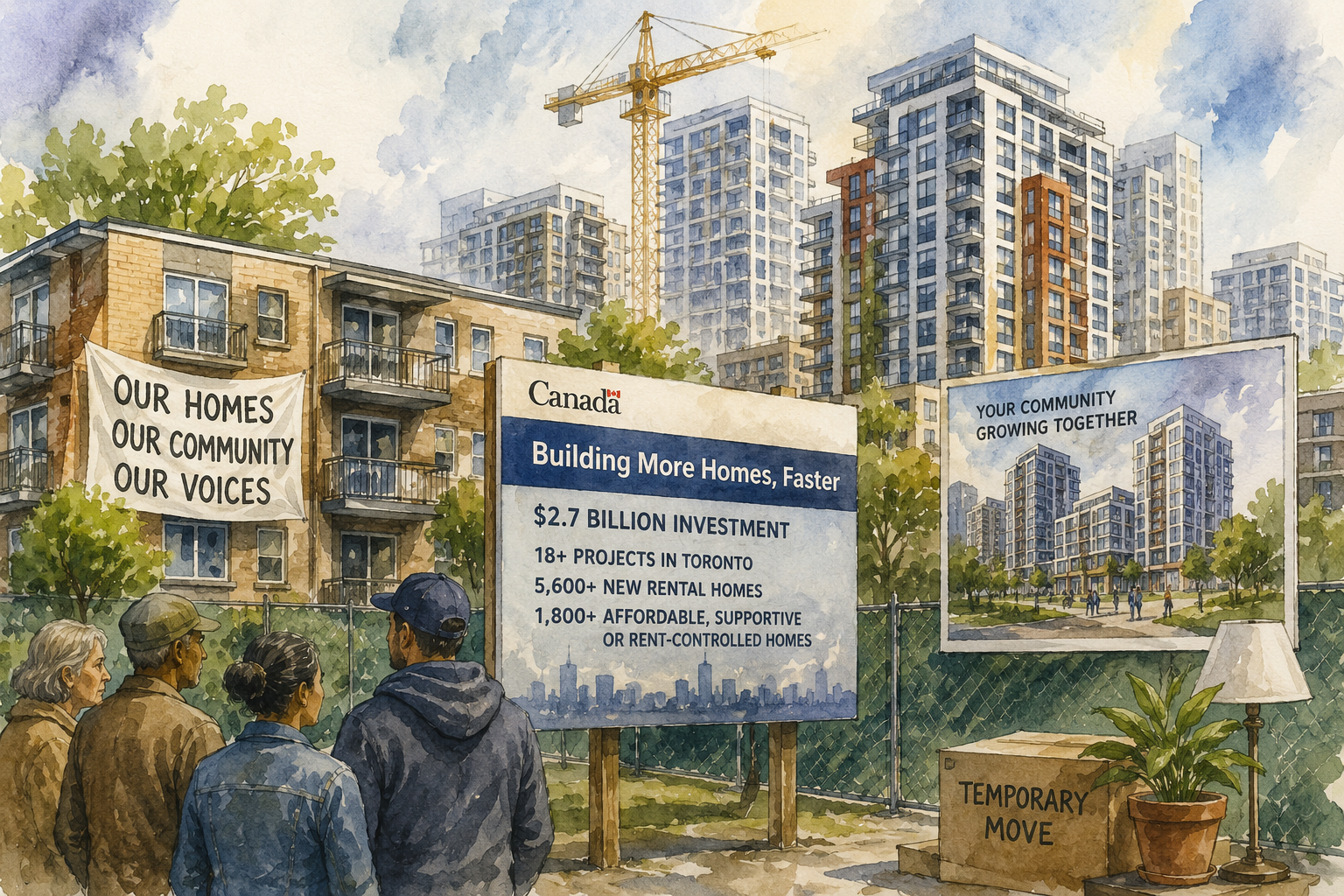
Last week, Prime Minister Mark Carney announced $2.7 billion in federal investment over the next three years for more than 18 rental housing projects across Toronto. The projects are expected to produce more than 5,600 new rental homes, including roughly 1,800 affordable, supportive or rent-controlled units.

Toronto has a housing problem that almost everyone agrees requires building more homes.
Then we get to the part where those homes actually have to be built.
Last week, Prime Minister Mark Carney announced $2.7 billion in federal investment over the next three years for more than 18 rental housing projects across Toronto. The projects are expected to produce more than 5,600 new rental homes, including roughly 1,800 affordable, supportive or rent-controlled units.
For a city where housing affordability has become one of the defining issues of daily life, that’s welcome news.
But one of the projects is also producing a reminder that solving Toronto’s housing shortage isn’t going to happen on empty land with nobody inconvenienced along the way.
Tenants at an existing Toronto rental property are objecting to federal money being connected to a redevelopment that will eventually mean the demolition of their homes.
It’s tempting to turn that into a very simple story.
Government gives developer money. Developer demolishes rental housing. Existing tenants lose.
Except the details make it considerably more complicated.
The redevelopment would dramatically increase the amount of housing on the property. Reports surrounding the project indicate the site would go from 121 rental units to more than 1,250. That’s not a marginal increase. It’s roughly ten times as much housing on the same piece of Toronto.
And the existing tenants aren’t simply supposed to be handed an eviction notice and wished good luck.
Toronto has some of the strongest rental-replacement rules in the country. Developments involving the demolition of six or more rental units require City approval, and Toronto’s policies generally require the replacement of existing rental housing.
Affected tenants can also receive moving assistance and financial compensation, and qualifying tenants typically have the right to return to a replacement unit of the same bedroom type and generally similar size. Their replacement rent is supposed to remain similar to what they were paying before redevelopment.
Those protections are important.
They also don’t make moving disappear.
Someone may have lived in the same apartment for 10, 20 or 30 years. Their doctor may be nearby. Their children may go to school around the corner. They may know their neighbours, their grocery store and their bus route. They may have built their entire daily life around an apartment that happens to sit on land Toronto now desperately needs to use more efficiently.
A cheque and a promise that you can eventually come back don’t make the years in between irrelevant.
And this is where Toronto’s housing debate gets uncomfortable.
We need density.
Toronto can’t continue adding hundreds of thousands of people while protecting every existing building, parking lot and low-density property from redevelopment. There simply isn’t enough room for that equation to work.
If a property containing 121 homes can eventually accommodate more than 1,200, it’s difficult to argue that the city should freeze the site permanently in its existing form.
At the same time, the people living in those 121 homes aren’t an abstraction standing in the way of a housing target.
They’re already Toronto’s renters.
The contradiction is going to become increasingly common as governments push harder to get housing built.
The federal announcement alone involves more than 5,600 new rentals across Toronto. That sounds impressive at a podium. Each project, however, has a physical address. Some will involve public land or properties that are easily redeveloped. Others will collide with existing buildings, businesses, tenants and neighbourhoods.
Toronto has already been dealing with this on a considerable scale. City data show that hundreds of affordable rental units have been approved for demolition and replacement in recent years as redevelopment intensifies.
The answer can’t be that nothing gets demolished.
That would protect today’s tenants by making Toronto’s housing shortage worse for tomorrow’s tenants.
But governments also shouldn’t congratulate themselves for the number of units being created without paying equal attention to what happens to the people displaced while they’re being created.
That’s where the standard should be higher.
If public money helps make a redevelopment possible, tenant protection shouldn’t merely satisfy the minimum legal requirement. Temporary housing arrangements need to be realistic. Compensation needs to reflect the actual cost of relocating in Toronto. Older people and tenants with disabilities may need considerably more help than someone capable of packing a few boxes and moving across town.
And the right to return has to mean something in practice, not simply exist in a legal agreement that somebody discovers years later is difficult to exercise.
None of that requires stopping construction.
It requires accepting that housing policy has two responsibilities at the same time: creating significantly more housing and treating the people already living there reasonably while we do it.
Toronto’s rental-replacement system at least recognizes that tension. Existing tenants have rights precisely because the city understands that redevelopment can create public benefits while imposing very private costs.
There will be more of these fights.
There almost have to be.
Toronto needs tens of thousands of additional homes, and many of them will have to be built where something already exists.
The measure of a successful housing policy won’t only be how many units appear in the announcement.
It’ll also be whether the people who were living there before construction started still have a place in the Toronto we’re building when it’s finished.