
The Canadianist | Blog
Quebec Is About to Show Canada What’s Wrong With Our Voting System
I left Quebec almost fifteen years ago, and for a long time I stopped paying attention to its politics. It was a part of my life I’d set down and walked away from. Lately, with democratic reform…

I left Quebec almost fifteen years ago, and for a long time I stopped paying attention to its politics. It was a part of my life I’d set down and walked away from. Lately, with democratic reform becoming a larger part of my work, I’ve found myself looking back at it.
What I see is one of the clearest demonstrations of what’s wrong with the way we elect our governments in this country.
A Small Gap in Support, a Large Gap in Power
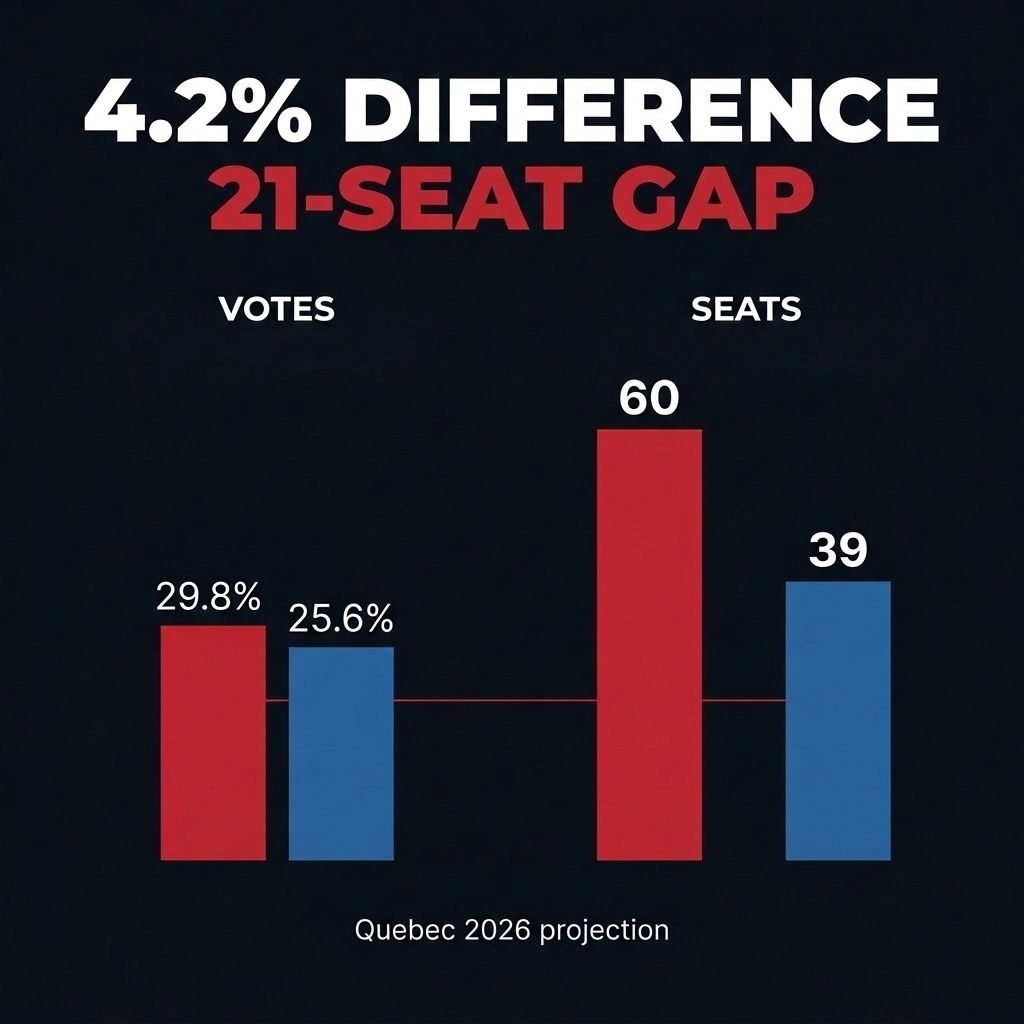
Quebec’s next provincial election is set for October 5. As of this writing, the 338Canada projection puts the Parti Québécois at 29.8 per cent and the Quebec Liberal Party at 25.6 per cent.
That’s a difference of 4.2 percentage points. The projected seats aren’t nearly as close. The PQ is projected to win 60 seats and the Liberals 39. A four-point gap in public support becomes a 21-seat gap in the National Assembly.
A projection isn’t a result. Polls will move, campaigns will be fought, and Quebecers will make the final call. Even so, the numbers show how our system can take a small difference in support and stretch it into a much larger difference in power.
Quebecers don’t have to wait until October to see how far this can go. It already happened, and last time the distortion ran the other way.
The 2022 Result Speaks for Itself
In 2022, the Parti Québécois received 600,708 votes and elected three members. The Quebec Liberals received 591,077 votes, which was 9,631 fewer than the PQ, and elected 21 members.
The Conservative Party of Quebec received 530,786 votes and elected nobody.
Fewer than 70,000 votes separated those three parties across the entire province. One elected 21 members, another elected three, and the third elected none. Those are the official results, not a model of what might happen.
Four years later, the same machinery that punished the PQ may reward it.
No party benefits from this arrangement for long. In 2022, the Liberals came out ahead. In 2026, it may be the PQ. And more than half a million Quebecers voted Conservative in the last election without sending anyone to represent them.
The System Rewards Geography, Not Ideology
The system doesn’t care who you vote for. It rewards where your votes happen to sit.
Under first-past-the-post, we don’t count votes across a province and translate that support into representation. We hold a series of separate local elections. The candidate with the most votes in each riding wins, and every other vote in that riding stops mattering to the makeup of the legislature.
A party can pile up a large number of votes and earn very little representation if those votes are spread thin across ridings it doesn’t win. Another party with similar support can elect far more members if its voters are concentrated in the right places.
Quebec makes this especially easy to see. The Bloc Québécois federally and the Parti Québécois provincially both carry strong sentiment concentrated inside one province. Spread that support across enough competitive ridings and it becomes remarkably efficient. Pile it up in a handful of safe seats, or finish second across dozens of ridings, and it earns almost nothing.
The votes count equally when they enter the ballot box. They don’t produce equal influence when they come out.
The Same Pattern, Now Federal
We saw it again in the 2025 federal election. The Bloc Québécois received 1,236,349 votes across Canada. The NDP received 1,234,673. Only 1,676 votes separated them nationally, and the Bloc elected 22 MPs while the NDP elected seven. The official results could hardly be cleaner.
Some will point out that the Bloc runs only in Quebec while the NDP runs everywhere. That’s true. And that’s exactly how geography turns one pile of votes into more than three times as many seats.
Even inside Quebec the distortion holds. The Bloc took 27.7 per cent of the Quebec vote and elected 22 MPs. The Conservatives took 23.3 per cent and elected 11. A gap of 4.4 percentage points produced twice as many seats. The Liberals took 42.6 per cent and captured 44 of Quebec’s 78 seats. The NDP drew more than 200,000 Quebec votes and elected one MP. The provincial breakdown shows the problem doesn’t vanish when you remove the rest of the country from the picture.
This is how a party can win around 40 per cent of the vote and end up controlling 60 per cent or more of the seats. The arithmetic follows the rules. The result doesn’t reflect how people voted.
What This Does to People Who Stop Voting
It also helps explain why so many Canadians have quietly stopped showing up.
Millions of people live in safe ridings where the outcome feels settled before the campaign starts. If you back the party that usually loses there, you already know what’s likely to happen to your ballot. You can get off the couch, walk to the polling station and cast your vote, and once the local winner is declared, your vote drops out of the calculation.
It elects nobody. It changes nothing in Ottawa. It becomes a line in a statistic about how many people lost.
After enough elections, people absorb the message. They’re told every vote counts while the system keeps showing them that some votes count far more efficiently than others.
Disengagement isn’t always apathy. Sometimes it’s a reasonable read of a system that has taught people their participation won’t change the outcome.
That’s the part of democratic reform we don’t talk about enough. The real damage isn’t only that one party gets too many seats and another too few. It’s whether a Canadian believes their vote ever travels past the edge of their own riding.
The Michaud Method
Here’s the repair I’ve been building toward. The Michaud Method keeps every local constituency and adds 50 national seats to the House of Commons, raising it from 343 to 393 members. You’d cast two votes. One for your local representative, and one for the party you want represented nationally.
Your first vote sends an MP to Ottawa. Your second vote makes sure your voice gets there too.
The local election runs exactly as it does now. Communities still choose their MPs, and those MPs stay accountable to the people who elected them. The second vote helps allocate the 50 national seats proportionally, bringing Parliament closer to the way Canadians actually voted.
For someone in a safe Liberal, Conservative, Bloc, NDP or any other riding, that second vote changes the whole calculation. Your local candidate may have little chance of winning, and your party vote still counts. It leaves your riding, joins votes from Canadians across the country and helps shape the Parliament that governs you.
Suddenly there’s a reason to get off the couch.
Nobody has to switch parties to vote strategically. Nobody has to settle for the candidate they dislike least because the person they actually support can’t win. Nobody has to accept that living in the wrong riding makes their voice irrelevant.
The local map still matters. It just wouldn’t get the final word.
What the Reform Is For
The Michaud Method isn’t built to weaken the Bloc, rescue the NDP, punish the Liberals or reward the Conservatives. It’s built so that a Canadian’s political influence doesn’t hang so heavily on where that Canadian happens to live and whether enough neighbours voted the same way.
The same idea works provincially. Quebecers could keep their local MNAs and use a second vote, along with a modest number of extra seats, to correct the worst distortions in the National Assembly.
Quebec voters may choose the Parti Québécois in October. They may choose the Liberals, the CAQ, the Conservatives, Québec solidaire, or produce a result nobody expects. That choice belongs to them.
What shouldn’t belong to the electoral map is the power to turn a small difference in support into an enormous difference in representation.
In 2022, Quebec’s voting system gave the PQ more votes than the Liberals and the Liberals seven times as many seats. Four years later, the same machinery may distort the result in the opposite direction.
Quebecers should get the government they vote for, not one manufactured by where their votes happen to be located.
The Michaud Method gives people their vote back.
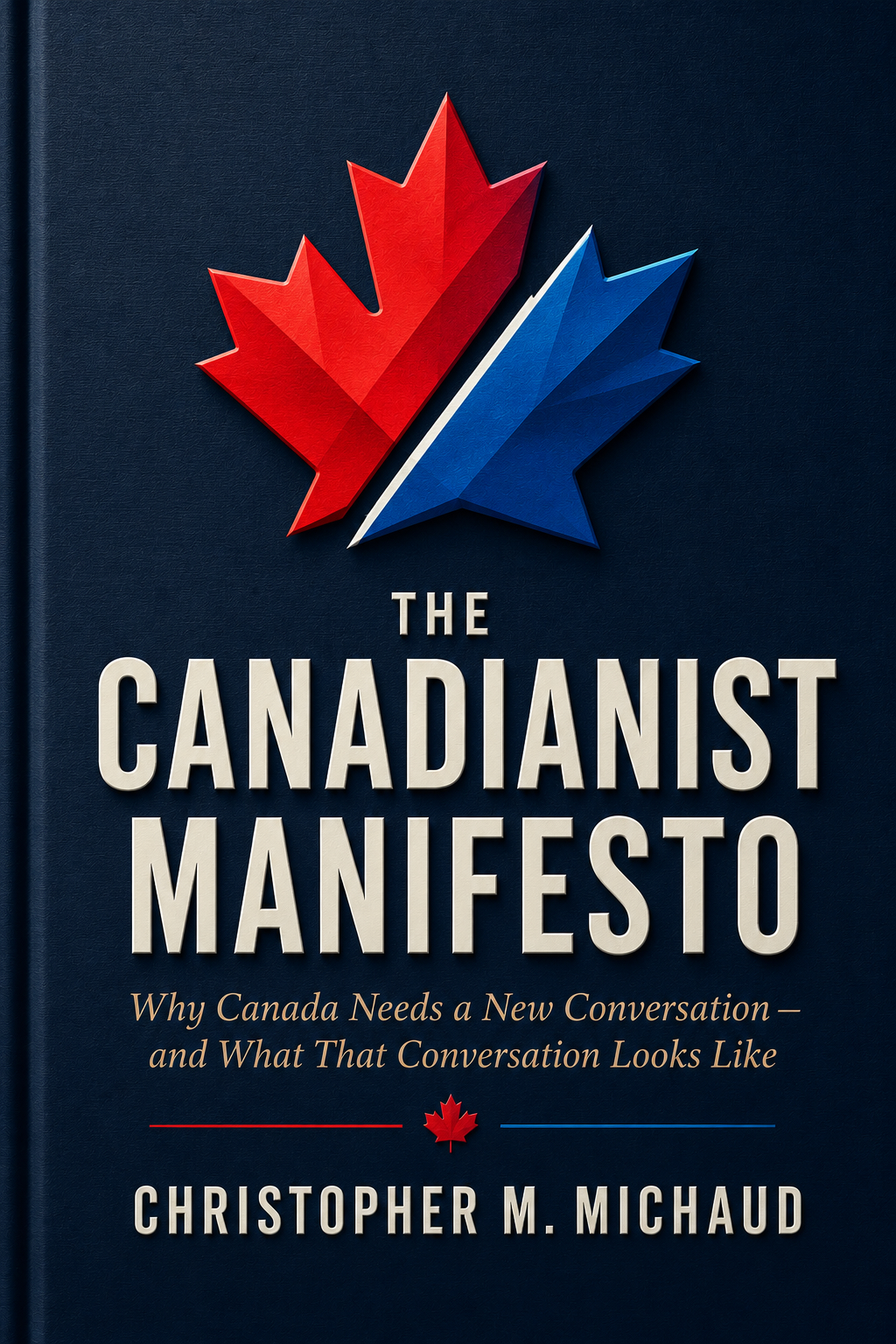
I lay out the complete proposal in my book, Democracy Renewed, part of the Canada As We Are series. The books are available in print and electronic editions, as well as audiobooks on Spotify.