

The Canadianist Exclusive | Opinion
AI Data Centres Are Straining America’s Power Grid. Canadian Hydro Is More Valuable Than Ever.

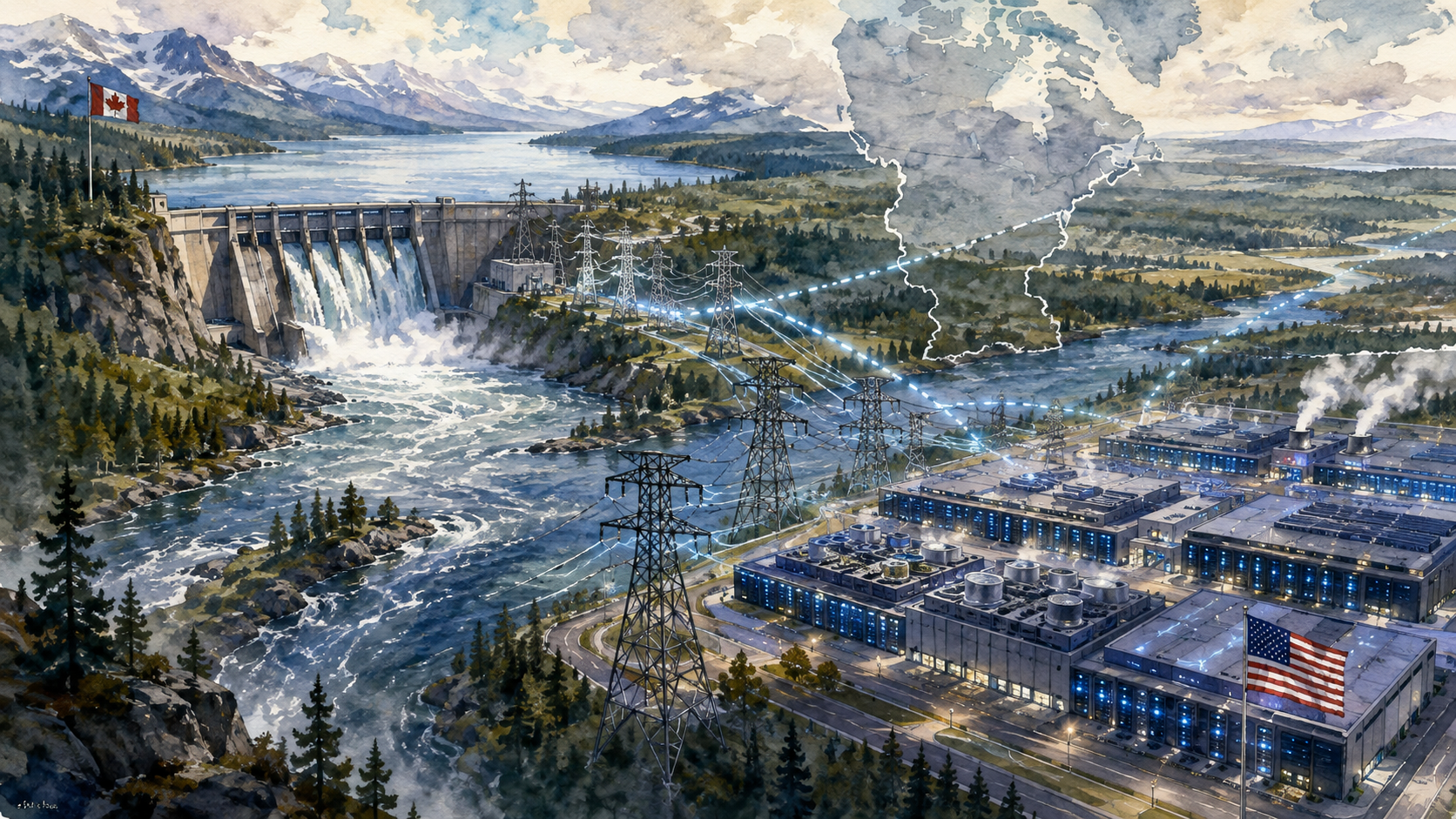
The Canadianist News | August 27, 2026
America is racing to build the infrastructure needed to dominate artificial intelligence.
There’s just one problem.
It has to power it.
Across the United States, resistance to massive new data centres is spreading quickly as communities confront the electricity, water and land requirements that come with them.
An analysis by The Information found more than 500 active bans or moratoriums on data-centre development across the United States by the beginning of August, up from just over 300 in late June. More than 150 towns and counties reportedly imposed temporary or permanent restrictions during July alone.
The resistance isn’t limited to one political camp.
The Associated Press reported Wednesday that opposition has brought together environmentalists, farmers, conservatives and local residents in communities from Nebraska to New Mexico. Their concerns vary, but electricity costs, water use, noise and the sheer scale of proposed developments appear repeatedly.
Texas, which has become one of the centres of the American AI buildout, has gone so far as to pause new data-centre grid approvals while the state examines their impact on electricity supply. San Antonio is considering its own restrictions.
The scale of what developers are asking for helps explain why.
Texas Governor Greg Abbott said proposed connections to the Texas grid represented more than 474 gigawatts of potential demand. That figure includes projects that will never be built, but it illustrates the magnitude of the applications now confronting American electricity planners.
The problem is particularly visible in PJM, the electricity market serving roughly 67 million Americans from the Midwest through Washington and the Mid-Atlantic.
PJM says data centres already account for more than seven percent of electricity use within its territory. Its latest forecasts project summer peak demand increasing by approximately 82 gigawatts over the next 15 years, driven heavily by large new electrical loads including data centres.
This week, PJM reported its second consecutive capacity shortfall as electricity demand continues to rise faster than new generating capacity can reliably be brought online.
Transmission is becoming a problem too.
Congestion costs on the PJM grid jumped 43 percent during the first half of this year to roughly US$6 billion, while wholesale electricity prices rose sharply. Northern Virginia, home to the world’s largest concentration of data centres, is among the areas facing significant transmission pressure.
America can build semiconductor plants.
It can build servers.
It can raise hundreds of billions of dollars for artificial intelligence.
Electricity is harder.
Generating stations take years to approve and construct. Transmission lines can take even longer. Nuclear plants aren’t built overnight. Natural gas requires pipelines and generation. Solar and wind require transmission, storage and backup generation.
AI data centres, meanwhile, operate continuously.
And directly north of the United States sits one of the largest electricity systems in the world.
Canada.
Canadian electricity already flows across an integrated continental grid into more than 20 American states.
In 2024, Canada exported 35.6 terawatt-hours of electricity to the United States. Quebec, Ontario, British Columbia and Manitoba were the country’s largest exporters. The Canada Energy Regulator says increasing electricity demand from data centres, artificial intelligence and cryptocurrency mining has already contributed to rising electricity prices in U.S. markets.
The relationship is becoming more important, not less.
On June 1, Hydro-Québec began delivering power directly into New York City through the new Champlain Hudson Power Express.
The 600-kilometre transmission system can move 1,250 megawatts of Quebec electricity into New York City. At full capacity, it can provide as much as 20 percent of the city’s electricity requirements. Hydro-Québec expects the contract to generate approximately US$34 billion over its lifetime.
During the July heat wave, electricity imports from Canada helped New York meet some of its highest demand of the summer. On July 3 alone, New York imported 52 gigawatt-hours of electricity from Canada, its highest daily level since early 2025.
Washington is expanding cross-border infrastructure as well.
In May, the U.S. Department of Energy approved two new transmission lines between North Dakota and Canada that will add as much as 650 megawatts of transfer capability. The department specifically described the project as strengthening grid reliability and affordability on both sides of the border.
Then there is Manitoba.
Manitoba Hydro’s existing interconnections give it almost 2,833 megawatts of firm export capability into the United States. Its hydroelectric system is already closely integrated with American markets.
All of this is unfolding as relations between Canada and the United States deteriorate.
President Donald Trump’s administration has imposed new tariffs on Canadian products following the collapse of trade negotiations. Prime Minister Mark Carney has responded with retaliatory measures, while Ontario Premier Doug Ford has again raised the possibility of using Canadian electricity exports as leverage.
The suggestion that Canada could simply turn off the lights in American cities is exaggerated.
The United States produces vastly more electricity than it imports from Canada, and grid operators have alternative generation available. Cutting Canadian exports wouldn’t plunge America into darkness. It could, however, increase electricity prices and reduce flexibility during periods of extreme demand.
That difference may become increasingly significant.
The American AI strategy requires enormous quantities of reliable electricity at precisely the moment communities are resisting new generating plants, new transmission corridors and the data centres themselves.
Canada possesses something the United States increasingly needs: large quantities of dispatchable, renewable hydroelectric power connected to the same continental grid.
Quebec has it.
Manitoba has it.
British Columbia has it.
Ontario has a large interconnected electricity system of its own.
None of this proves that America’s increasingly aggressive posture toward Canada is being driven by electricity.
There is no public evidence establishing that connection.
It does, however, change the calculation of Canadian leverage.
For months, much of the Canada-U.S. trade debate has been framed around what Canada needs from the United States.
The emerging AI economy adds another question.
As America attempts one of the largest infrastructure expansions in its history, where exactly is all that electricity going to come from?
Some of it may already be flowing south across the Canadian border.