

National | Immigration
Carney Links Immigration Cuts to Economic Slowdown as Canada Enters Technical Recession

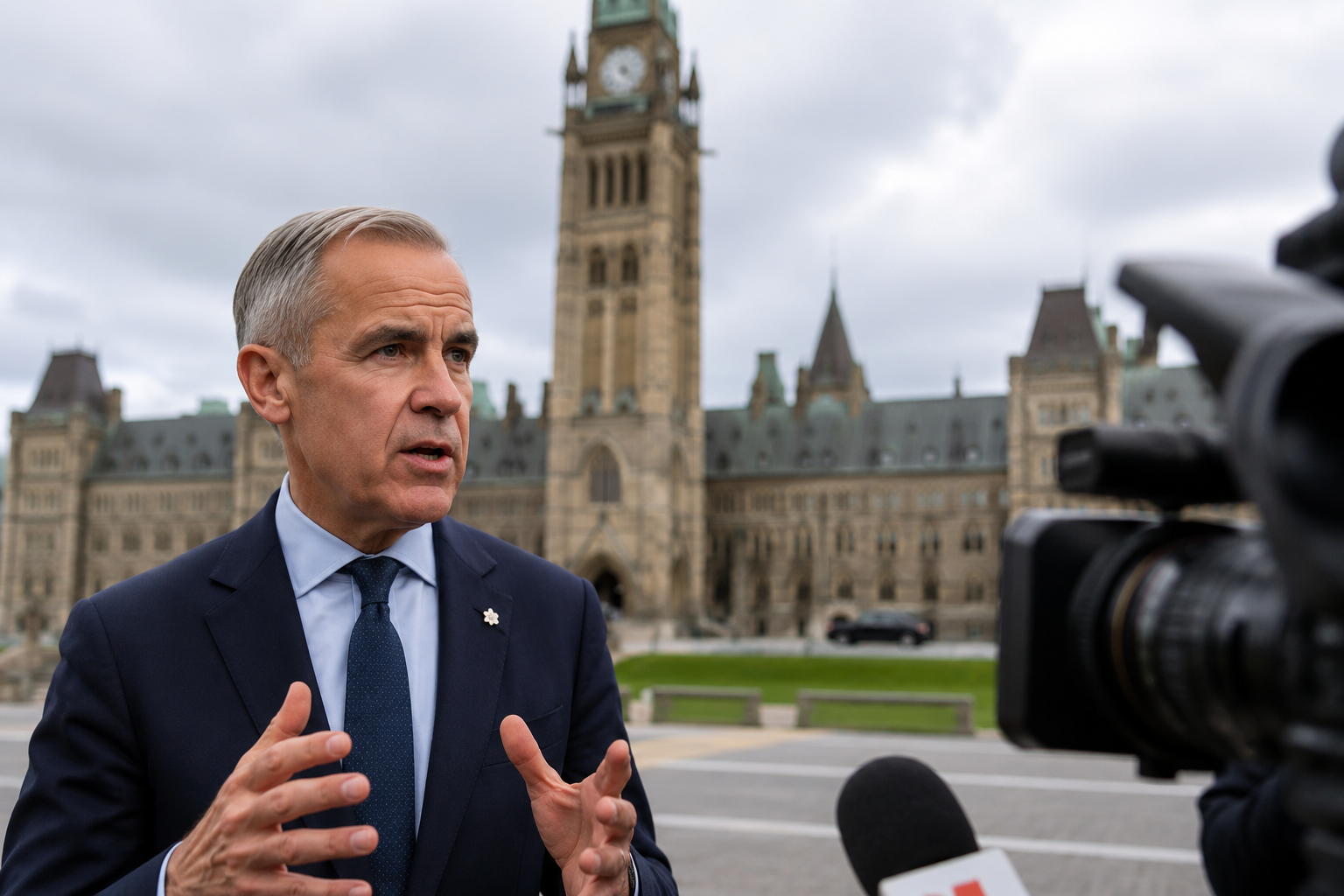
Prime Minister Mark Carney has made his clearest public connection yet between Canada’s reduced immigration levels and the country’s recent economic contraction, adding a new dimension to an already contentious debate over population growth, housing pressures, and economic performance.
Speaking to reporters outside a cabinet meeting on June 2, Carney acknowledged that government policy decisions have contributed to recent economic weakness. He specifically cited the federal government’s efforts to reduce immigration levels, describing the move as “taking back control of immigration” and noting that population growth has slowed dramatically over the past two quarters.
The comments came days after Statistics Canada reported that Canada’s real gross domestic product contracted at an annualized rate of 0.1 percent during the first quarter of 2026. The decline followed a revised 1.0 percent contraction in the fourth quarter of 2025, meeting the commonly accepted definition of a technical recession.
It marks the first time Canada has entered a technical recession since the economic disruption caused by the COVID-19 pandemic in 2020.
The government’s immigration reductions were introduced in response to growing concerns over housing affordability, infrastructure pressures, and the capacity of social services to absorb record population growth. The policy shift has significantly slowed the pace of new arrivals and, according to recent demographic data, contributed to a flattening or decline in population growth.
Carney’s remarks have prompted debate among economists over the extent to which immigration levels should be linked to the country’s economic performance.
Some analysts argue that the headline GDP figures may not fully capture what is happening in the broader economy. Economists at National Bank pointed out that Canada’s population declined during the first quarter, meaning economic output was spread across fewer people. As a result, real GDP per capita increased by 0.9 percent during the quarter and has been trending upward for roughly two years.
From that perspective, the overall GDP contraction may paint a more negative picture than individual economic outcomes suggest.
Others argue the relationship between immigration and economic growth is more complicated. Economist Mikal Skuterud has challenged the notion that weaker economic performance is a direct consequence of lower immigration targets. Instead, he contends that Canada’s long-standing productivity challenges have been obscured by rapid population growth.
According to that view, higher immigration levels boosted total economic output but did little to improve productivity or living standards on a per-person basis. Between 2014 and 2024, Canada’s real GDP per capita grew by just 3.2 percent, significantly below the OECD average of 15 percent over the same period.
The debate arrives at a politically sensitive moment for the Carney government.
During the federal election campaign, the Liberals argued that immigration levels needed to be adjusted to better align with housing availability and public service capacity. Those reductions are now occurring at the same time as a slowing economy, creating competing pressures on the government from both sides of the policy debate.
The issue is likely to remain central to federal policy discussions throughout the coming year. Canada’s next Immigration Levels Plan review is scheduled for November 2026, and economic performance between now and then could influence whether the government maintains its current approach or considers increasing immigration targets once again.
For now, policymakers face the challenge of balancing economic growth objectives with concerns about housing, infrastructure, and long-term sustainability.