

National | Finance
Canada Enters Technical Recession as GDP Contracts for Second Consecutive Quarter

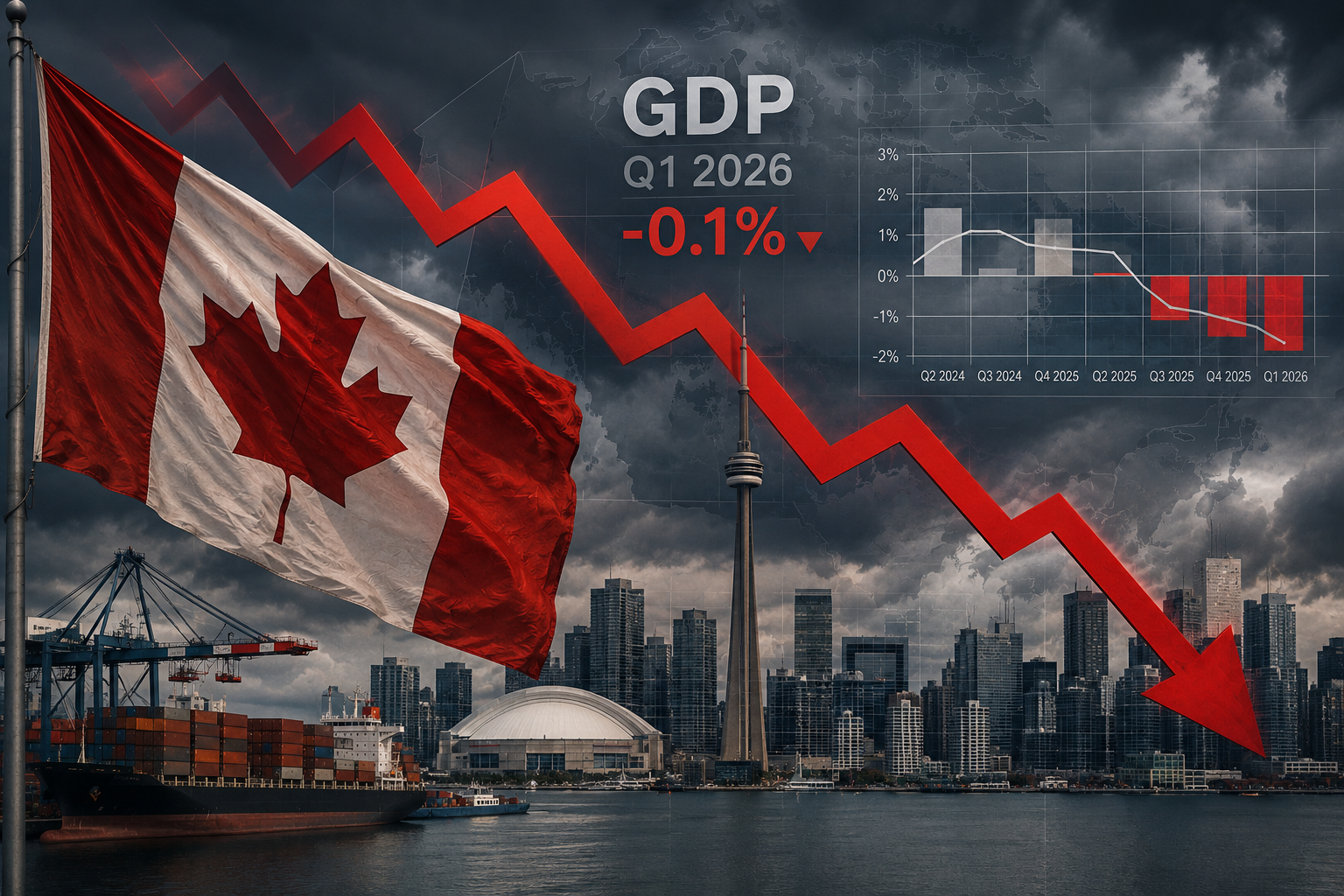
Canada’s economy contracted for a second consecutive quarter in early 2026, placing the country in what economists commonly describe as a technical recession.
Statistics Canada reported on May 29 that real gross domestic product declined at an annualized rate of 0.1 per cent during the first quarter of 2026. The result followed a revised annualized decline of 1.0 per cent in the fourth quarter of 2025, marking two straight quarters of negative economic growth.
It is the first time since the COVID-19 pandemic that Canada has experienced such a pattern. Three of the last four quarters have now recorded negative real GDP growth, underscoring the challenges facing the Canadian economy amid ongoing trade uncertainty, weaker investment activity, and slowing population growth.
The latest figures came as a surprise to many economists. Forecasts surveyed by Bloomberg had anticipated annualized growth of approximately 1.5 per cent in the first quarter, a projection broadly consistent with expectations outlined earlier by the Bank of Canada.
The weakness was spread across several areas of the economy.
Business investment continued to decline, falling 0.7 per cent during the quarter and marking the fifth consecutive quarterly decrease. Investment in engineering structures dropped 4.6 per cent, while investment in residential structures declined 2.0 per cent after falling 2.4 per cent in the previous quarter.
Housing-related activity also weakened. Ownership transfer costs, a measure tied to resale housing transactions, fell 9.9 per cent, reflecting continued softness in Canada’s housing market.
Government and business capital spending also declined during the quarter, contributing to the broader slowdown.
Some areas of the economy provided support. Household spending increased, helping offset part of the decline in investment activity. Business inventories also accumulated during the quarter, partially balancing the impact of increased imports, particularly imports of gold.
Even so, final domestic demand edged down by 0.1 per cent, highlighting the generally subdued nature of economic activity.
Despite the disappointing quarterly result, there are signs that conditions may have improved somewhat at the start of the second quarter.
Statistics Canada’s preliminary estimate for April points to monthly GDP growth of 0.4 per cent, driven largely by renewed strength in mining, quarrying, and oil and gas extraction. If confirmed, the rebound would represent a significantly stronger start to the second quarter than economists had anticipated.
Business groups say uncertainty remains a major obstacle to investment and expansion.
According to the Canadian Federation of Independent Business, many small business owners continue to delay investment decisions amid concerns about energy costs, trade tensions, and the broader economic outlook. CFIB President Dan Kelly described many businesses as being in a holding pattern while waiting for greater economic clarity.
The recession designation itself remains the subject of some debate. While two consecutive quarters of negative growth meet the widely used definition of a technical recession, the contractions have been relatively modest compared with previous downturns.
Statistics Canada also reported that real GDP per capita increased by 0.2 per cent in the first quarter. Because Canada’s population declined during the period, economic output was distributed across fewer people, producing a modest gain on a per-person basis despite the overall contraction.
Nevertheless, economists continue to monitor signs of weakness in business investment, housing activity, and trade-sensitive sectors as Canada navigates an increasingly uncertain economic environment.