
The Canadianist Exclusive | Opinion
Why Canada-U.S. Trade Talks Need More Privacy
Canada and the United States need to talk again. When they do, the rest of us don’t need a seat at the negotiating table.
There is something uncomfortable about quiet diplomacy in an age when we expect to know everything immediately.

Canada and the United States need to talk again. When they do, the rest of us don’t need a seat at the negotiating table.
There is something uncomfortable about quiet diplomacy in an age when we expect to know everything immediately.
We want to know what was offered. What was rejected. Who said what. Who blinked. Who walked away. Who was responsible.
After the collapse of the latest Canada-U.S. trade negotiations, those are reasonable questions. Canadians are facing 50 per cent U.S. tariffs on billions of dollars of goods, with Canadian retaliatory tariffs coming in response. This isn’t an abstract diplomatic disagreement. Jobs, businesses, investment and prices are involved.
Canadians deserve answers.
That doesn’t mean we need a transcript.
There is a difference between holding a government accountable for the decisions it makes and expecting to watch those decisions being negotiated in real time.
On August 18, Prime Minister Mark Carney said Canada and the United States had made “substantial progress” and that negotiations were continuing. The United States postponed its threatened tariffs for three days to give those talks more time. By August 21, the talks had collapsed.
We now have competing accounts of what happened.
Carney says Washington introduced last-minute terms that Canada considered unfair and uneconomic. The U.S. says Canada introduced demands of its own late in the process. Since then, both governments have revealed pieces of what was discussed, while politicians, premiers, industry representatives, commentators and the rest of us have tried to reconstruct what happened inside the room.
We should.
I don’t blindly trust this government, or any government, to manage the country’s interests without scrutiny. Parliament exists for a reason. So does the opposition. So does a free press. When billions of dollars, Canadian jobs and elements of our sovereignty are on the table, the government should eventually have to explain what it agreed to, what it refused, what it surrendered and why.
But eventually is an important word.
Diplomacy requires something politics increasingly doesn’t allow: room to change your mind.
A negotiator needs to be able to float an idea without committing a country to it. Canada needs to be able to tell the Americans privately, “We might move here if you’ll move there.” The Americans need the same freedom. Both sides need to be able to reject an idea, modify it, revisit something they dismissed yesterday or find a compromise neither government could have announced at the beginning.
Once every proposal becomes public, it becomes political.
A bargaining position becomes a headline. A possible concession becomes a surrender. A compromise becomes ammunition for someone’s opponents. Within minutes, politicians are responding, industries are lobbying, commentators are assigning winners and losers, and social media is demanding that nobody give an inch.
Too many cooks spoil the broth.
That expression may be particularly appropriate for the Canada-U.S. relationship right now.
There are already plenty of legitimate interests at the table. Ottawa has to consider provinces, workers, manufacturers, farmers, energy producers and consumers. Washington has its own industries, states and political constituencies. The two economies are so deeply integrated that changing a tariff on one side of the border can affect a factory, supplier or customer on the other.
Adding a live audience to every conversation doesn’t necessarily make the process more democratic. It can make an agreement harder to reach.
There is already evidence of how quickly negotiating positions can become politically charged. Carney has publicly disclosed that Canada was prepared to remove remaining retaliatory tariffs in strategic sectors if the United States substantially reduced its own, encourage provinces to return American alcohol to store shelves, and make administrative changes around supply management. He also identified areas his government says it wouldn’t compromise, including Canadian sovereignty, French-language protections and culture.
We know those things because the talks broke down and the Prime Minister had to explain why Canada walked away.
That’s accountability.
It doesn’t follow that we needed to know all of it while Canadian and American negotiators were still sitting across from each other.
Canada and the United States aren’t going anywhere. Whatever the temperature of the relationship today, geography will still put us beside each other tomorrow. Our economies will remain connected. Our security interests will overlap. Our governments will eventually have to talk again.
When they do, perhaps everyone else should give them some room.
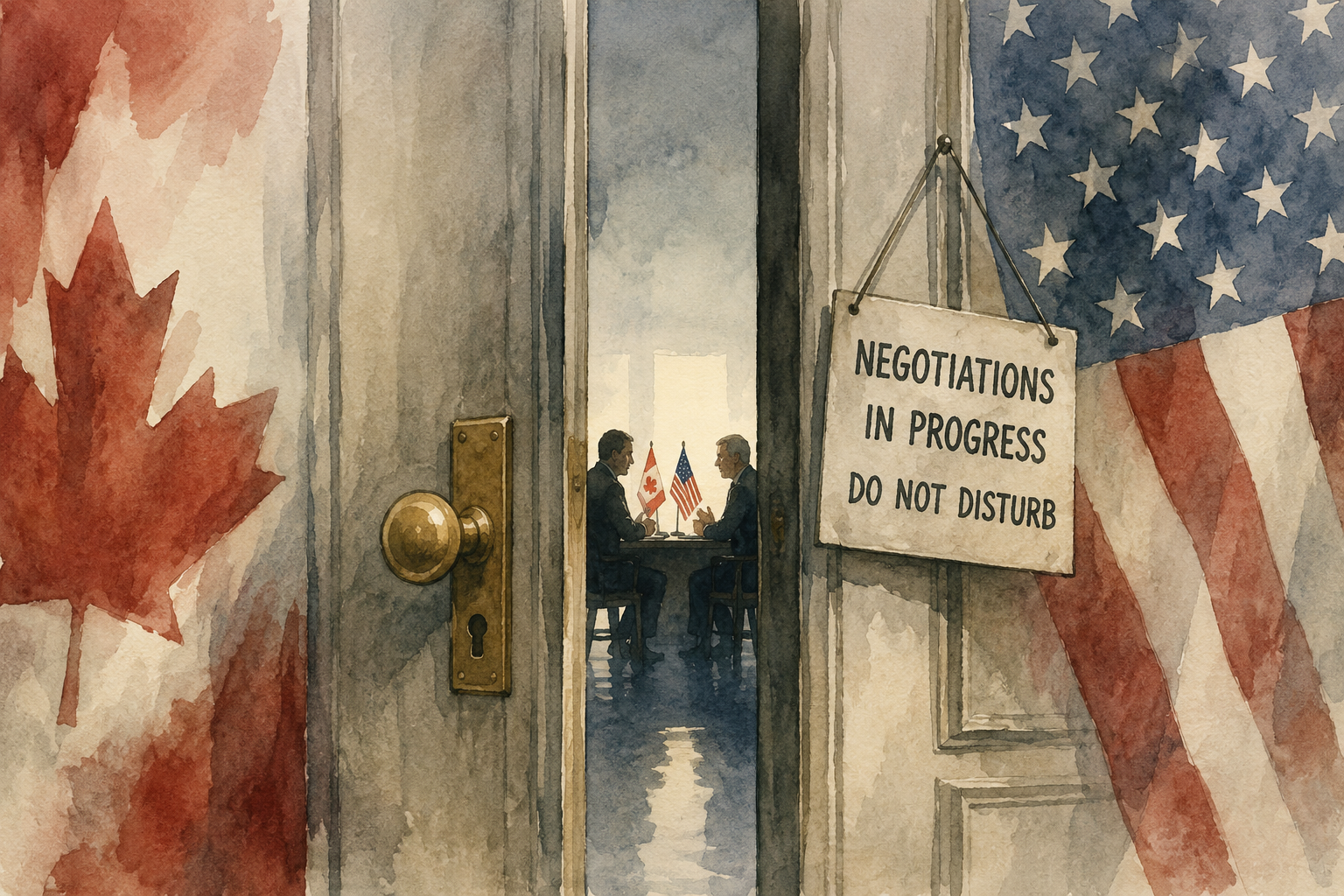
Close the door. Let the negotiators negotiate. Let them explore possibilities, argue, retreat, compromise and occasionally say things neither government wants appearing on the evening news.
Then open the door.
Tell Canadians what was agreed to. Put the agreement before the institutions responsible for scrutinizing it. Let Parliament question it. Let the opposition challenge it. Let journalists investigate it. Let Canadians decide whether their government served them well.
We have every right to demand an accounting from the people negotiating on our behalf.
We don’t need to listen through the keyhole while they’re doing it.