
The Canadianist Exclusive | Opinion
From Sparks Street: What We Learned About Protest, Occupation, and “Freedom”


A ground-level view from Ottawa, and why the conversation needs more precision if we actually want solutions
My Experience
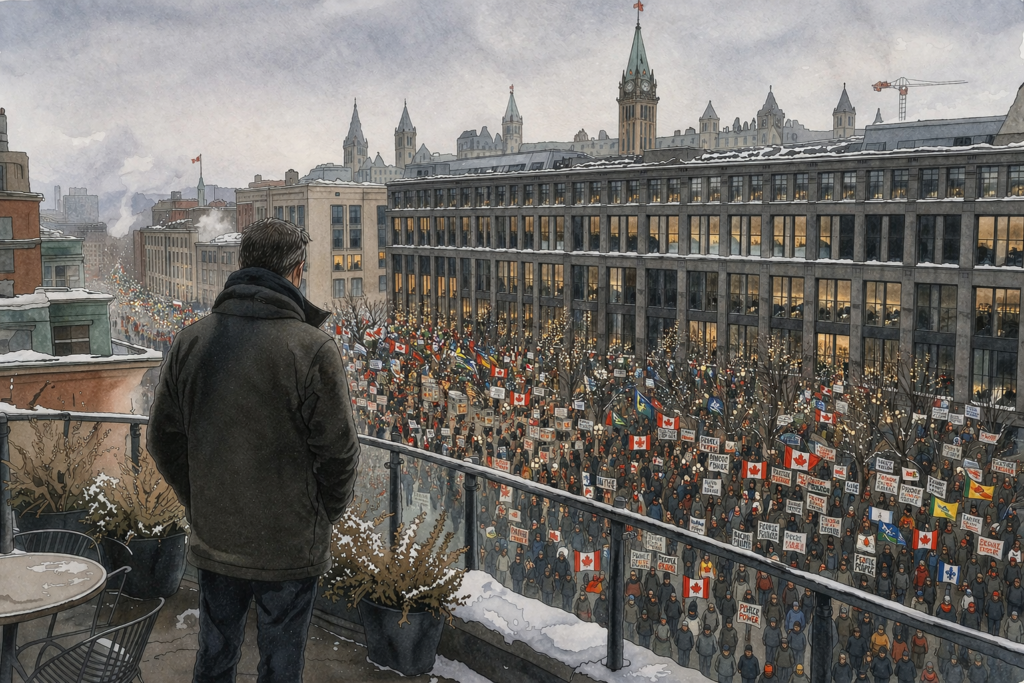
I lived at 126 Sparks Street during the convoy.
Not nearby, not across town, right there. Every night I had to pass through checkpoints just to get home. Show ID, explain where I lived, wait to be let through. For about three weeks, downtown Ottawa stopped functioning as a normal city. Streets were blocked, movement was restricted, and a lot of businesses, mine included, were forced to shut down.
That experience doesn’t settle the broader debate, but it does add something that’s often missing from it, a clear view of what was actually happening on the ground.
What Happened
Canada protects the right to protest. That part isn’t controversial. People have every right to gather, speak, and challenge government decisions. That’s part of how the system is supposed to work.
But what happened in Ottawa went beyond that. Not because of violence, there wasn’t widespread violence, but because of the scale and duration of the disruption. When streets are blocked for weeks, when residents can’t move freely, when businesses are closed and daily life breaks down, the situation changes.
At that point, it’s no longer just a protest.
What Is a Protest
A protest is part of a functioning democracy. It’s visible, sometimes loud, sometimes inconvenient, but it exists within limits. People make their point, apply pressure, and the rest of society continues to function around it.
That balance is important. It allows dissent without shutting everything else down.
What Is an Occupation
An occupation is different.
It’s not defined by violence, it’s defined by control of space and the impact on others. When public areas are held for an extended period, when access is restricted, when residents and businesses can’t operate normally, the nature of the event changes.
That’s what many of us experienced in downtown Ottawa.
This isn’t about assigning motive. It’s about recognizing that rights exist alongside other rights. The ability to protest doesn’t cancel out the ability of others to live and work in the same space.
During those weeks, that balance didn’t hold.
What’s the Real Beef
Fast forward to today, and the original issues are gone.
The mandates are gone. The restrictions that triggered the convoy are gone. And yet the language hasn’t changed. The word “freedom” is still being used to describe what people are feeling.
If we’re being honest, it’s not always clear what that word is pointing to anymore.
That doesn’t mean there aren’t real concerns behind it. There are. People are feeling squeezed financially. Housing is out of reach for many. Costs are rising across the board. There’s also a growing sense that the system isn’t really listening.
There’s also something else, and it shouldn’t be ignored. A lot of people are simply fed up with the federal government. They’ve been in power for a long time, and for some Canadians, that frustration has built up to the point where it’s no longer about a single policy. It’s about the direction of the country as a whole.
That’s not unique to one group. You hear it quietly in a lot of places. The convoy just made it louder.
But none of those issues are clearly defined by the word “freedom.” When everything is bundled under one label, the conversation loses focus. Economic pressure, political frustration, and questions about representation are not the same thing, and they can’t be addressed the same way.
How Do We Get Through It
If we want to move forward, the conversation has to become more precise.
Instead of speaking in broad terms, it helps to ask direct questions. What specifically isn’t working? What would change things in a meaningful way?
That doesn’t dismiss anyone’s concerns. It takes them seriously enough to define them properly.
Because once the issue is clear, the path forward becomes clearer too. If the concern is affordability, then the discussion is about economic policy. If it’s trust in government, then it’s about accountability. If it’s something deeper about how voices are reflected in decisions, then we’re looking somewhere else.
The Case for Electoral Reform
This is where the conversation leads.
A lot of the frustration in this country comes down to a feeling that people aren’t being properly represented. That their vote doesn’t translate into influence in a way that reflects how they actually think.
Canada’s system tends to produce strong majority governments without majority support. Over time, that creates a gap between what people vote for and what they get.
When that gap grows, frustration grows with it.
For some, that frustration becomes quiet disengagement. For others, it becomes louder. In extreme cases, it turns into something like what we saw in Ottawa, people stepping outside the normal channels because they don’t believe those channels are working.
Seen through that lens, what’s being expressed as “freedom” is often something else entirely. It’s a reaction to a system that doesn’t feel responsive.
Electoral reform doesn’t solve every problem, but it addresses that core issue. It creates a system where outcomes more closely reflect the range of views in the country. It gives people a stronger sense that their voice matters, even if their preferred party isn’t in power.
That doesn’t eliminate disagreement. It makes it more representative.
The Bottom Line
From where I stood on Sparks Street, it was clear that two things were happening at once.
People were trying to make themselves heard.
At the same time, the way it unfolded had real consequences for others who were simply living there.
Both of those realities matter.
Canada is a free country. That doesn’t mean everything is working the way it should. There’s room, and a need, for improvement.
But if we want to get there, we need to be clear about what the problem actually is.
Because once we are, we can start to fix it.