
The Canadianist Exclusive | Opinion
The Project Canada Can’t Decide On
Pierre Poilievre is opposing high-speed rail in the Toronto–Quebec City corridor, and the argument is exactly what you’d expect, it’s too expensive, too risky, and too easy for government to get wrong.

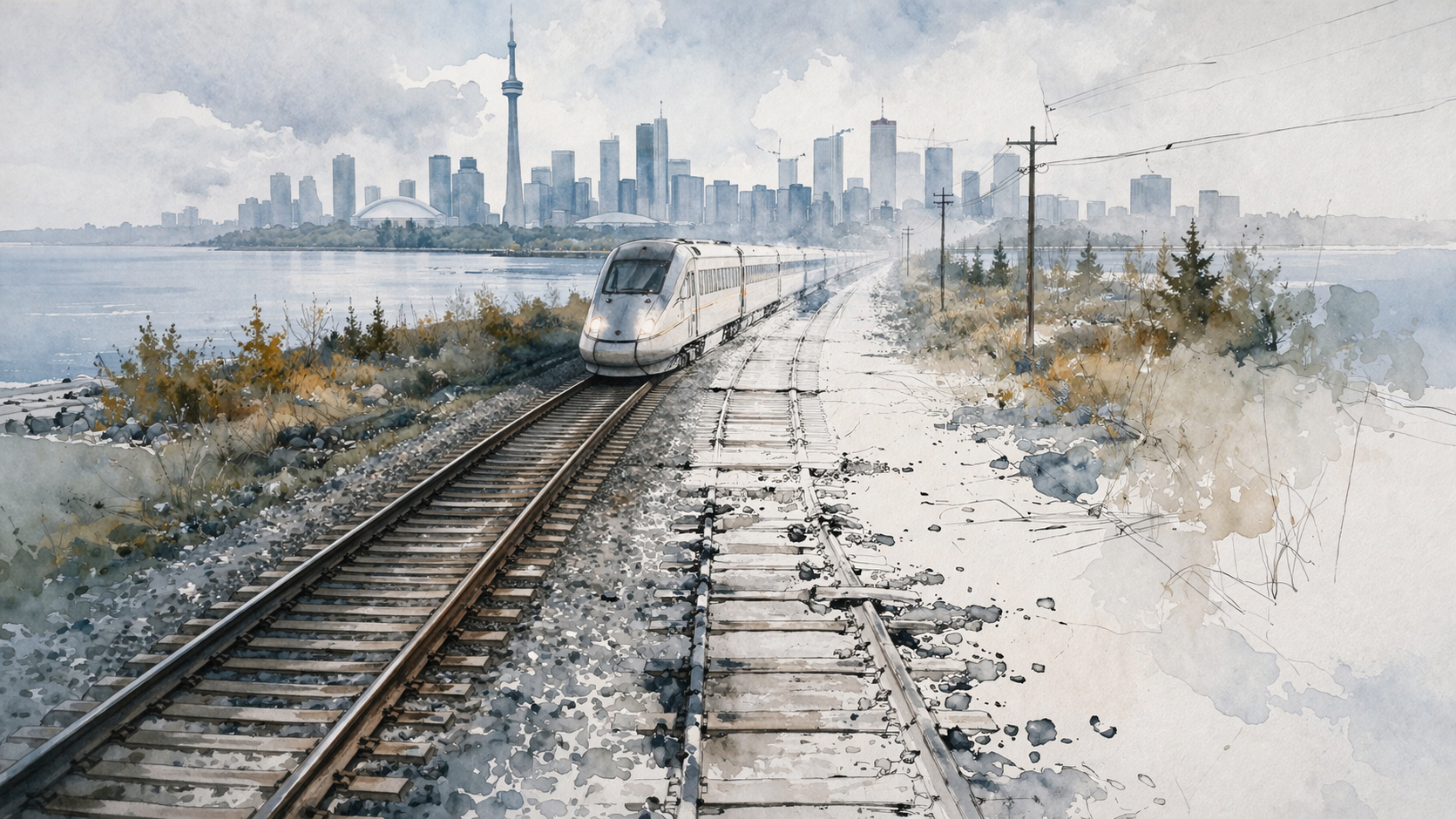
High-speed rail is being debated as a line item. It’s really a test of whether Canada still builds for the future.
Pierre Poilievre is opposing high-speed rail in the Toronto–Quebec City corridor, and the argument is exactly what you’d expect, it’s too expensive, too risky, and too easy for government to get wrong.
There’s truth in that.
Canada doesn’t have a great track record when it comes to delivering large projects cleanly. Costs drift. timelines stretch. Public confidence erodes. Anyone pretending otherwise isn’t paying attention.
But if that’s where the conversation stops, we’re missing something bigger.
Because this isn’t really a debate about trains.
It’s a debate about whether Canada still believes in building at scale.
The corridor in question isn’t hypothetical. It’s the most economically active stretch of the country, linking Toronto, Ottawa, Montreal, and Quebec City. Millions of people move through it every year, and yet the system connecting them remains slow, inconsistent, and constrained by infrastructure that hasn’t kept pace with the country around it.
That gap isn’t just inconvenient. It’s inefficient.
Time lost in transit is lost productivity. Limited connectivity narrows labour markets. Businesses operate in smaller, more fragmented ecosystems than they should. Over time, those inefficiencies become structural.
Other countries didn’t build high-speed rail because it was cheap. They built it because it changed how their economies functioned. It tightened geographic distance, expanded opportunity, and made entire regions more competitive.
Canada’s instinct is different.
We start with the price tag, and often we end there.
Every large proposal gets filtered through the same lens, what could go wrong, how much could it cost, and who gets blamed if it does. Those are fair questions. They’re necessary questions.
But they’ve become the only questions.
And that creates a quiet kind of paralysis.
Because there is a cost to inaction, even if it doesn’t show up on a balance sheet.
It shows up in slower growth. In missed opportunities. In a country that feels like it’s always catching up rather than setting direction.

This is where the divide actually sits.
On one side, there’s a belief that Canada needs to invest in itself, to modernize core systems and take on projects that match the scale of its economy. On the other, there’s a belief that the risk of government failure outweighs the potential upside, and that restraint is the safer path.
Both positions are grounded in reality.
But if restraint becomes the default response to every major idea, the outcome is predictable. The country doesn’t fail dramatically. It just gradually loses momentum.
High-speed rail is not a perfect project. It will be expensive. It will be complicated. It will require political will that Canada hasn’t consistently shown in recent years.
But the more important question is whether we’re still capable of doing something like it at all.
Because if the answer is no, then the debate is already over, and not just for rail.
It’s over for anything ambitious.