
National | Industry
Ottawa, Alberta and B.C. Reach three-way pipeline accord; West Coast Pipeline route formally submitted

The most significant development on the energy and unity file in months arrived Thursday in a coordinated sequence of announcements. Prime Minister Mark Carney and B.C. Premier David Eby unveiled the Canada–British Columbia Cooperative Prosperity Agreement in Vancouver, an MOU under which Ottawa commits to uphold the tanker ban on B.C.’s North Coast, compensate the province for environmental risk associated with any new pipeline, and contribute funds toward port infrastructure upgrades. Eby, long a critic of Alberta’s pipeline ambitions, acknowledged that pipelines fall under federal jurisdiction and said B.C. “will not be going to court to fight a pipeline project.”
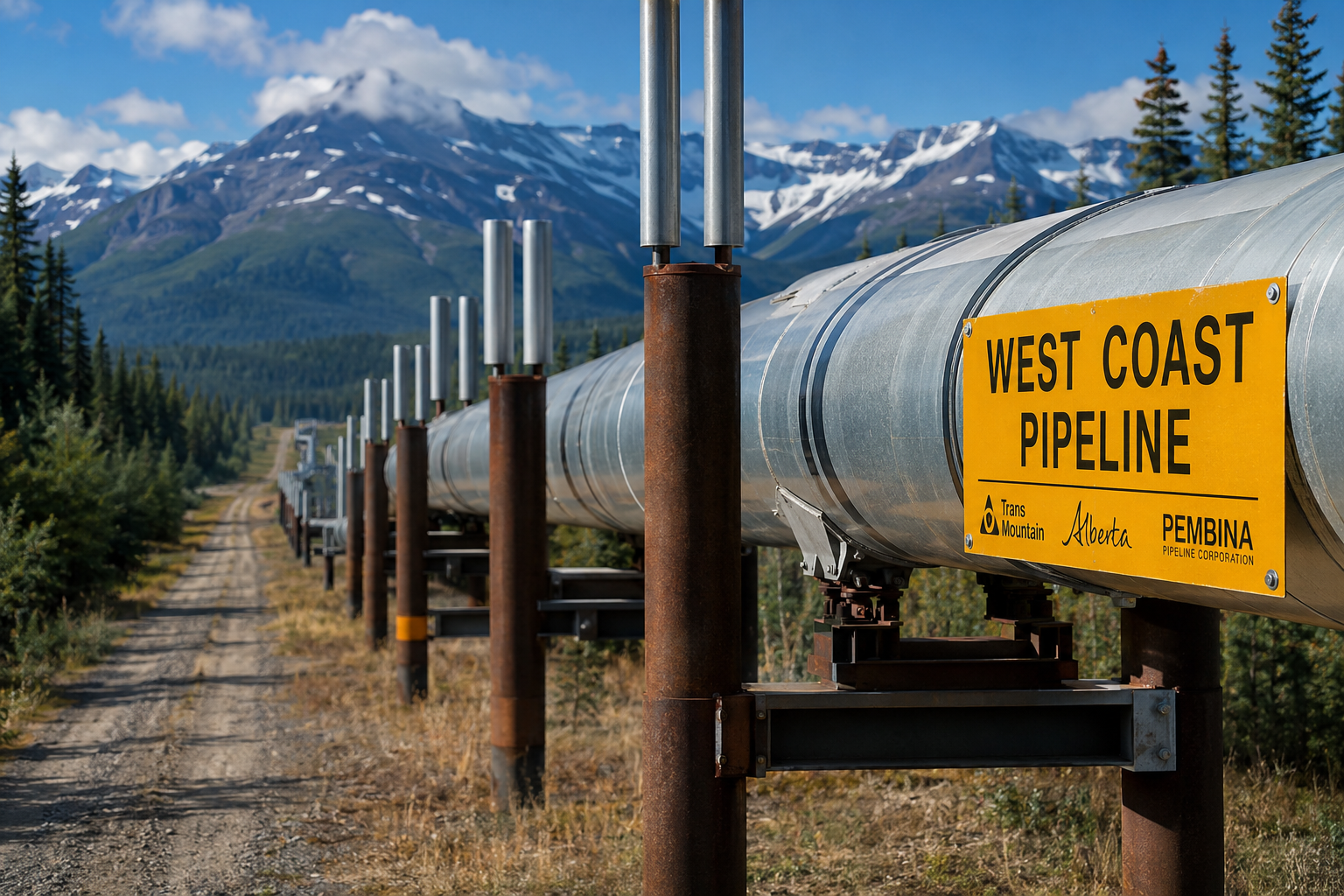
Hours later in Calgary, Alberta Premier Danielle Smith announced her government has submitted a formal route proposal to the federal Major Projects Office for what is now officially branded the West Coast Pipeline — a roughly 1-million-barrel-per-day bitumen line running from Bruderheim, Alberta to B.C.’s southern coast, largely following the existing Trans Mountain corridor. The estimated price tag runs between $35.2 billion and $43.7 billion. Alberta is partnering with the federally owned Trans Mountain Corporation and Calgary-based Pembina Pipeline, though the ownership split has not been finalized; Trans Mountain’s CEO confirmed Ottawa and Alberta will hold majority interest.
The submission package indicates the route crosses the traditional territories of up to 125 Indigenous communities, and Carney said consultations on the new southern alignment will begin immediately — a notable shift, since many communities were previously consulted under the assumption Alberta was pursuing a northern route. The Coastal First Nations Great Bear Initiative, which had opposed a northern corridor, welcomed the outcome; Heiltsuk Nation elected chief Marilyn Slett said her alliance would “never allow oil tankers” on the North Coast and framed the deal as validation of years of opposition to that route.
Why it matters: This is the clearest sign yet that the Carney government’s “nation-building” strategy on energy has produced a workable, if fragile, three-way arrangement — B.C. gets its northern tanker ban preserved and compensation guarantees; Alberta gets a viable corridor and federal buy-in; Ottawa gets a project it can point to as evidence Confederation “can work,” in Carney’s words. It also directly intersects with the Alberta separation question: separatist leaders immediately argued the deal proves Alberta remains “beholden” to Ottawa even to move its own resources to market, while Smith and Carney are positioning it as the opposite case. Indigenous ownership terms and the compressed consultation timeline on the newly chosen southern route are likely flashpoints as the file moves toward the October 1 national-interest designation deadline.