
National | Economy
Canada Seeks CUSMA Renewal as July 1 Review Approaches Amid Growing U.S. Pressure


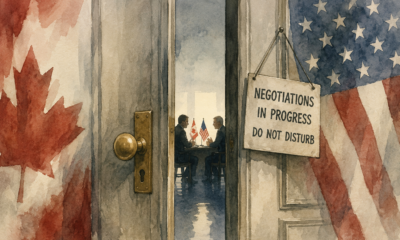
Canada is preparing for the formal review of the Canada-United States-Mexico Agreement (CUSMA) on July 1 as trade tensions with Washington continue to complicate negotiations over the future of North America’s most important trade pact.
Earlier this month, Canada’s Minister of Canada-U.S. Trade, Dominic LeBlanc, traveled to Washington alongside Canada’s chief negotiator, Janice Charette, to formally notify American and Mexican officials that Canada is seeking renewal of the agreement when the scheduled six-year review begins.
The move came one day after U.S. President Donald Trump publicly questioned the value of the agreement from an American perspective.
Speaking to reporters, Trump said he was “not looking to renew” CUSMA and argued that the United States does not need goods from either Canada or Mexico. His comments added uncertainty to an already complex negotiation process that is expected to shape North American trade relations for years to come.
LeBlanc responded during the 2026 U.S.-Canada Summit in Toronto, stating that Canada has presented proposals that would benefit both economies and support continued cooperation under the agreement.
The review process is taking place against a backdrop of broader trade disputes between the two countries.
U.S. Trade Representative Jamieson Greer recently identified Canada’s retaliatory tariffs as a concern for American negotiators. At the same time, Greer indicated that Washington is seeking changes to what it views as weaknesses within the current agreement, particularly regarding rules of origin provisions that determine whether products qualify for tariff-free treatment within North America.
American officials have expressed concerns that some countries, including China, may be using gaps in existing rules to gain indirect access to North American markets through member countries.
The United States has also proposed additional duties on imports from certain countries under separate trade investigations. While some proposals have included Canada among the affected jurisdictions, products that qualify under CUSMA would remain exempt from certain tariff measures.
Canada has already taken steps to reduce friction in the relationship.
In June 2025, the federal government suspended collection of its digital services tax and subsequently moved to repeal the legislation following concerns raised by the United States. The decision was widely viewed as an effort to prevent the dispute from escalating during broader trade discussions.
Despite those concessions, political challenges remain for Prime Minister Mark Carney’s government. Trump’s continued criticism of Canada has made further accommodation politically sensitive, even as Canadian officials seek to preserve stable access to the country’s largest export market.
Economists and trade analysts continue to emphasize the importance of CUSMA to Canada’s economy.
The agreement provides preferential access to the American market for Canadian exporters across a wide range of sectors, including manufacturing, agriculture, energy, and automotive production. Businesses on both sides of the border rely heavily on integrated supply chains that depend on predictable trade rules.
Industry observers note that the July 1 review is not a deadline that automatically threatens the agreement’s existence. Instead, it marks the beginning of a formal process through which the three countries assess the pact and determine whether changes are required.
However, uncertainty surrounding the review is already creating concerns for exporters and investors. Some analysts believe the United States may seek a framework that allows for more frequent reviews in the future, potentially increasing Washington’s leverage in future negotiations.
For Canada, the outcome of the review could play a significant role in shaping trade policy and economic planning throughout the remainder of the decade.