

National | Economy
Carney and Modi Set $50 Billion Trade Goal in Landmark India Visit

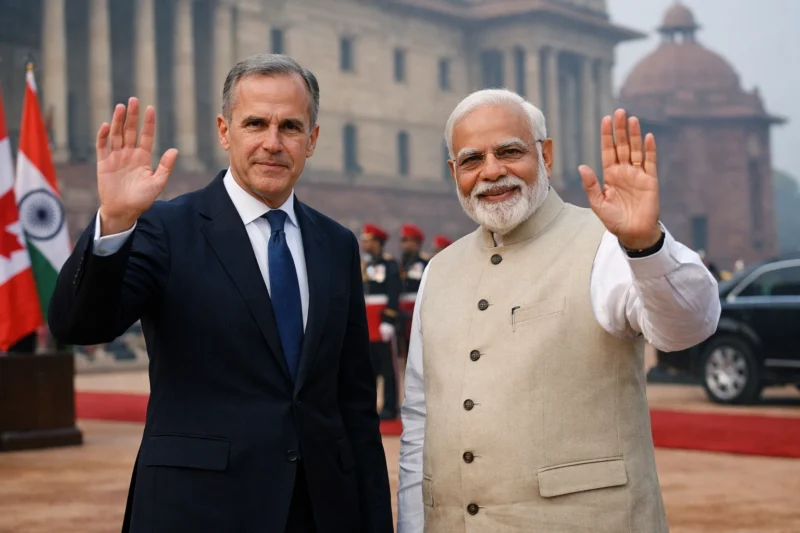
NEW DELHI : Prime Minister Mark Carney and Indian Prime Minister Narendra Modi have formally established a bilateral trade target of $50 billion by the year 2030, marking a definitive shift in diplomatic relations between the two G20 nations. The announcement, made during Carney’s official state visit to India this week, signals a comprehensive "reset" following several years of diplomatic cooling and trade stagnation.
The two leaders met for extensive bilateral talks at Hyderabad House in New Delhi on Monday. The centerpiece of the discussions was the acceleration of the Comprehensive Economic Partnership Agreement (CEPA), which both administrations now aim to conclude by the end of 2026. This timeline represents a significant narrowing of the previous negotiation window, reflecting a shared urgency to diversify supply chains and deepen economic integration.
A New Chapter in Bilateral Relations
The meeting between Carney and Modi is viewed by international observers as the culmination of a normalization process that began last year. Relations between Ottawa and New Delhi reached a historic low in late 2023 following allegations concerning the death of a Canadian citizen in British Columbia. However, the diplomatic climate began to shift when Prime Minister Carney invited Modi to the G7 summit held in Alberta, facilitating a series of high-level ministerial exchanges that paved the way for this week’s summit.
In a joint press conference, Prime Minister Modi characterized the economic collaboration as the "anchor" for the next phase of the Indo-Canadian relationship. He noted that the new trade targets would generate "fresh opportunities across sectors in both economies," moving beyond traditional commodities into high-tech and renewable energy sectors.
Prime Minister Carney echoed these sentiments, emphasizing that the $50 billion goal is not merely a number but a "strategic roadmap" for stability in the Indo-Pacific region. He noted that the agreement would provide Canadian businesses with unprecedented access to one of the world's fastest-growing middle-class markets.

Security, Terrorism, and Extradition
A critical component of the joint statement issued on Monday was a renewed commitment to addressing terrorism and extremism. Both leaders pledged to enhance intelligence sharing and law enforcement cooperation. This inclusion is seen as a pivotal diplomatic compromise, addressing longstanding concerns from both capitals regarding domestic security and the activities of separatist movements.
The joint declaration states that both nations "condemn terrorism in all its forms and manifestations" and emphasizes the importance of ensuring that their respective territories are not used for activities that threaten the territorial integrity of the other. For Canada, this signifies a pragmatic approach to foreign policy that balances the protection of domestic civil liberties with the security requirements of international partners. For India, it represents an acknowledgment from Ottawa of New Delhi’s security priorities.
Civil Nuclear and Energy Security
Beyond the broader trade targets, the visit yielded several sector-specific agreements. Foremost among these is a landmark civil nuclear cooperation deal. Under the terms of the agreement, Canada will supply approximately 22 million pounds of uranium to India over the coming years.
This deal is a strategic win for Canada’s mining sector and positions the country as a primary energy partner for India as it seeks to pivot away from traditional, high-emission energy sources. The move is expected to bolster India’s domestic nuclear power program, which is central to its carbon-reduction goals.
Parallel to the nuclear deal, the two nations exchanged Memoranda of Understanding (MoUs) regarding critical minerals. As global demand for battery metals and rare earth elements rises, Canada and India intend to collaborate on extraction, processing, and supply chain resilience. This partnership aims to reduce reliance on third-party nations for the materials necessary for the electric vehicle and semiconductor industries.
Institutional Investment and Pension Funds
Prime Minister Modi highlighted the significant role of Canadian institutional investors in India’s infrastructure and growth. Currently, Canadian pension funds have approximately $100 billion invested in various Indian assets, ranging from renewable energy grids to logistics and real estate.
"The presence of Canadian capital in our markets is a symbol of their deep belief in India's growth story," Modi stated during the summit.
The new framework discussed on Monday seeks to streamline these investments, providing Canadian funds with more transparent regulatory environments while offering India the patient capital required for long-term nation-building projects. For Canadian retirees, these investments represent a stake in the emerging markets of the Global South, diversifying the portfolios managed by major funds like the CPP Investments and CDPQ.

Agriculture and Innovation
Agriculture remains a cornerstone of the bilateral relationship, particularly regarding pulse exports. To solidify this, a Declaration of Intent was signed to establish a Joint Pulse Protein Centre of Excellence in India. This facility will focus on research and development to improve crop yields and process plant-based proteins, benefiting both Canadian farmers in the Prairies and Indian consumers.
Furthermore, a trilateral MoU involving India, Canada, and Australia was exchanged, focusing on technology and innovation. This agreement is intended to foster collaboration in artificial intelligence, quantum computing, and biotechnology. By pooling resources with Australia, another key player in the Indo-Pacific, Canada and India aim to create a democratic alternative to state-led tech monopolies.
For more information on Canada's evolving international trade landscape, you can visit The Canadianist News or explore our post-sitemap.xml for recent updates.
The Path to 2026
While the $50 billion trade target and the 2030 horizon provide a long-term vision, the immediate focus remains on the CEPA negotiations. Trade officials from both countries are expected to resume technical rounds in Ottawa next month.
Analysts suggest that the most challenging aspects of the negotiations will involve intellectual property rights, professional mobility (visas for skilled workers), and tariffs on specific agricultural goods. However, the high-level political backing from both Carney and Modi is expected to provide the necessary momentum to overcome these hurdles.
The shift in tone is notable. Where previous years were marked by public disagreements and the withdrawal of diplomatic staff, the New Delhi summit was characterized by a focus on "mutual respect and functional cooperation." This pragmatic approach reflects a realization in both capitals that the economic costs of a fractured relationship outweighed the political benefits of the previous impasse.

Regional Implications
The rapprochement between Canada and India has broader implications for the Indo-Pacific strategy. As Canada seeks to reduce its economic dependence on traditional partners, a robust partnership with India provides a necessary counterweight. For India, Canada represents a reliable source of energy, food, and high-tech investment.
The visit also touches on local interests within Canada. Regions such as the Maritimes and Quebec are increasingly looking toward international export markets to sustain economic growth. Similarly, businesses in major hubs like Toronto and Montreal stand to gain from increased financial services and tech collaboration with Indian firms.
As the Canadian government navigates these new waters, the emphasis remains on a "Balanced" approach, ensuring that economic gains do not come at the expense of national security or core values. The Carney-Modi summit appears to have set the stage for a relationship defined by economic realism and strategic partnership.
For a deeper dive into how this affects national policy, readers can review our previous analysis on U.S. trade policy and its impact on Canada.
Conclusion of the Visit
Prime Minister Carney is scheduled to meet with several Indian business leaders in Mumbai before returning to Ottawa later this week. The success of this visit will ultimately be measured by the progress made in the CEPA negotiations over the next 18 months. However, the establishment of the $50 billion target and the resolution of several key sticking points suggest that the India-Canada relationship has entered a new, more stable era of cooperation.
The joint statement concluded with an invitation for Prime Minister Modi to visit Canada in late 2026, potentially to sign the final trade agreement. Should the current momentum continue, that visit could mark the formalization of one of Canada's most significant trade partnerships in the 21st century.
For ongoing coverage of Canadian international relations and economic news, follow The Canadianist News.