
The Canadianist Exclusive | Opinion
Canada’s Immigration Debate Has Entered a New Phase, and Pretending Otherwise Won’t Help
The question is no longer whether Canada needs immigration. The question is whether Canada still has the capacity, credibility, and public trust to manage it responsibly.

The question is no longer whether Canada needs immigration. The question is whether Canada still has the capacity, credibility, and public trust to manage it responsibly.
Canada’s immigration debate is changing, and many of our political leaders still seem afraid to admit it.
For years, the conversation was framed in simple moral binaries. You were either “pro-immigration” or “anti-immigration.” You were either compassionate or intolerant. Either global-minded or fearful.
That framing no longer reflects the reality Canadians are living through.
The public concern emerging across the country today is not fundamentally about whether immigration itself is good or bad. Most Canadians still broadly support immigration. They understand the country needs growth, workers, skills, and renewal.
What Canadians are increasingly questioning is whether the system itself is still being managed coherently.
That is a very different conversation.
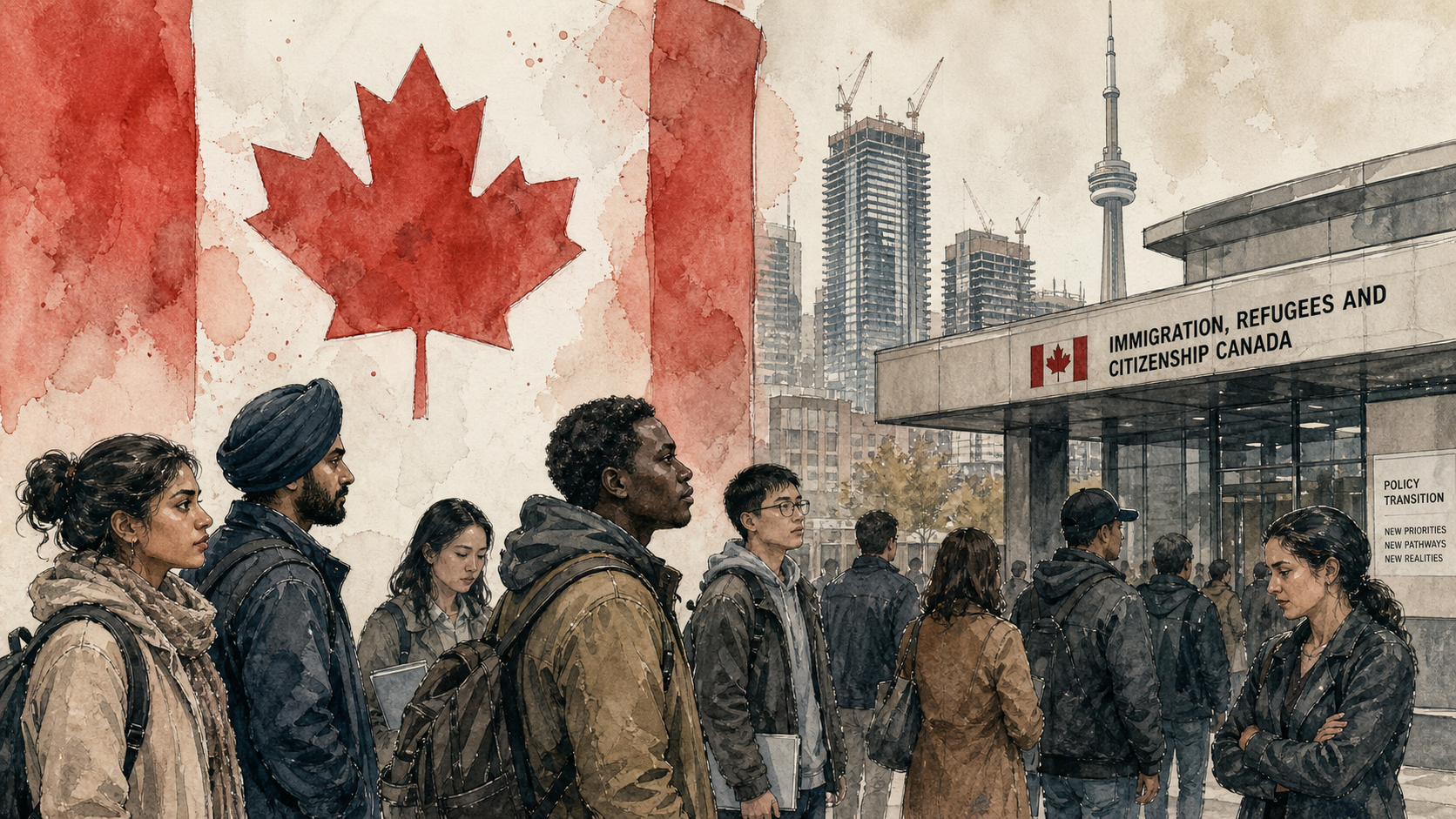
The federal government’s new pathway allowing 33,000 temporary workers to transition to permanent residency has become the latest flashpoint. On paper, the number itself is relatively modest. Canada has admitted millions of temporary residents over the past decade through international student programs, temporary foreign worker streams, post-graduate work permits, and asylum claims.

That is precisely why the reaction has been so intense.
People are not reacting to 33,000 people.
They are reacting to the growing belief that “temporary” no longer actually means temporary.
That loss of trust matters.
Canada now finds itself trapped between realities that are increasingly difficult to reconcile.
The country likely cannot permanently absorb everyone currently inside the temporary resident system without worsening already severe pressures on housing, infrastructure, healthcare, and entry-level labour markets.
At the same time, Canada cannot realistically remove millions of people rapidly even if it wanted to. No modern Western democracy has the operational, economic, or political capacity to execute something on that scale without creating enormous disruption.
Meanwhile, many of the people now caught inside this system arrived legally under policies Canada itself created, encouraged, and marketed aggressively overseas.
That is the real dilemma.
The public frustration directed at Justin Trudeau is rooted in this contradiction. His government attempted to solve legitimate problems. Canada faced labour shortages, demographic decline, and slowing economic growth. Those concerns were real.
The mistake was not recognizing the problems.
The mistake was scale.
The Trudeau-era expansion moved faster than the country’s ability to absorb it socially, economically, administratively, and psychologically. Canadians can feel that in daily life now, whether in housing, healthcare wait times, infrastructure strain, or youth employment.
That last point is becoming particularly volatile.
Parents increasingly see their children struggling to find entry-level jobs while the visible composition of many service-sector workplaces has changed dramatically in a relatively short period of time. People notice what they see around them. Pretending those observations are imaginary only deepens resentment and distrust.
The answer, however, cannot be to slide into ethnic hostility or collective blame. That would be both morally wrong and socially destructive.
The issue is not that one ethnic group is uniquely responsible for Canada’s current tensions. The issue is that government policy created a scale and concentration effect that many Canadians feel was never honestly discussed with them beforehand.
That distinction matters enormously.
Recently, while driving for Uber, I picked up a federal immigration claims processor who spoke candidly about the strain being felt even inside the system itself. The details of her estimates are less important than the larger point she was making: even among people working within immigration administration, there appears to be growing concern about whether Canada still has a full and coherent grasp on the true scale and complexity of the system it created.
That should concern everyone regardless of political affiliation.
Because ultimately, this debate is no longer only about immigration.
It is about state credibility.
Canadians need to know:
- that the rules mean something,
- that temporary programs have actual limits,
- that enforcement exists,
- that infrastructure planning matters,
- and that governments are capable of speaking honestly about tradeoffs.
None of this requires abandoning immigration. Canada will continue to need immigration for economic and demographic reasons.
What Canada likely needs now is a stabilization phase.
Lower future intake growth. Better alignment between population growth and infrastructure capacity. Stronger labour-market discipline. Credible but humane enforcement. Selective regularization where appropriate. Clearer long-term planning tied to housing, healthcare, and integration.
In other words, Canada may need to stop treating population growth itself as the measure of success.
The real measure of success is whether the country remains socially cohesive, economically functional, and trusted by the people living in it.