
The Canadianist Exclusive | Opinion
Carney Isn’t Trying to Restore the Old Deal, He’s Managing the End of It
A tense exchange revealed more than a dispute over alcohol or tariffs. It showed a prime minister trying to explain a structural shift, in a language he’s still learning to translate.

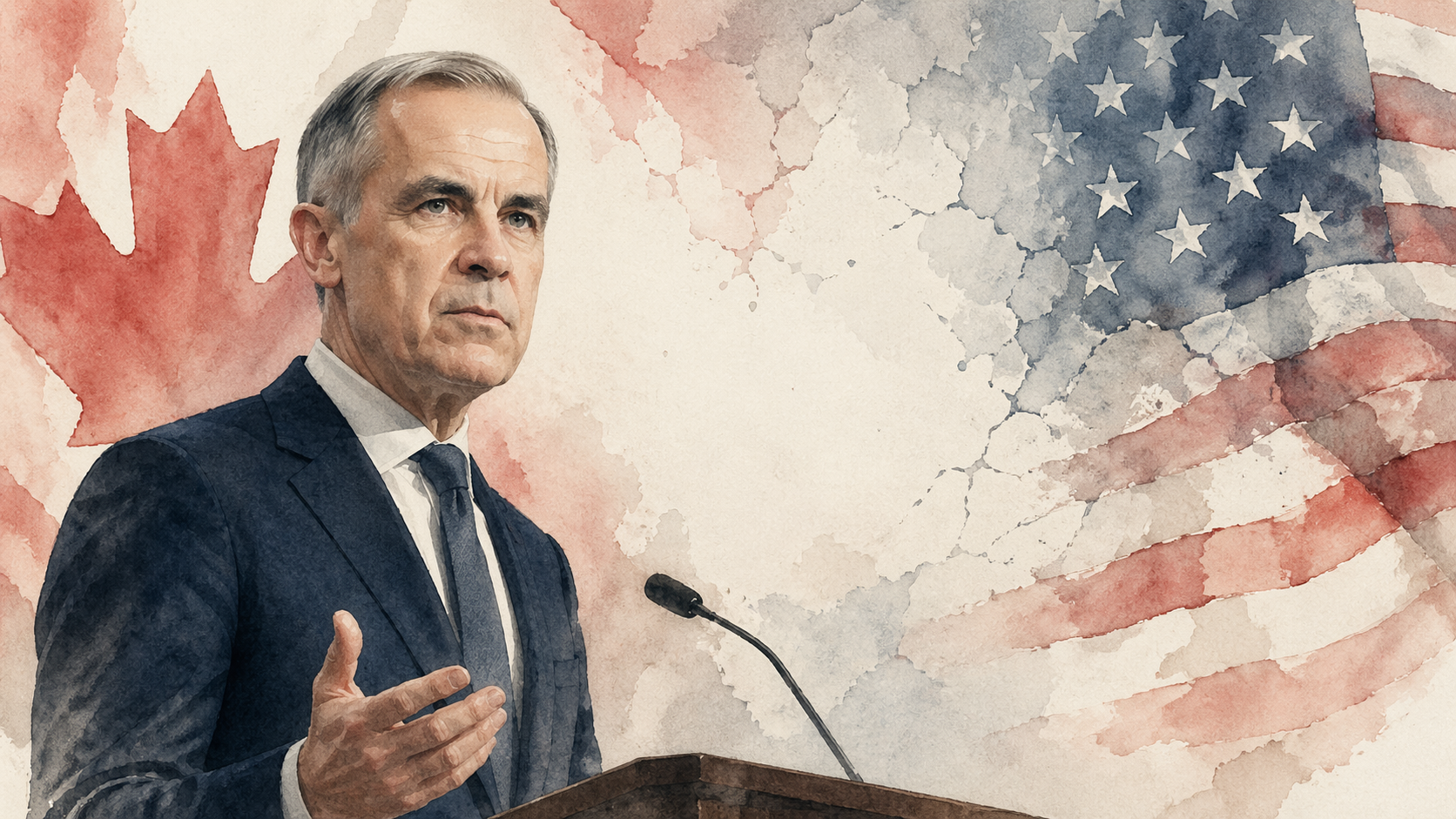
A tense exchange revealed more than a dispute over alcohol or tariffs. It showed a prime minister trying to explain a structural shift, in a language he’s still learning to translate.
A press conference exchange with Mark Carney this week offered a clearer view of how the federal government is approaching the current trade tensions with the United States, and more importantly, how it believes the relationship itself has changed.
When pressed on Ontario’s handling of alcohol distribution through the LCBO, and whether such moves risk escalating tensions, Carney dismissed the issue as secondary. He instead pointed to tariffs on aluminum, automobiles, and forest products as the substantive concern, describing them as violations of existing trade agreements.
That distinction matters. It signals that Ottawa is attempting to keep the focus on areas where it has a stronger legal and economic position, rather than becoming drawn into a cycle of retaliatory measures at the provincial level.
However, the broader significance of the exchange lies in Carney’s repeated assertion that the previous era of deep economic integration between Canada and the United States has effectively ended.
He described the current moment not as a typical negotiation, but as a “rupture,” emphasizing that conditions have changed fundamentally. In doing so, he moved away from any suggestion that policy is oriented toward restoring pre-existing arrangements. Instead, the emphasis appears to be on adapting to a new set of conditions, while seeking agreements that reflect those changes.
This represents a notable shift in tone. For decades, Canadian trade strategy has largely operated on the assumption that integration with the United States would continue to deepen, even amid periodic disputes. Carney’s framing suggests that this assumption no longer holds.
The exchange also highlighted a secondary challenge for the government, translating a structural argument into clear political communication.
At one point, Carney referred to provincial actors as “clients” before correcting himself. While likely an inadvertent choice of language, the moment underscored the extent to which his approach is rooted in institutional and economic frameworks, rather than conventional political messaging. His responses throughout were measured and deliberate, but at times lacked the immediacy typically associated with political exchanges under pressure.
This is not, in itself, a weakness. It reflects a style that prioritizes precision and control. However, in a media environment that rewards clarity and speed, it can create a perception of hesitation, particularly when questions remain focused on narrower, tactical issues.
That tension was evident throughout the exchange. Questions centred on immediate developments and escalation risks, while Carney consistently redirected toward longer-term structural considerations. The result was a conversation that appeared, at times, misaligned, with each side operating at a different level of analysis.
For Canadians, the implications extend beyond the specifics of any single dispute.

If the government’s assessment is correct, that the bilateral relationship has entered a fundamentally different phase, then the policy challenge ahead is not simply one of negotiation, but of transition. That includes managing economic exposure, diversifying trade relationships, and maintaining domestic stability during a period of adjustment.
It also raises a broader question of public understanding.
A shift of this magnitude requires more than policy alignment, it requires a clear and consistent articulation of what is changing, and what that means in practical terms. Without that, there is a risk that the public conversation remains focused on individual flashpoints, rather than the underlying transformation they reflect.
Carney’s remarks suggest that the government recognizes the scale of the shift.
The task now is to communicate it with the same clarity.