
Economy
Carney Concedes Immigration Cuts Are Dragging the Economy — Recession Debate Opens a New Front

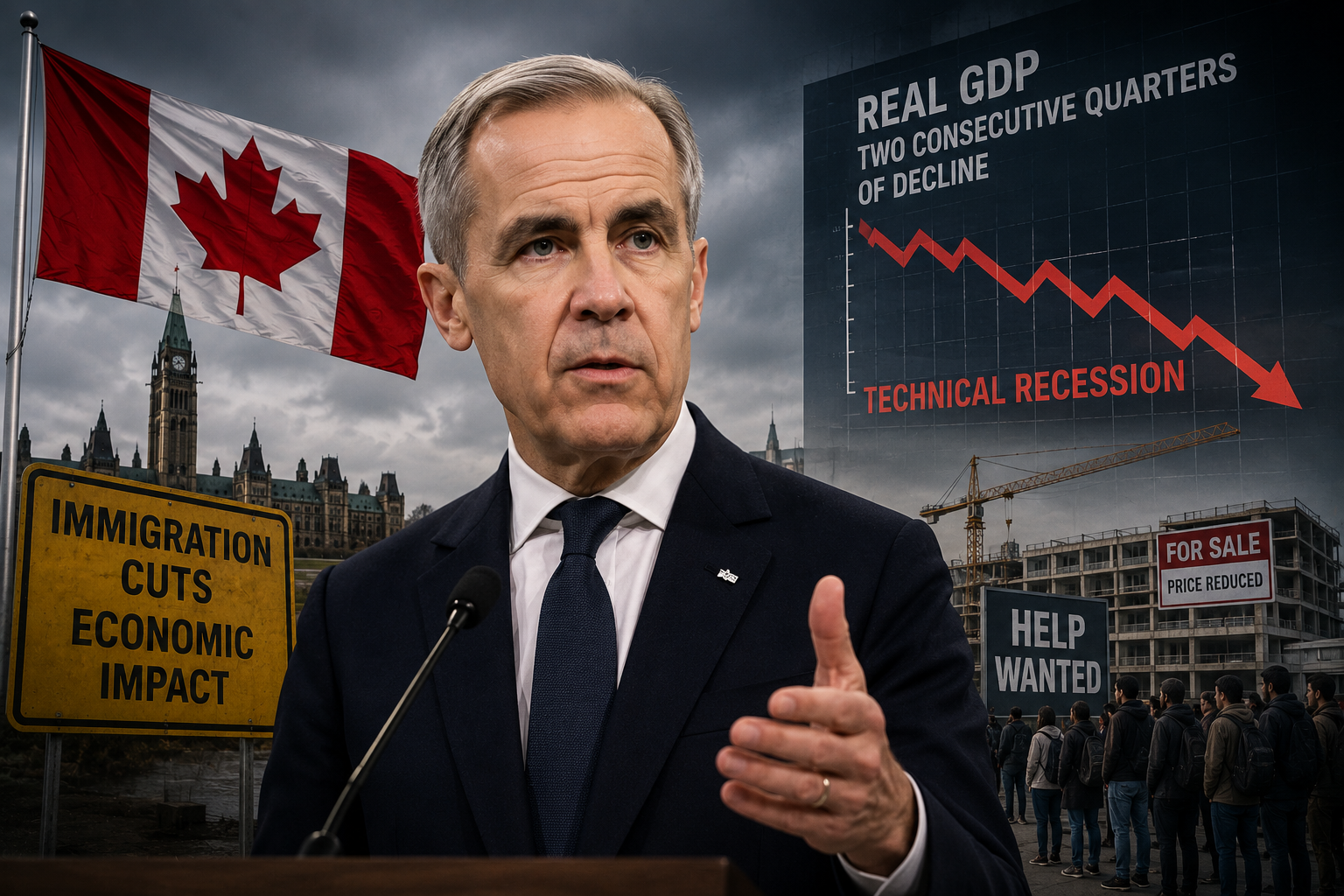
Prime Minister Mark Carney has made a striking public acknowledgment: the federal government’s decision to reduce immigration is a contributing factor in Canada’s current economic contraction. Speaking to reporters on his way into a cabinet meeting, Carney said part of the economic slowdown stems from “clear decisions by the government,” including reining in immigration and government spending. He stated specifically that taking back control of immigration has caused population growth to flatten, slow, or turn negative over the last two quarters. BNN BloombergImmigration News Canada
The remarks came after Statistics Canada data showed the country in a technical recession — two consecutive quarters of negative real GDP growth — covering the six-month period between October 2025 and March 2026. Carney did not use the word “recession,” framing the data as a predictable byproduct of necessary structural adjustments. On a per capita basis, real GDP actually increased 0.2% in Q1 2026, because the population declined for a second consecutive quarter. Global NewsImmigration News Canada
National Bank economists described immigration policy as a “key variable” weighing on growth, noting that the country’s population was smaller in the first quarter of 2026 than in the fourth quarter of 2025. Canada had previously reported its first annual population decline in records dating back to the 1940s — a drop of more than 100,000 people in 2025. Unemployment sits at 6.9 per cent and the housing market remains in a slump, while U.S. tariffs on autos, industrial metals, and wood products continue to weigh on exports. The Globe and MailThe Globe and Mail
Not all economists accept Carney’s framing. Critics, including economists cited by The Hub, argue that weak real GDP per capita growth is not a consequence of lower immigration targets — and that what Canada faces is not a recession but years-long stagnation previously masked by population-driven headline growth. Lack of investment is cited as a more fundamental indicator of systemic weakness. Conservative immigration critic Michelle Rempel Garner also pushed back, arguing that mass rapid intake of low-skilled temporary foreign labour had both masked and amplified structural economic problems. The HubNational Observer
Why it matters: This is the first time a sitting Canadian prime minister has directly connected immigration reduction to economic contraction — a significant rhetorical and political moment. It reframes the immigration debate from a capacity and housing argument into an economic growth argument, and is likely to intensify pressure on the Carney government’s 2027–2029 levels planning process.
