Opinion
Access and Allies
When access becomes a weapon, every institution built to preserve peace begins to fail.

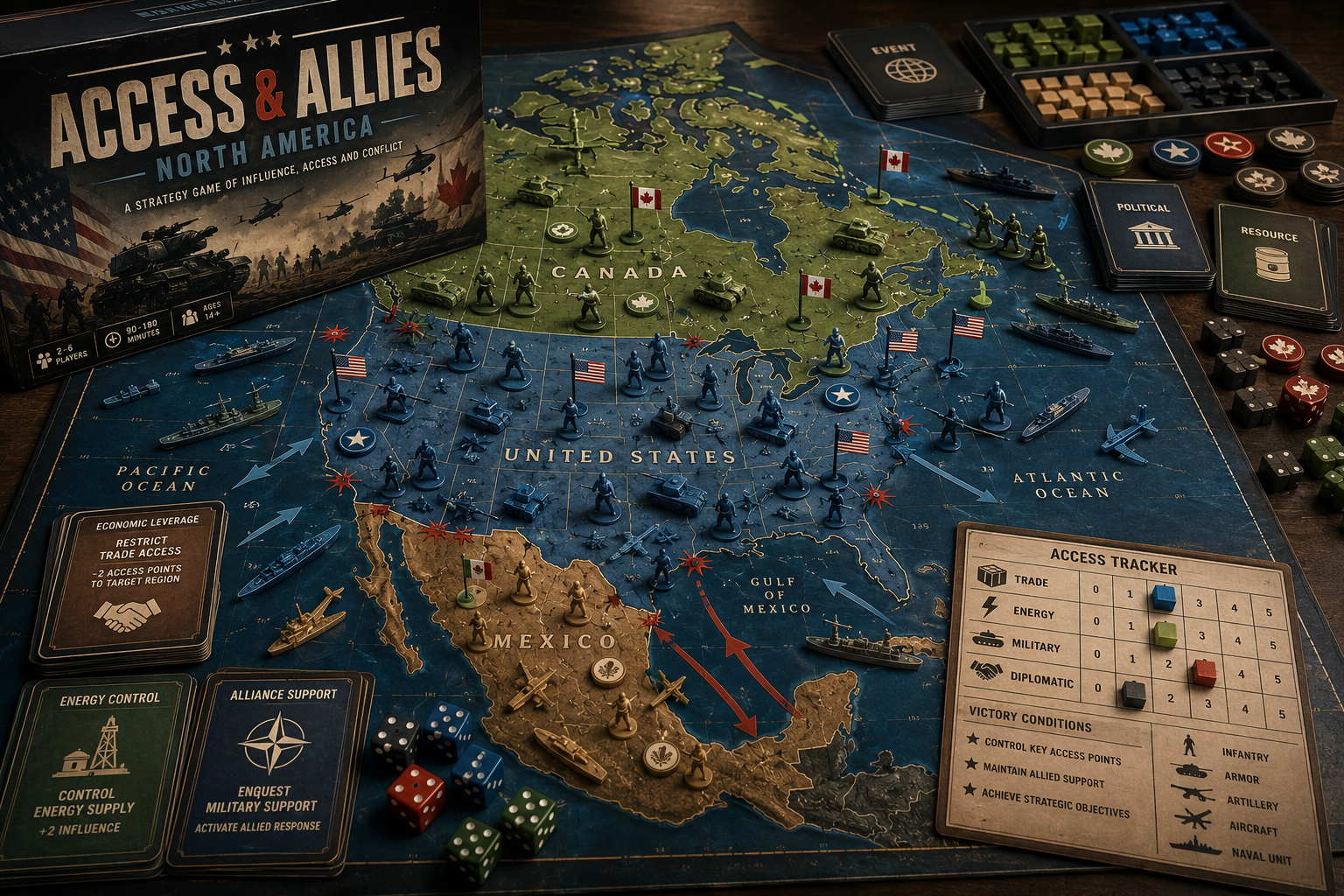
When access becomes a weapon, every institution built to preserve peace begins to fail.
A note before we begin: nothing in the pages that follow has happened. This is not a prediction, not a leak, not a warning of something already in motion. It’s a simulation — the kind a general runs on a border he prays never gets crossed — built entirely out of facts that are true today, and one question about where they could lead tomorrow.
Part One: A Law of Physics
Imagine, if you will, two countries that have spent nearly two centuries proving war between them was unthinkable. The longest undefended border on Earth. The largest trading relationship in the history of the world. A quiet joke among their own citizens that peace between them was simply a law of physics, like gravity — not a choice anyone had to keep making, just a fact of the map.
Now imagine that law quietly stops applying.
Not with a bomb. Not with an army crossing at dawn. It starts the way these things always start — small, almost forgettable.
Part Two: The Spark
It’s already happened once, in miniature. In March of 2025, Ontario Premier Doug Ford slapped a 25 percent surcharge on electricity exports to Michigan, Minnesota and New York, retaliation for a tariff war he didn’t start. “If the United States escalates,” he said, “I will not hesitate to shut the electricity off completely.” Trump answered within a day, threatening a national emergency over electricity and doubling steel tariffs to 50 percent. Forty-eight hours later, both men blinked. Ford suspended the surcharge. The lights stayed on. The story died in a news cycle, the way these things usually do.
In our simulation, nobody blinks.
A different premier, a worse month, a president who’s already floated annexing the country out loud more than once — and this time the surcharge doesn’t come off. The shutoff isn’t a threat anymore. A few million homes and businesses in the American Northeast go dark over a trade dispute most of the people affected couldn’t explain if you asked them. It’s a small thing, as these things go. It just happens to be the small thing that doesn’t get walked back.
In a bar somewhere in Ontario, someone glances up at the score crawl mid-period and stops mid-sentence. There’s no way that’s real, somebody says, half a laugh in it, and nobody laughs back. The game keeps playing behind the scroll of text nobody in the room is really watching anymore.
By the second bulletin — the premier, the shutoff, and now this — the anchor’s voice has that particular flatness reserved for news nobody has found the right tone for yet. Troop movement, the crawl says, along the border. Confirmed. Not rumoured.
It wouldn’t be the first time a fight this size dragged both countries somewhere neither one meant to go. In 1812, the United States marched north over trade, impressment and a president convinced Canada would fall in weeks. It didn’t. The war dragged on for two and a half years, and before it was over, American troops had burned York, and British and Canadian troops had burned the White House in return. Nobody who started that war thought they were lighting that fuse either.
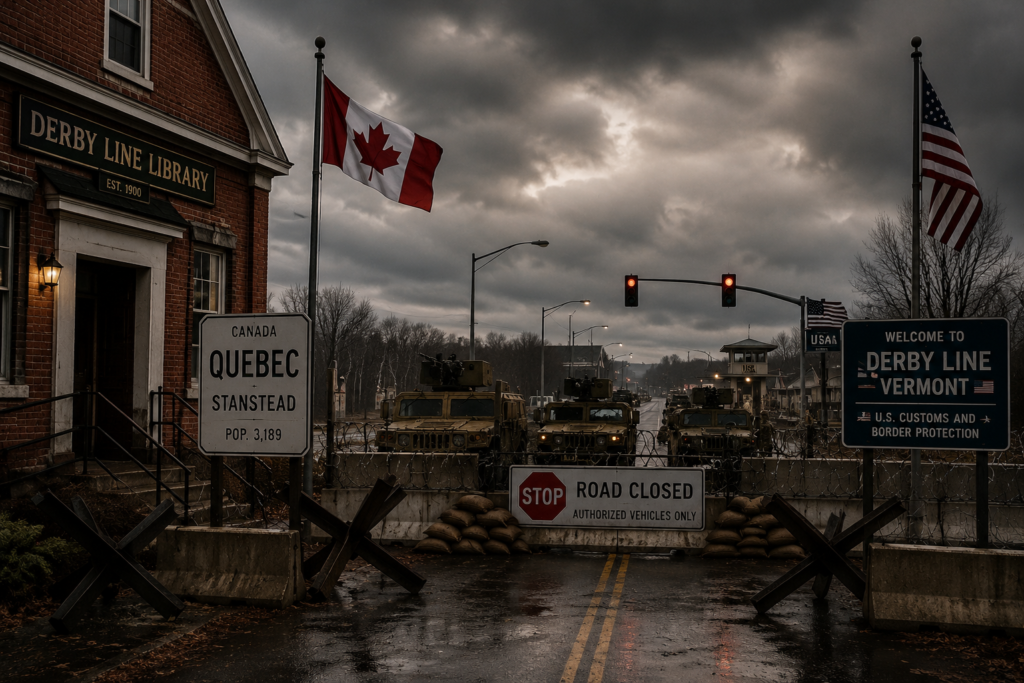
At Derby Line, Vermont — a town so fused with Stanstead, Quebec, that a line of black tape running through the local library marks the only border most residents ever had to think about — the fiction of an open frontier had already been thinning for a year before any of this happened. The library’s American entrance, open to Canadians without a passport for more than a century, had been sealed off, agents posted where there used to just be a sidewalk. Vermont’s own tourism numbers had cratered by nearly 40 percent, and the state’s economists had been warning anyone who’d listen that a border this porous doesn’t survive contempt indefinitely, only affection. Almost nobody outside Vermont had been paying attention.
Nobody’s paying anything but attention now. At a crossing that waved the same two guards through slow Tuesday afternoons for twenty years, they stand on either side of a barrier neither one raised himself. Are you kidding me, says the American — not really a question. No, says the Canadian. Neither one moves for a moment. Then the radio on the American’s belt crackles, and he does what the order tells him to do, and doesn’t quite look up while he’s doing it. Behind him, a roadblock goes up where a sidewalk used to be, and somewhere down the line, so does something with wheels and a machine gun on it.
Part Three: The Treaty That Can’t Save You
Here’s the part that should unsettle anyone who assumes the postwar order simply holds, no matter what: Canada is a member of NATO. Article 5 says an attack on one member is an attack on all. It’s the whole architecture of collective defense, built on one quiet assumption nobody ever had to say out loud — that the threat comes from outside the family.
Nobody built it for this. If the aggressor is the alliance’s own anchor member, the country that hosts SACEUR and funds the largest share of the whole operation, Article 5 doesn’t just fail to protect Canada. It stops meaning anything at all. Who invokes a mutual defense pact against the country the pact was built around? Who enforces it against the enforcer?
That’s not a loophole. That’s the discovery at the center of this whole scenario: the safety net Canadians have taken for granted since 1949 was never actually built to catch this fall.
Part Four: A King, Reminding
There’s a second safeguard, older than NATO by a century and a half, and it doesn’t have the same problem. The King of England is Canada’s head of state — not a metaphor, not a ceremonial leftover, but the actual constitutional architecture of the country. In May of 2025, Charles III flew to Ottawa to deliver the Speech from the Throne in person, only the second time a reigning monarch has opened Canadian Parliament since 1977. He did it while Donald Trump was publicly musing about annexation. Prime Minister Mark Carney was blunt about why: the visit, he said, underscored Canadian sovereignty, at a moment when the Americans had needed a revolution to get free of the Crown Canada still shares.
That’s not background colour. That’s Ottawa consciously reaching for the one piece of its constitution Washington has no claim over and no vote in, and putting it on display for the world to see. An invasion, in this scenario, isn’t just a treaty violation. It’s an attack on a fellow realm of the Commonwealth, with a shared monarch as head of state — and that pulls Britain in on a footing NATO membership never could. Not as an ally. As kin.
Part Five: The Mountains Don’t Negotiate
Whoever plans an American occupation of Canada in this scenario runs into a problem no war game fully solves: holding ground and controlling territory are not the same thing, and Canada is very good at making them different.
This isn’t a country with a few strategic chokepoints. It’s a population strung out along a narrow shelf near the border, backed by a landmass so large and so cold that “controlling” it would mean something closer to controlling two or three population corridors and calling the rest pacified. Military history has proven the same principle for two centuries running, in more places than anyone can count: distance, terrain, and a population that knows both intimately turn occupation into a different kind of war than invasion. The math has never needed a specific war to prove it, only a big enough map and a population determined enough not to fold. Canada has both. An occupying force doesn’t get defeated in a scenario like this one. It just never actually wins. It bleeds, slowly, for years, the way these things always do once the shooting stops being the hard part.
Part Six: A Military Already Spread Thin
None of this happens to a United States with a free hand. Not far down this road, the same country attempting to hold Canadian territory is still entangled in the Middle East, still managing the fallout of Iran, still maintaining a base network numbering in the hundreds across the globe. Occupying and holding a country the size of Canada is a fundamentally different problem than a quick strike, and it’s one more front for a military that already has too many. Afghanistan and Iraq are the ghosts standing in the room the planners in this scenario refuse to look at directly.
Part Seven: An Unlikely Pressure, Not an Unlikely Ally
There’s a complication in this scenario that has nothing to do with loyalty to Canada, and everything to do with self-interest — which is exactly why it’s believable.
Alberta’s Trans Mountain pipeline, expanded in 2024, was built to get Canadian crude to Asian markets instead of just American ones. It worked. China is now the single largest buyer of oil moving through that pipeline, having overtaken the United States, and Ottawa has spent the past two years deliberately deepening that relationship — new pipeline capacity, a proposed deepwater port, a supply line built explicitly to diversify away from Washington’s unpredictability. China didn’t do this out of friendship. It did it because it didn’t want to depend on a supplier it couldn’t trust, the United States included.
An invasion that disrupts Alberta’s oil corridor to the coast doesn’t just threaten a neighbour. It threatens a supply line Beijing has spent two years and billions of dollars insulating itself with. China doesn’t need to like Canada to lean on Washington over this. It just needs functioning ports and pipelines — and a war is very good at threatening both. That’s an unlikely ally in the only sense that actually holds up: not a friend, just an interest that happens, for the moment, to point the same direction as yours.
Part Eight: The Country That Doesn’t Agree With Itself
Wars are supposed to unify a country, at least for a while. This one doesn’t, and it exposes something that was always true and rarely said out loud: the United States isn’t one economy or one political culture wearing a single flag. It’s several.
California’s economy alone ranks fourth largest in the world, ahead of Japan. Texas isn’t far behind it. Border states like Michigan, Minnesota, New York and Vermont have generations of cross-border families, cross-border trade and cross-border electricity contracts — the very infrastructure this war started over. None of that requires anyone to actually secede for the fracture to be real. It requires governors refusing to activate the National Guard for a fight they didn’t choose, state legislatures quietly debating resolutions nobody expected to take seriously a decade ago, and two economies the size of G7 nations discovering they don’t agree on what their own country is doing.
It shows up smaller too, and this is where it actually hurts. Canadians in Los Angeles have joked for decades that their city is the fourth-largest Canadian city in North America — a line that traces back to real 1980s emigration data and has never quite stopped feeling true, whether or not the number still holds exactly. Millions of families like that sit on both sides of this border, not as statistics but as people.
Somewhere in the United States, in this scenario, a man picks up the phone to call his mother in Canada. He doesn’t know, for the first time in his life, whether the call is going to go through. She answers on the second ring, and for a moment neither one says much of anything. She just listens, to make sure the line is still open.
That’s the part of a war like this that never makes a casualty list, and it’s the part that does the most lasting damage to a country’s idea of itself.
Part Nine: The World Is Watching, and Taking Notes
Every rival the United States has ever had gets a gift it didn’t have to lift a finger for: a superpower attacking the one neighbour it never had to fear, in front of everyone. NATO doesn’t recover from this in any recognizable form. European allies who spent seventy-five years building their security around American guarantees start quietly rebuilding around each other instead. The phrase “leader of the free world” stops being something anyone says without an edge in their voice.
That’s isolation, and it’s not a mood. It’s structural — alliances rebuilt without you at the table, currencies and trade routes rerouted around your unpredictability, a seat at the head of the table that simply isn’t offered again the same way.
Part Ten: What This Simulation Was Actually About
Again, plainly: none of what you just read is a forecast. It’s an argument, told as a story, about how little of the peace on this continent was ever actually guaranteed — just habitual, and unexamined, right up until someone stopped honouring it.
Every safeguard we assume would stop something like this from happening was built on the idea that the threat comes from outside the family. NATO assumed the enemy wasn’t its own anchor member. The Crown assumed Canadians would need reminding it still mattered, not rescuing by it. Even the map itself — Ontario’s grid, Alberta’s pipeline, a border eight thousand kilometres long — was built for trade, not for war, because nobody who built it thought war was a serious possibility between these two countries.
Canada survives this, in every version of the simulation — bruised, changed, occupied in places, but standing, the way it always has. The United States does not come out the other side the country it went in as. It loses Europe. It loses the easy assumption that the rest of the world takes its word at face value. And it discovers, in real time, just how many different countries have been quietly sharing one flag all along.
We are not there. This was only a simulation. But simulations exist for a reason: so that if the real thing ever starts to rhyme with them, somebody notices before it’s too late for the noticing to matter. Trust, once spent, is the one resource no military on Earth can replenish.