

The Canadianist Exclusive: Journeys
“I Don’t See a Future Yet”: What One Uber Ride Taught Me About Canada’s Immigration Machinery
He climbed into my car after another security shift. Three years in Canada, working a job that was never part of the plan, still searching for the role that would qualify him for permanent…

He climbed into my car after another security shift. Three years in Canada, working a job that was never part of the plan, still searching for the role that would qualify him for permanent residence.
He came from India expecting to work hard. He expected to start at the bottom. He expected years of grinding before things got comfortable.
He did not expect the rules to keep changing while he followed them.
A Life Measured in Program Announcements
He measures time by immigration programs now. One pathway opens. Another closes. A job category qualifies, then quietly stops qualifying. Every change forces him to recalculate his entire future.
He described it calmly, which struck me more than anger would have.
“The government wants us to move to smaller communities. But there aren’t enough qualifying jobs there.”
Sit with that for a moment, because it captures the whole problem. The incentives point toward small towns. The opportunities sit in the cities. He wants to comply. The system he’s trying to comply with points in two directions at once.
His sister carries degrees, a master’s, and real experience. None of it guarantees enough points, because age, occupation, language, and shifting government priorities all enter the equation. Healthcare workers are in demand today. Tomorrow it will be someone else.
I want to be clear about what I heard in that car. This was a person trying to understand the rules well enough to follow them. Canada asked him to play by the book, and he keeps discovering the book has been revised.
Permanent Residence as a Starting Line
Here’s the part I keep returning to. He spoke about permanent residence the way most Canadians talk about buying a first home.
As a beginning.
Once he knows he can stay, he wants to study again. Build a career. Maybe start a business. Support his parents. Put down roots without wondering whether the ground will still be there next year.
“I don’t see a future yet,” he told me.
That sentence should bother you. It bothers me. When a motivated, working, tax-paying person can’t see a future after three years of effort, the problem sits in the system, above any individual. This is the pattern I keep finding underneath our biggest debates. Housing, healthcare, immigration, affordability. They look like separate crises. They’re symptoms of institutions that stopped evolving while the country kept growing.
Uncertainty carries a cost we rarely count. People in limbo delay education, delay businesses, delay commitment to communities. We invite talent here and then leave it idling in security shifts and paperwork. That’s a loss for him and a loss for every one of us.
He Chose Canada. On Purpose.
Canada was no accident for him. Family in Alberta told him about the people, the opportunities, the quality of life. He weighed other countries and kept coming back to this one.
Even after eight months of job searching, burning through the savings his parents sent with him, he holds no regret.
“I love being here,” he said. He likes the balance. He likes the people. He even likes the weather. “I don’t like the sun too much,” he laughed. “Canada is perfect for me.”
Then the conversation turned ordinary, and honestly, that was the best part. Video games. Football. The World Cup. Winter. French lessons. Government jobs. For a stretch of Toronto highway, it was just two people talking.
Near the end, we drifted toward racism. His answer stayed with me. He refuses to assume every unpleasant interaction is about race. Sometimes people are having a bad day. Sometimes they’re carrying problems he knows nothing about. That has been his experience. Others carry different stories, and this one belongs to him. I found real maturity in that answer, the kind our public conversation could use more of.
The System Is Working as Designed. That’s the Problem.
Here’s my editorial position, plainly stated.
Our immigration machinery functions exactly as designed. It sorts, scores, and re-prioritizes people according to whatever the government needs this quarter. The design itself has fallen out of alignment with the country it serves and the people it invites.
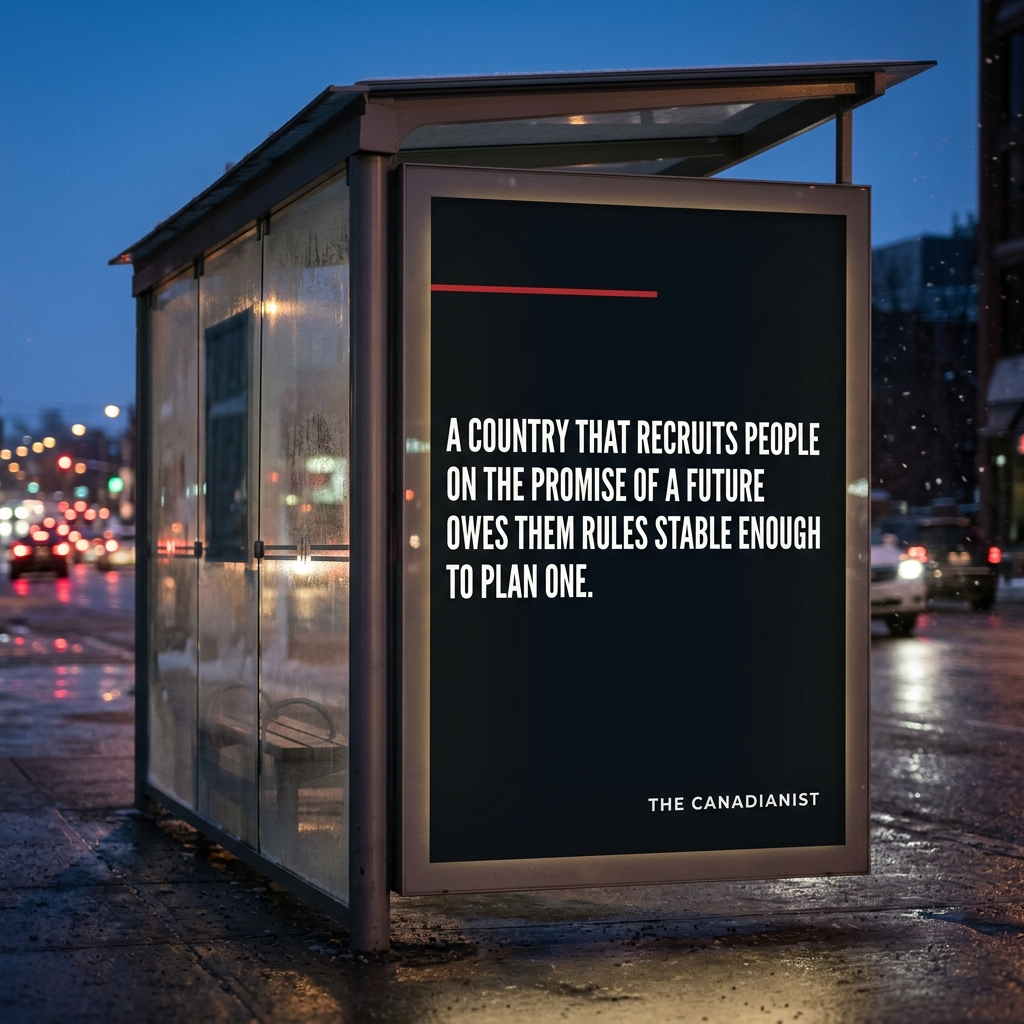
A country that recruits people on the promise of a future owes them rules stable enough to plan one.
Canada isn’t in decline. Canada grew and changed while systems like this one stood still. Fixing that requires structural thinking, built for generations instead of election cycles.
💡 Next time you hear an immigration debate, ask what the system actually rewards and whether those rewards match reality on the ground. That question cuts through most of the noise.
When he first arrived, he knew almost no one. He figured out work, banking, and the entire system alone. He’s further along than he gives himself credit for.
He’s still moving. One shift. One application. One step closer to calling Canada home.
The least we can do is build a system worthy of that effort.
