
Montréal | East End
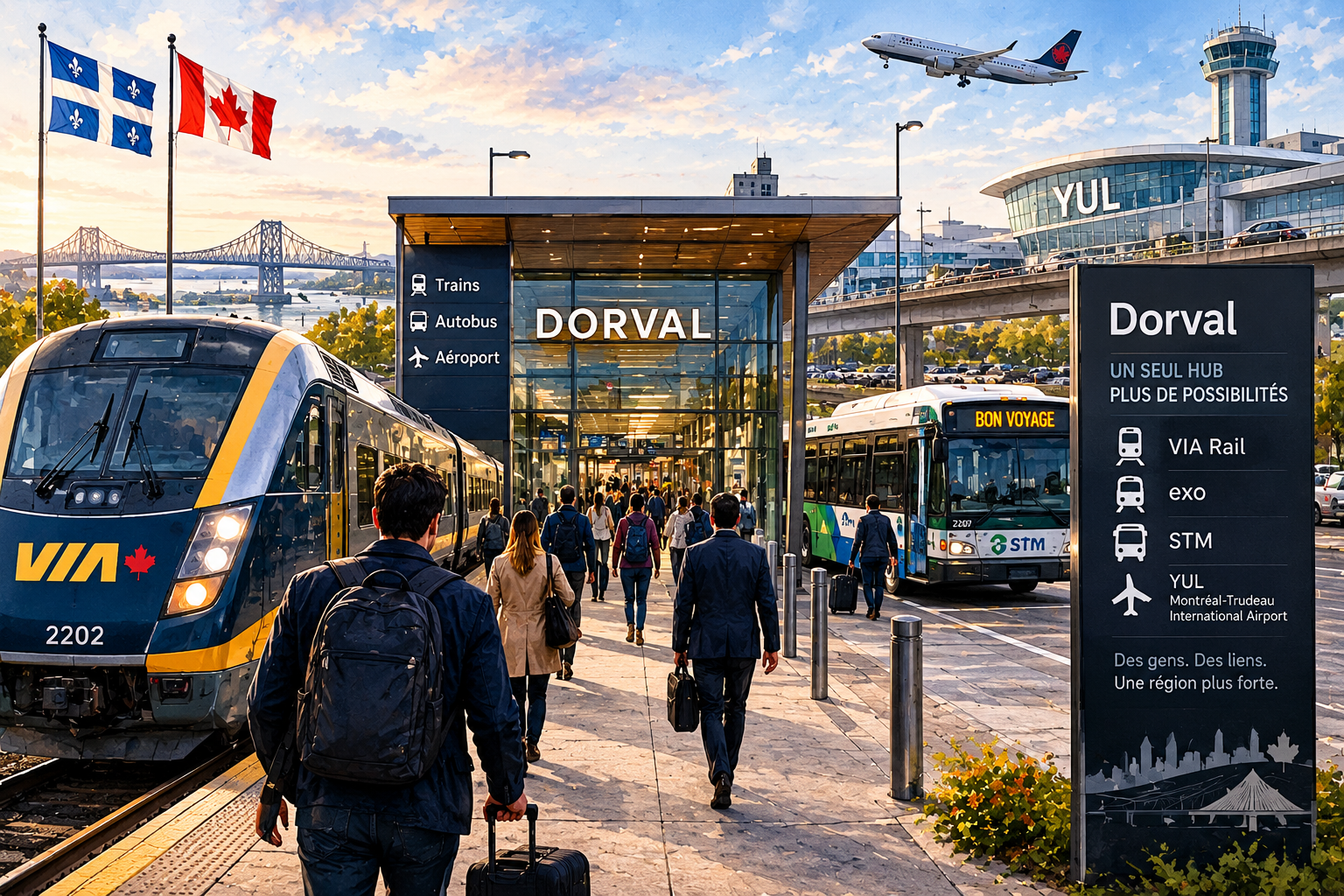
Dorval Has Trains, an Airport and Buses. VIA Rail Finally Wants to Make Them One Hub.
If you’ve lived in Montreal’s West Island for any length of time, the transportation setup around Dorval has always been a little difficult to explain.
There’s an international airport. There’s a VIA Rail station. There’s an exo commuter train station. There’s a major STM bus terminus. Highways 20 and 520 meet nearby.

If you’ve lived in Montreal’s West Island for any length of time, the transportation setup around Dorval has always been a little difficult to explain.
There’s an international airport. There’s a VIA Rail station. There’s an exo commuter train station. There’s a major STM bus terminus. Highways 20 and 520 meet nearby.
They’re all sitting within roughly the same transportation neighbourhood.
And yet travelling between them has often felt less like using one transportation system and more like completing a series of unrelated tasks.
VIA Rail announced Wednesday that it wants to change that.
The Crown corporation has launched the co-development phase of a new Dorval Multimodal Hub, an integrated station intended to bring VIA Rail intercity trains, exo commuter rail and the shuttle connection to Montréal-Trudeau International Airport together in one location.
VIA says the new hub will also sit near the existing STM Dorval terminus, creating a much more coherent connection between local buses, commuter rail, intercity trains and the airport.
Construction is currently expected to begin in 2027.
It’s an announcement that makes so much obvious sense that the more interesting question may be why Dorval hasn’t worked this way all along.
The area is already one of the most important transportation crossroads in western Montreal.
VIA says approximately 250,000 passengers pass through its Dorval station every year. From there, travellers can head toward Toronto, Ottawa, Quebec City and other destinations along the Quebec City-Windsor corridor.
Right beside it is the exo station serving the Vaudreuil-Hudson line.
The STM bus terminus is nearby.
And about two kilometres away sits Montréal-Trudeau, one of Canada’s busiest airports.
On a map, it looks like a transportation hub already.
On the ground, not quite.
The airport connection illustrates the problem particularly well.
A passenger can take VIA to Dorval and transfer to a shuttle for the airport, but the experience isn’t the same as arriving at an integrated rail-air terminal where the transfer is simply another part of the journey.
Recent travellers have continued to complain about long shuttle waits and uncertainty about when it will arrive. That’s anecdotal rather than systematic evidence, but it points to the larger problem VIA is now trying to address: putting transportation services beside one another doesn’t necessarily make them connected.
The new project is supposed to approach Dorval differently.
VIA has selected Kiewit as its design and construction partner for the co-development phase and is working with exo, the Autorité régionale de transport métropolitain and Aéroports de Montréal.
Rather than arriving with a completed design, the partners will now work out how the station should function, how passengers will move between services, what technical problems need to be solved and what the project will actually cost.
That’s important because VIA hasn’t announced a final price tag yet.
Nor should this be treated as though a shiny new station has suddenly been funded, designed and is ready to open.
We’re at the development stage.
But the idea behind it deserves attention because Dorval has the ingredients for something Montreal has never quite managed to create properly: a western transportation gateway where different systems actually meet.
For West Islanders, there’s another dimension to it.
The arrival of the REM this year fundamentally changed public transportation west of the city. Pointe-Claire, Kirkland and Sainte-Anne-de-Bellevue now have rapid-transit stations connecting them toward the metropolitan core.
Dorval, meanwhile, remains a major transportation node of a different kind.
It has the airport, VIA, exo and the STM.
Those two transportation worlds aren’t the same thing, and the new VIA project doesn’t suddenly connect the REM directly to Dorval station. The airport’s future REM station will form another piece of the regional network when that connection is completed.
What we’re beginning to see, however, is the outline of something the West Island has needed for decades: transportation planned as a network rather than as a collection of individual projects.
That sounds obvious.
Montreal’s history suggests it isn’t.
The West Island grew largely around the automobile. Highways came first in much of its postwar development, followed by shopping centres, industrial parks and suburban neighbourhoods designed around driving.
Public transportation was layered onto that landscape afterward.
The result is familiar to anyone who has tried travelling across the West Island without a car. You can often get where you’re going, but the journey may involve a bus to a train, a walk between services, another transfer and a timetable that punishes you considerably if one piece doesn’t line up with the next.
A successful Dorval hub won’t fix all of that.
It could fix one particularly important part of it.
Imagine arriving from Ottawa by VIA and moving naturally into an airport connection. Or coming from Vaudreuil on exo and transferring within the same hub to an intercity train. Or taking an STM bus from elsewhere in the West Island and arriving at a station designed around the fact that you’re transferring rather than simply discovering that another transportation service happens to be nearby.
That’s what multimodal transportation is supposed to mean.
The project also arrives at an interesting moment for Dorval itself.
For years, the area around the airport has been viewed largely as infrastructure: highways, hotels, parking lots, industrial properties, airport facilities and transportation corridors.
But its location makes Dorval enormously important to how western Montreal connects with the rest of Quebec, Ontario and the country.
The opportunity now is to stop treating those connections as separate systems occupying neighbouring pieces of land.
There are still plenty of questions.
We don’t know the final cost. We don’t know exactly what the new station will look like. We don’t know the construction schedule beyond VIA’s current expectation that work begins next year.
And anyone familiar with major transportation projects in Montreal has earned the right to remain somewhat cautious about schedules.
Still, the basic idea is difficult to argue with.
Dorval already has the trains.
It already has the buses.
It already has the airport.
What it has been missing is the hub.