Toronto | The City
Olivia Chow Leads Brad Bradford 47–40 in New Toronto Mayor Poll

Toronto’s mayoral race is starting to look considerably more interesting.
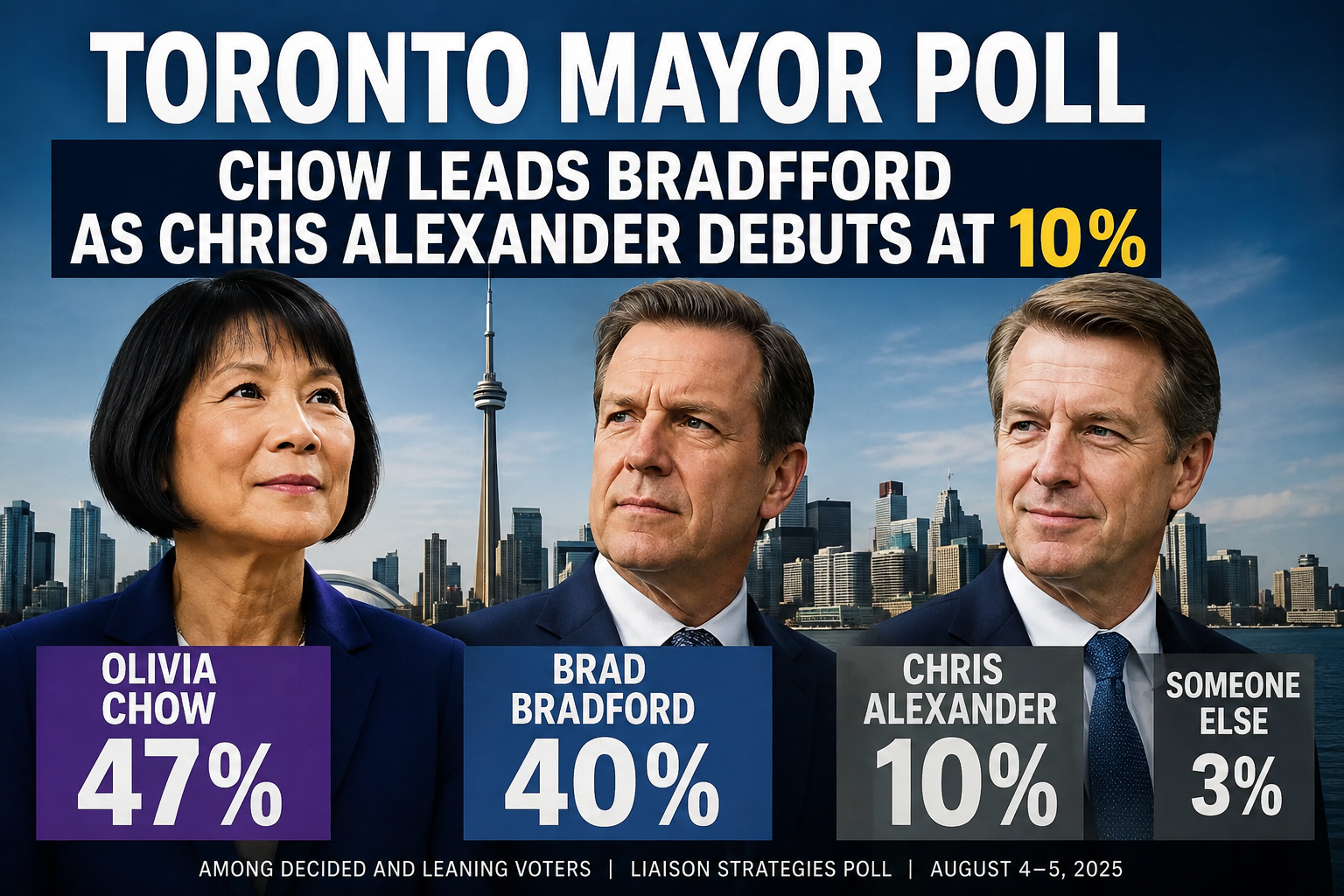
The latest Liaison Strategies poll has Mayor Olivia Chow ahead of Councillor Brad Bradford by seven points among decided and leaning voters, 47 per cent to 40 per cent. That’s already a competitive race for an incumbent mayor.
Then Chris Alexander showed up.
The former Conservative cabinet minister is sitting at 10 per cent in his first appearance on a published ballot test, with another three per cent choosing someone else. Before Alexander was included, Chow led Bradford 49 to 41.
It would be easy to look at those numbers and conclude that Alexander has tightened the race. He hasn’t, at least not yet. Chow’s lead has actually gone from eight points in the two-person matchup to seven with Alexander included.
The more interesting question is where Alexander’s 10 per cent is coming from, and whether he has just created a much bigger problem for Bradford than for Chow.
Bradford’s clearest path to the mayor’s office was always going to involve consolidating voters who want a change from Chow. He needs conservatives, centre-right voters, some centrists and enough voters who may not identify strongly with any political camp but have decided they want a different direction at City Hall.
Alexander gives some of those voters another place to go.
That doesn’t mean everyone supporting Alexander would otherwise vote for Bradford. Toronto voters aren’t pieces on a political chessboard that can simply be moved from one candidate to another. But a former Conservative cabinet minister polling at 10 per cent is clearly competing for at least part of the electorate Bradford needs if he’s going to get past Chow.
And 10 per cent isn’t nothing.
The race becomes even more unsettled when undecided voters are included. Among all respondents, Chow has 38 per cent, Bradford 32, Alexander eight, while 20 per cent remain undecided.
One voter in five hasn’t picked anyone.
That’s why calling this race over would be premature. Chow is ahead, and there’s no particularly creative interpretation of the poll that changes that. But she’s also an incumbent mayor sitting below 50 per cent among decided and leaning voters, with a major bloc of voters still available.
The geography tells another part of the story.
Chow leads downtown 55 to 36, which isn’t especially surprising. More significant may be her strength outside the core. She leads Bradford 52 to 37 in North York and 50 to 41 in Scarborough.
Bradford, meanwhile, has a substantial advantage in Etobicoke, leading Chow 54 to 35.
That produces a Toronto electoral map that looks familiar in some ways but doesn’t divide neatly into the old downtown-versus-suburbs storyline. Chow isn’t surviving solely because of overwhelming support in the centre of the city. If these numbers hold, she has significant support across several parts of Toronto.
For Bradford, that means winning Etobicoke comfortably isn’t enough. He needs to make gains elsewhere, particularly in the suburban areas where a centre-right challenger would normally expect to be competitive.
Alexander potentially makes that harder.
There’s still plenty of time for his support to move. A candidate can enter a race with name recognition, attract an initial group of curious or ideologically sympathetic voters, and then watch that support disappear once the campaign becomes serious. Ten per cent today doesn’t guarantee 10 per cent on election day.
It does, however, earn Alexander a place in the conversation.
The nomination deadline is August 21, which means Toronto still doesn’t have its final field. Once it does, voters will have a clearer idea whether this becomes a relatively conventional Chow-versus-Bradford contest with Alexander on the margins, or a genuine three-way race capable of changing the electoral arithmetic.
There’s another lesson buried in these numbers too. Our winner-take-all electoral system encourages us to reduce political opinion into camps that are often much more complicated than the labels suggest. Voters who broadly occupy the same part of the political spectrum don’t automatically support the same candidate, and a plurality can be enough to win even when most voters choose someone else. That’s one of the recurring distortions of first-past-the-post politics.
For now, Chow remains the clear frontrunner. Bradford remains the candidate with the best chance of defeating her.
But Alexander has introduced a new variable into a race that Bradford probably would have preferred to keep simple.
If Alexander grows, Chow may not have to win over Bradford’s voters.
She may only have to watch them divide.