Montréal | Centre-Ville
Montreal Is Having a Banner Tourism Year. So Why Is Downtown Still Fighting for Foot Traffic?
Montreal Is Having a Banner Tourism Year. So Why Is Downtown Still Fighting for Foot Traffic?

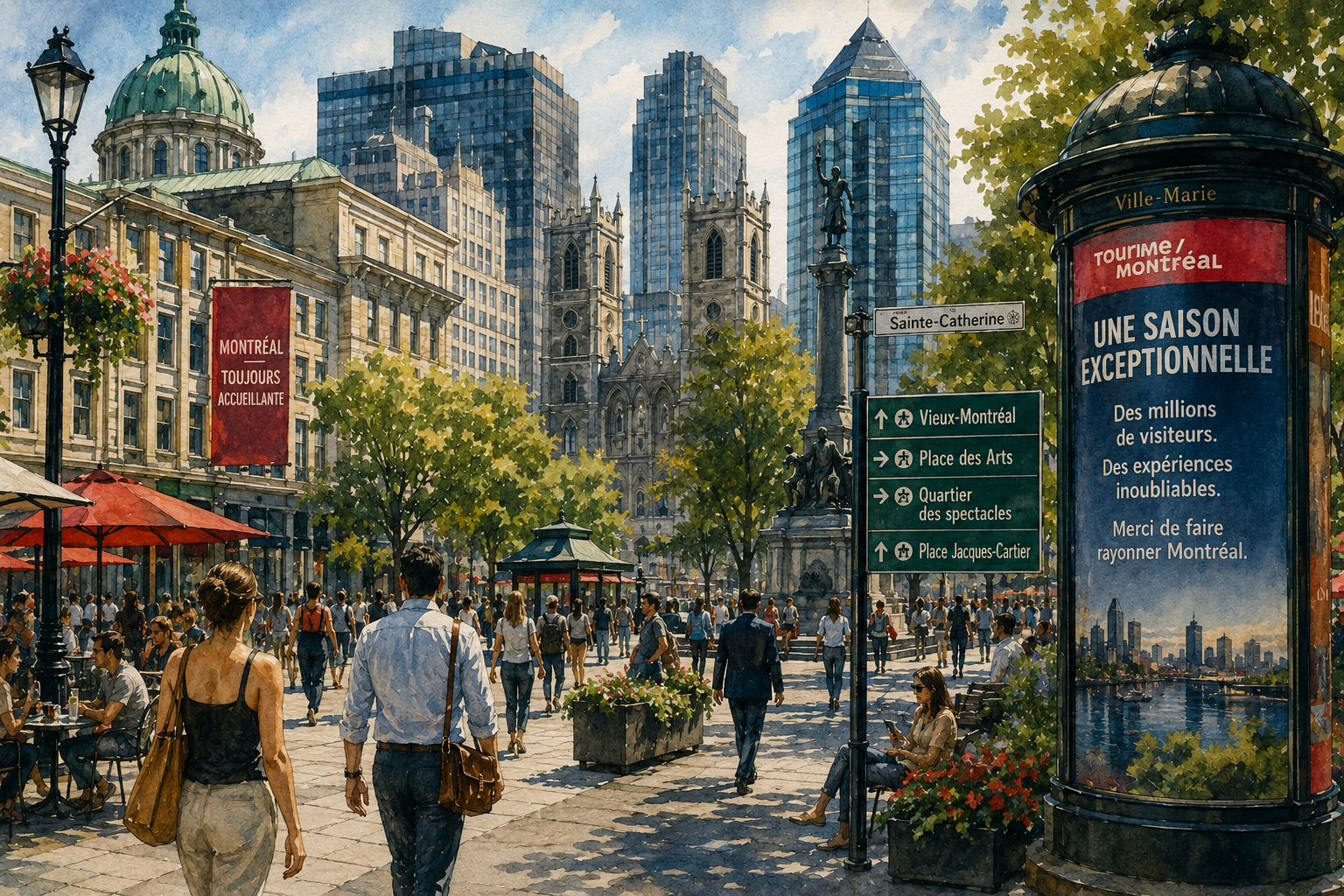
Montreal is having the kind of tourism year most cities would envy.
Visitors are pouring into the city, hotels and attractions are benefiting from a strong summer, and Tourisme Montréal says the city is continuing to build on tourism growth that has pushed visitor numbers beyond their pre-pandemic levels.
There’s even an interesting international shift taking place. Tourisme Montréal CEO Yves Lalumière told La Presse that Montreal is seeing particularly strong interest from overseas markets. While scheduled Paris-New York air capacity is declining for the coming months, Paris-Montreal capacity is moving in the opposite direction.
Walk through Old Montreal on a summer afternoon and none of this is particularly difficult to believe.
The restaurants are busy. Place Jacques-Cartier is full. Tourists wander along Saint-Paul, through the Old Port and up toward downtown. Festivals, concerts and major events continue to give Montreal something few North American cities can reproduce quite the same way.
So why is the City of Montreal simultaneously worried about getting enough people downtown?
Because tourists and office workers aren’t interchangeable.
Montreal released its Downtown Strategy 2030 earlier this summer, and buried underneath the language about vitality, attractiveness and urban transformation is a remarkably straightforward diagnosis of what’s happened to the city’s core.
Hybrid work has changed it.
The City identifies declining downtown attendance associated with hybrid work as the issue having the greatest impact on the area. Fewer workers coming downtown means less demand for office space and fewer customers walking through the doors of businesses that spent decades depending on the weekday office population.
That’s a very different problem from whether Montreal remains an attractive city.
Clearly it does.
People are travelling considerable distances to get here.
The harder question is what downtown becomes when the people living 20 kilometres away no longer have to come five days a week.
Before the pandemic, much of the downtown economy operated on a rhythm that nobody really questioned. Tens of thousands of people arrived every morning, worked in office towers, bought coffee, ate lunch, stopped at stores, occasionally stayed for dinner and then went home.
Businesses grew around that predictable flow.
Hybrid work broke the pattern.
It didn’t eliminate downtown employment, and downtown Montreal certainly hasn’t emptied out. But even losing one or two commuting days per worker across thousands of employees changes the economics at street level.
A restaurant doesn’t pay lower rent because its regular customers work from home on Monday and Friday.
The barber doesn’t get a discount on hydro because fewer people are walking past the shop.
And an office tower doesn’t become less expensive to operate because its elevators aren’t as busy as they were in 2019.
Tourism can fill some of those gaps, particularly during Montreal’s enormously successful summer season. But a visitor spending four nights in the city is participating in a different economy from someone who works downtown 200 days a year.
Montreal appears to understand that the old pattern isn’t simply going to return on command.
Its downtown strategy is consequently trying to change the reason people come.
The City wants more activity throughout the day and throughout the year, rather than relying as heavily on the traditional office rush. Plans include strengthening individual downtown neighbourhoods, creating a winter animation strategy, developing new residential neighbourhoods in the Faubourgs and Bridge-Bonaventure sectors, improving cleanliness and public spaces, expanding active transportation and investing in existing buildings.
Even the language the City uses is revealing. It wants people to choose downtown to live, work, study, shop, go out and be entertained.
Choose is doing a lot of work there.
For generations of Montreal office workers, going downtown wasn’t a choice. That’s where the job was.
Now it often is.
That leaves Montreal competing for its own residents’ attention in much the same way it competes for tourists.
And perhaps that’s where the tourism numbers become more interesting than a simple good-news story.
Montreal clearly knows how to make people want to come to Montreal.
The festivals work. The restaurants work. The architecture, neighbourhoods, nightlife, cultural institutions and sheer character of the city continue to draw people from elsewhere.
The challenge is applying some of that same thinking to downtown itself.
Montreal is already experimenting. Ville-Marie has pedestrianized or partially pedestrianized several downtown streets for the summer, including sections around Place Jacques-Cartier and Saint-Paul. Some terraces have extended operating hours. The City is also running a downtown innovation laboratory this summer aimed at reducing the disruption caused by construction and improving how people move through the core.
None of these things will recreate the downtown of 2019.
They probably shouldn’t try.
Hybrid work isn’t simply an emergency measure that hasn’t disappeared yet. Six years after the pandemic began, it has become part of how a significant portion of the economy operates.
The office district built around five commuting days has to adapt to a workforce that may only provide three.
That means more residents downtown, more reasons to visit outside working hours and an economy less dependent on whether thousands of people happen to be sitting upstairs in office towers.
Montreal’s tourism success offers some reassurance.
People haven’t stopped wanting Montreal.
Quite the opposite.
The city now has to convince more Montrealers that downtown is somewhere worth going even on the days when their boss doesn’t make them.