Toronto | East of the City
What’s With That Giant Airplane Sitting at Pearson?

The Canadianist | Toronto
If you drive the 427 past Pearson International Airport regularly, you’ve probably seen it.
It’s hard to miss. An enormous white cargo plane sits off on the airport grounds, seemingly in the same place every time you go by. After a while, it becomes part of the scenery. Another piece of Pearson that you stop wondering about.
Except this particular airplane has quite a story.
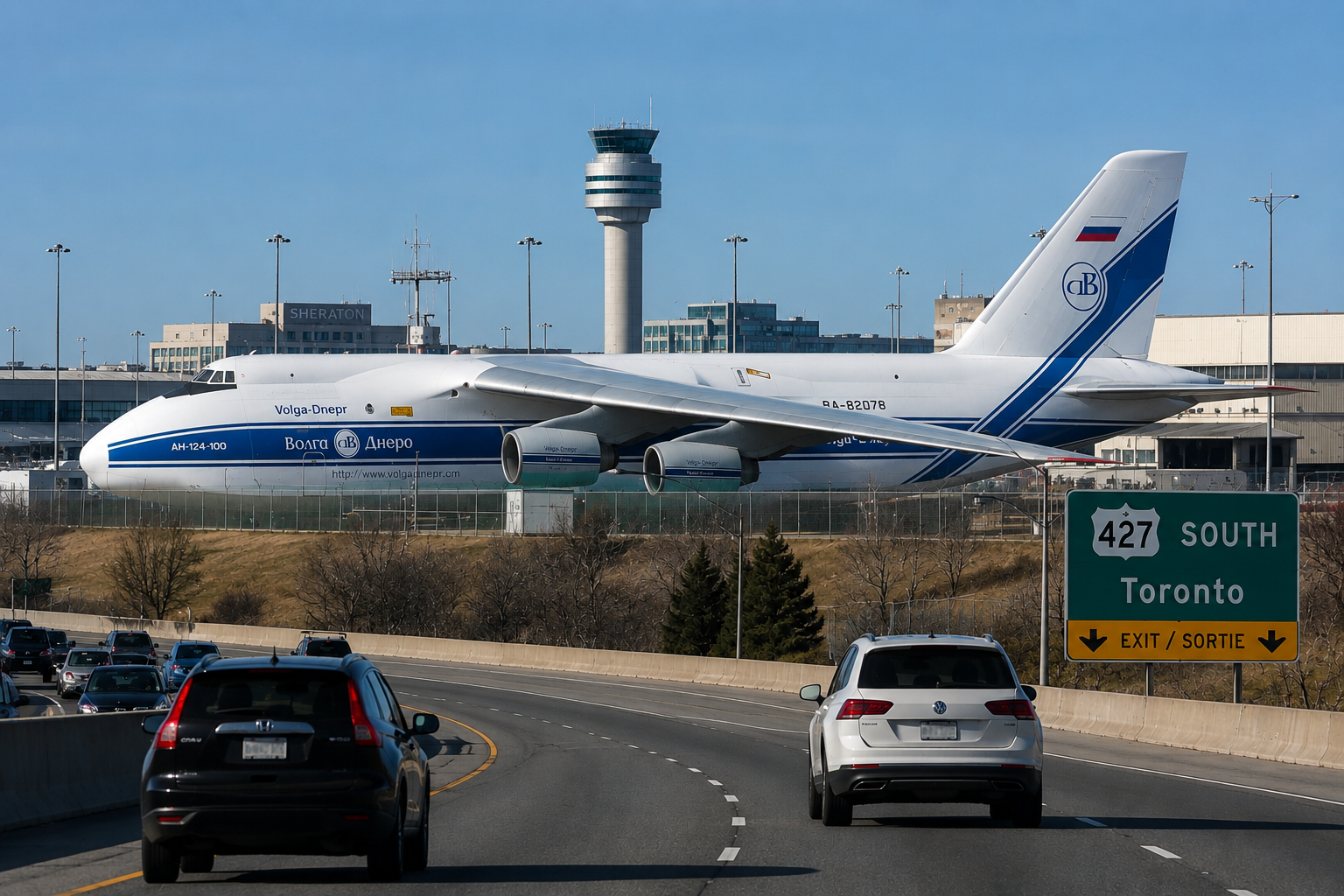
It’s a Russian Antonov An-124, one of the largest cargo aircraft in the world, and it has been stranded at Pearson since February 27, 2022.
More than four years later, it still isn’t going anywhere.
A recent Federal Court decision has made its immediate future even clearer. Volga-Dnepr Airlines, the Russian cargo carrier fighting Canadian sanctions and trying to recover the aircraft, has lost its latest challenge against the federal government.
So, what exactly is that giant airplane doing beside the 427?
It arrived at exactly the wrong time
The aircraft is an Antonov An-124-100, registration RA-82078, operated by Volga-Dnepr Airlines, Russia’s largest cargo airline.
The An-124 is a heavy-lift aircraft designed to carry the kind of oversized cargo that ordinary freighters can’t handle. Its enormous fuselage, high-mounted wings and four engines explain why it looks so different from most of the aircraft around Pearson.
RA-82078 arrived in Toronto carrying COVID-19 rapid tests.
Its timing could hardly have been worse for its operator.
Russia had launched its full-scale invasion of Ukraine on February 24, 2022. Three days later, Canada closed its airspace to Russian-owned, chartered and operated aircraft as part of the international response.
The Antonov had already landed at Pearson.
Once Canada’s airspace closed, it couldn’t legally take off and fly out.
It has been sitting there ever since.
Canada eventually seized it
Being grounded and being seized are two different things.
For more than a year, the Antonov remained at Pearson because Canadian airspace restrictions prevented it from leaving. Then Ottawa went further.
In June 2023, the federal government formally seized the aircraft under Canada’s Special Economic Measures Act.
The seizure order identified the airplane specifically: an An-124-100-150 manufactured by Aviastar-SP, registration RA-82078, serial number 9773054559153, located at Toronto Pearson.
Canada subsequently replaced that original order with an updated seizure order identifying several parties believed to own, hold or control interests in the aircraft, including Volga-Dnepr entities, company founder and former president Aleksey Isaykin and Sberbank.
Under the current order, the federal Minister of Public Works and Government Services has possession and control of the airplane.
So that giant Antonov you see from the 427 isn’t merely a Russian aircraft that can’t get permission to leave.
It’s property that has been formally seized by the Government of Canada.
The Russians want it back
Volga-Dnepr hasn’t accepted Canada’s actions quietly.
The airline has challenged the sanctions against it and argued that it should be removed from Canada’s sanctions list.
Volga-Dnepr maintains that it hasn’t carried military cargo since 2018 and disputes Canada’s characterization of its relationship with the Russian state.
Ottawa sees things very differently.
Global Affairs Canada has argued that the airline benefited from Russian government contracts and subsidies and played a role in helping the Putin government work around Western sanctions to obtain goods that were sanctioned or potentially useful in sensitive and military-related sectors.
Volga-Dnepr sought judicial review of Canada’s refusal to remove the company and Isaykin from the sanctions list.
This month, it lost.
A Federal Court judge rejected the challenge, finding the airline hadn’t demonstrated that the federal government’s decision was unreasonable or procedurally unfair.
The sanctions remain.
So does the airplane.
There is a much bigger legal fight underway
The Federal Court ruling doesn’t end the story.
Volga-Dnepr has opened a separate international arbitration case against Canada under an investment agreement originally signed between Canada and the Soviet Union.
The airline served Canada with notice of its intention to pursue arbitration in August 2023 and formally filed its claim in August 2024.
Its demand is substantial.
Volga-Dnepr wants the Antonov returned.
If it can’t get the aircraft back, it is seeking at least US$100 million in compensation from Canada.
The airline argues that Canada’s closure of its airspace and subsequent seizure of the aircraft violated Canada’s obligations under the investment agreement.
That arbitration remains active.
Canada wants to go in the opposite direction
Ottawa’s objective has been to pursue forfeiture of the aircraft as part of Canada’s sanctions regime against Russia.
Seizure, however, doesn’t automatically mean Canada owns the airplane outright and can simply sell it tomorrow.
There are additional legal steps involved before permanent forfeiture and disposal of the aircraft can occur.
That distinction helps explain why an airplane Canada seized years ago is still sitting at Pearson instead of being sold, transferred or put back into service.
There are potentially enormous sums involved, competing ownership interests and an active international arbitration claim.
There is also the question of what condition the aircraft will be in by the time anyone is legally able to do something with it.
Four years is a long time for an airplane to sit
Aircraft are built to fly. Keeping one parked for years creates an entirely different set of problems.
An An-124 is an extraordinarily complex piece of machinery. Engines, hydraulic systems, tires, seals, electronics and the airframe itself require maintenance and inspection.
Returning an aircraft that has spent years on the ground to commercial service isn’t as simple as putting fuel in it and starting the engines.
Any eventual attempt to fly RA-82078 again would require the aircraft to be brought back into an airworthy condition and satisfy the appropriate aviation authorities.
That could become increasingly expensive the longer the legal fight continues.
Then there is the parking bill.
Reports over the years have put Pearson’s parking charges for the aircraft at more than $1,000 per day. After years on the ground, the accumulated amount has reportedly climbed beyond $1 million.
It may be one of the most expensive long-term parking situations in Toronto.
The airplane beside the 427
Most of this is happening far away from the people who see the airplane every day.
There are federal sanctions, Russian counterarguments, an international investment treaty, Federal Court proceedings, forfeiture law and a dispute potentially worth more than US$100 million.
From the 427, none of that is visible.
You just see a really big airplane.
It arrived in Toronto carrying COVID tests during the final days of February 2022 and happened to be sitting at Pearson when Canada’s response to Russia’s invasion of Ukraine effectively closed the door behind it.
More than four years later, the pandemic has moved into history, the war continues, the legal battle continues, and RA-82078 is still sitting exactly where thousands of Toronto drivers can see it.
Now you know why.