National | Politics
Three Ridings, One Government: What August 31 Really Decides

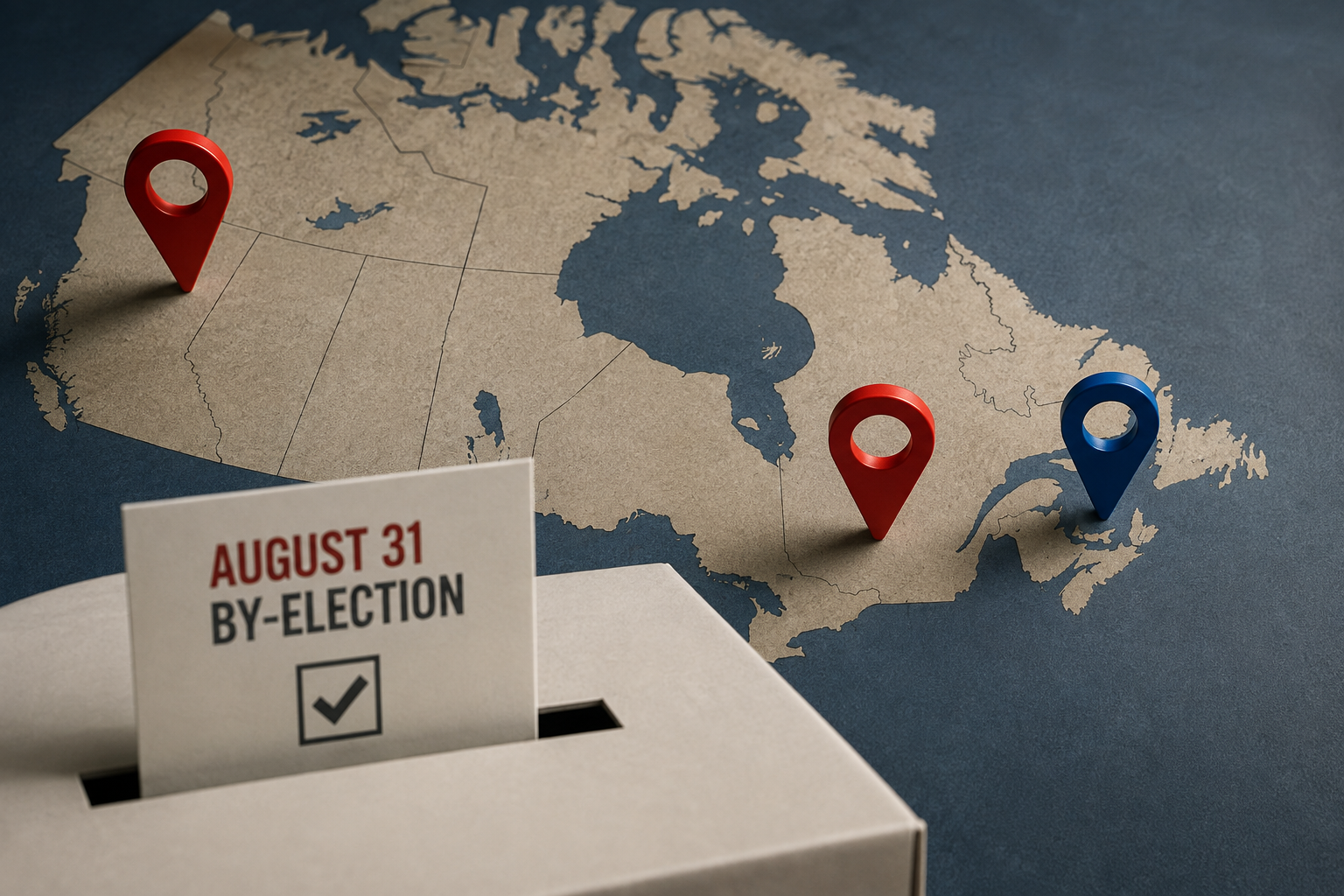
OTTAWA — Three federal by-elections on August 31 could determine whether Prime Minister Mark Carney keeps majority control of the House of Commons. But for all the attention being paid to three ridings in three provinces, the balance of power may come down to a single seat in Quebec.
Voters in Beaches–East York in Ontario, North Vancouver–Capilano in British Columbia and Chicoutimi–Le Fjord in Quebec will elect new MPs two weeks from today. Elections Canada has confirmed advance voting will run from August 21 through August 24.
The Liberals need to win just one of the three seats to maintain their majority in the Commons.
Two of the races begin with substantial Liberal advantages.
Beaches–East York was held by former housing minister Nate Erskine-Smith, who resigned his federal seat in July. North Vancouver–Capilano became vacant after former cabinet minister Jonathan Wilkinson was appointed Canada’s ambassador to the European Union. The third vacancy was created when Conservative MP Richard Martel left Chicoutimi–Le Fjord after being appointed to the Senate.
That makes Quebec the race to watch.
Chicoutimi–Le Fjord was already one of the country’s closest three-way contests in the last federal election. Martel won with 34.1 per cent of the vote, while the Bloc Québécois took 31.2 per cent and the Liberals 31.1 per cent. Fewer than three percentage points separated first and third.
The first riding poll of the by-election suggests little has changed.
A Pallas Data survey conducted in July put the Bloc at 30 per cent, the Liberals at 28 and the Conservatives at 26, with 13 per cent undecided. The survey included 317 respondents.
The three major parties have responded accordingly. Liberal candidate Daniel Gobeil, president of Les Producteurs de lait du Québec, faces Conservative Régis Gaudreault and Bloc Québécois candidate Caroline Dubé, a former Parti Québécois candidate.
There are plenty of conventional ways to read the race.
A Liberal victory would be presented as evidence of Carney’s continued strength in Quebec. A Conservative hold would give Pierre Poilievre’s party an important defence in a province where expanding the Conservative seat count remains difficult. A Bloc victory would inevitably be examined for clues about Quebec nationalism and the political mood heading toward the provincial election.
But August 31 is also exposing something much larger about the way Canada chooses a government.
The Liberals don’t need to win a national election on August 31.
They don’t need to increase their share of the national popular vote. Canadians outside the three affected ridings don’t get another say in the composition of Parliament.
They need one seat.
And if Beaches–East York and North Vancouver–Capilano behave roughly as their recent electoral histories suggest, the decisive seat could be Chicoutimi–Le Fjord.
That would leave voters in one riding in the Saguenay effectively deciding whether the federal government retains majority control of the House of Commons.
There is nothing unconstitutional or irregular about that. It is a consequence of Canada’s first-past-the-post electoral system.
Canada doesn’t elect its government through a national vote. It elects MPs in individual ridings, with the candidate receiving the most votes winning each seat. Those seats are then added together to determine who controls the House.
National vote totals don’t determine parliamentary power directly.
Geography does.
The distinction is usually buried inside the results of a general election, when 343 riding contests happen simultaneously. August 31 strips much of that complexity away.
One additional riding victory can mean one additional seat. One additional seat can mean majority control. And majority control can determine how easily a government passes legislation, survives confidence votes and carries out its agenda for the remainder of the Parliament.
Chicoutimi–Le Fjord itself demonstrates the peculiarities of the system.
Martel won the riding in the last election with just over one-third of the vote. Almost two-thirds of those who voted chose someone else.
His victory was entirely legitimate. He received more votes than any other candidate and therefore won the seat.
But Parliament doesn’t record the other two-thirds of the electorate as representation. The riding produces one MP and one seat.
That principle, repeated across the country, is how a party can win a majority of seats without winning a majority of votes nationally, producing what electoral reform advocates describe as an artificial majority.
The issue has been examined repeatedly in debates over Canadian electoral reform. First-past-the-post rewards parties according to where their votes are located as much as how many votes they receive. Concentrated support that produces first-place finishes wins seats. Support that finishes second or third does not.
August 31 offers an unusually clear demonstration of the consequences.
Imagine two Canadians with identical political preferences.
One lives in Chicoutimi–Le Fjord. The other lives a few kilometres outside the riding.
Only one of them will have a ballot capable of affecting whether the government retains its majority this month.
That’s not because one citizen has formally been given greater democratic rights. It’s because one happens to live where a seat is vacant at precisely the moment when a single seat could change the parliamentary arithmetic.
Under a more proportional electoral system, the local race would still matter. Chicoutimi–Le Fjord would still elect a representative, and voters there would still determine who speaks for their community in Ottawa.
What would be reduced is the ability of one geographically isolated result to alter the balance of national political power independently of the broader preferences of Canadian voters.
That debate will continue long after August 31.
For now, the parties have a much more immediate problem.
The Liberals need one.
The Conservatives want to hold the Quebec seat they won in 2025.
The Bloc sees an opportunity to take a riding where it was already within striking distance.
And the voters of Chicoutimi–Le Fjord may find themselves casting ballots carrying considerably more national weight than anyone expected when they last went to the polls.
Three by-elections are taking place on August 31.
But Canada may really be watching one.
And whichever party wins it, the larger question will remain: should the governing arrangement of an entire country ever depend this heavily on where a few thousand votes happen to fall?