TRADE WAR
Hiding in Plain Sight: Trump Says America Doesn’t Need Canada. So Why Won’t He Leave Us Alone?

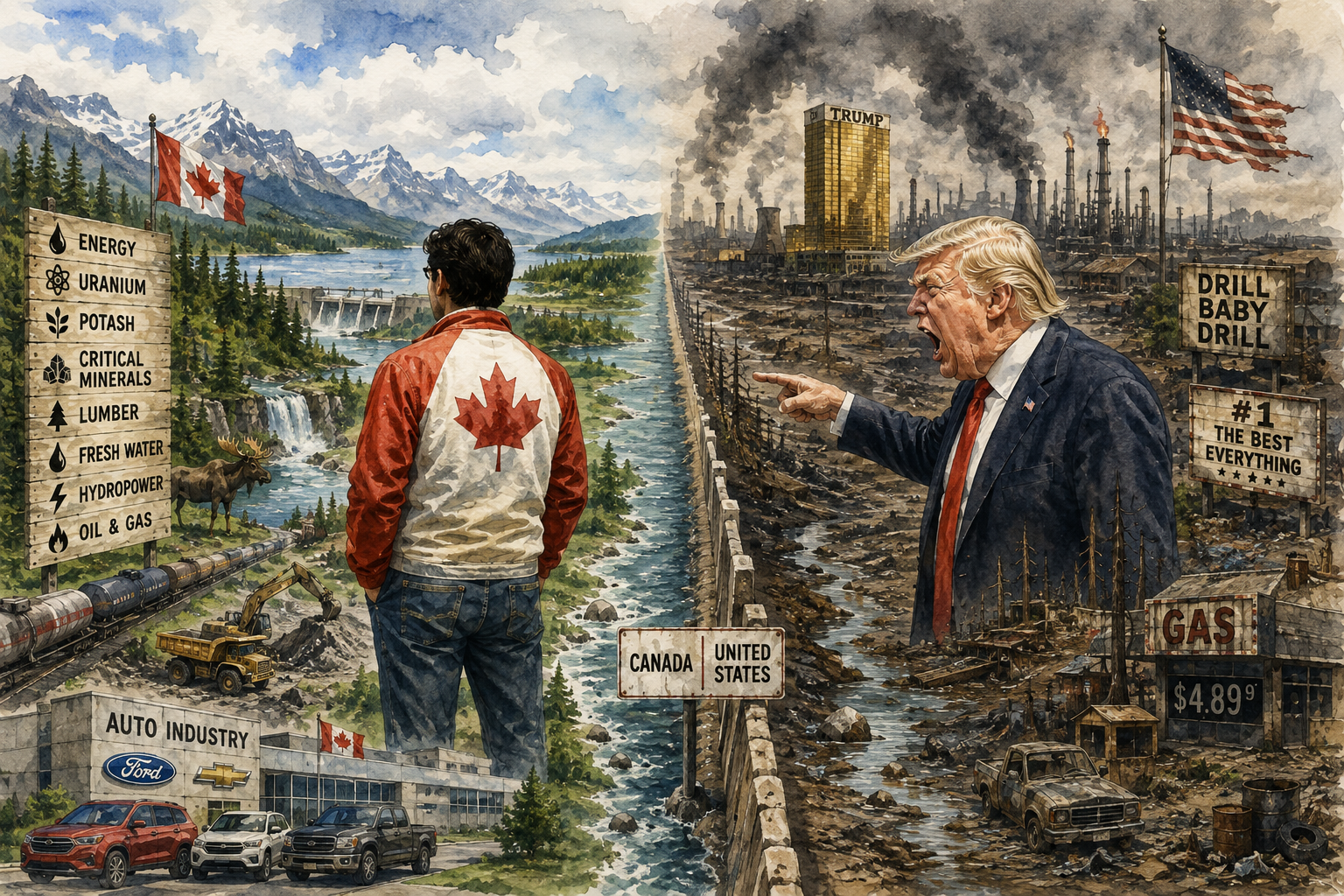
The grievances keep changing. The pressure never does. Behind the tariffs, threats and 51st-state taunts sits everything America says it doesn’t need. The louder Trump screams about how little Canada matters, the more obvious it becomes how badly America wants what we have.
Donald Trump keeps telling Americans they don’t need Canada. Then why won’t he leave us alone? Countries don’t usually spend this much time trying to control things they don’t need. If Canada were the economic dead weight Trump repeatedly portrays us as, the solution would be remarkably simple. Shut the door. Buy somewhere else. Build everything in America. Tell Ottawa, “We’ll call you when we need you.” Instead, the President of the United States appears almost obsessed with Canada.
And the excuse keeps changing. First, Canada was a fentanyl problem. Then we were a border problem. Then dairy. Alcohol. Autos. Steel and aluminum. Trade deficits. National security. Tariffs go on, come off, get delayed, come back and rise to 50%. Deadlines move. Agreements approach the finish line and collapse. Now Trump is threatening to call Lake Ontario “Lake America” because the United States apparently doesn’t expect to do much business with Ontario anymore. Right. At some point Canadians are entitled to stop chasing the grievance of the week and ask whether the grievance was ever really the point. Maybe all of this is hiding in plain sight.
America Doesn’t Need Us? Take Another Look.
Pull out a map of Canada and forget politics for a minute. Look at what is actually here: energy, uranium, potash, critical minerals, aluminum, lumber, hydroelectricity, oil, natural gas, fresh water, an enormous Arctic territory sitting above a rapidly changing geopolitical frontier, and an industrial economy that has spent generations becoming intertwined with the American one.
In 2025, Canada supplied 63.4% of all crude oil imported by the United States, nearly 100% of its imported natural gas, 97.9% of imported natural gas liquids and 81.3% of imported electricity. Canadian exports of crude oil, refined petroleum products, natural gas and natural gas liquids to the United States were worth $157.5 billion that year. The United States was also Canada’s largest critical-minerals trading partner in 2025. Canada exported $28.8 billion in critical minerals to the U.S., with copper and potash among our leading exports.
Does that sound like a country America has no use for? Or does it sound like a country America has an enormous strategic interest in keeping close, predictable and economically aligned with Washington?
Imagine If It Were All American
Forget Donald Trump for a moment and think like an American strategist. Imagine a United States with effectively guaranteed access to Canada’s energy, uranium, potash, critical minerals, lumber, hydroelectricity, Arctic geography and industrial capacity. Not through the messy business of dealing with another sovereign country capable of saying no, making its own trade agreements, protecting its own industries and developing relationships with Europe and Asia. Imagine instead that Canada were economically dependent enough on Washington that saying no became prohibitively expensive.
You don’t need to invade Canada to achieve that. You don’t need tanks crossing the Ambassador Bridge. You don’t need the 51st state. You need leverage — enough leverage over Canadian trade, industries and access to the American market that Ottawa increasingly has to consider Washington’s wishes before making decisions supposedly belonging to Canadians.
I cannot prove that this is Donald Trump’s master plan. I can look at what is happening and ask whether Canadians are being far too incurious about it.
Listen to What He’s Actually Saying
The 51st-state rhetoric was easy to dismiss when it first started. Just Trump being Trump. Then it kept happening. “Governor.” Canada doesn’t deserve to exist without America. Canada should become a state. Economic pressure. Threats. Tariffs. And now “Lake America.” At what point does repeatedly talking about diminishing another country’s sovereignty stop being a joke Canadians are expected to laugh off?
We don’t have to believe Trump is secretly planning an invasion. I don’t believe he is. Economic power is far cheaper than military power. If you can make another country sufficiently dependent on your market, you don’t need to own its territory to exert extraordinary influence over what happens there.
Carney says Washington sought restrictions affecting Canada’s ability to enter future trade arrangements with other countries. He has described American demands as threatening Canada’s major industries and treating Canada like a subsidiary rather than a sovereign partner. The Americans dispute Canada’s characterization of parts of those negotiations, and the negotiating texts remain unavailable publicly. Show us the documents. But if Canada’s account is substantially correct, we’re no longer arguing merely about the price of cheese. We’re arguing about who gets to make Canadian decisions.
The Grievance Keeps Changing. The Pressure Doesn’t.
If fentanyl were the problem, solve fentanyl. If the border were the problem, secure the border. If dairy were the problem, negotiate dairy. If autos were the problem, negotiate autos. But when one grievance merely gives way to another, followed by another and another, perhaps Canadians should consider the possibility that satisfying the grievance was never going to end the pressure.
The grievance keeps changing. The pressure doesn’t.
Trump’s claim that America doesn’t need Canada is contradicted by his own behaviour. You don’t spend this much presidential time, political capital and economic firepower trying to reshape the behaviour of a country irrelevant to you. You walk away. Trump hasn’t walked away. He’s leaning in. Hard.
Maybe We Have More Leverage Than We Think
For decades, Canadians have been conditioned to think about this relationship almost exclusively from our own vulnerability. We need the American market. True. We need American investment. True. Millions of Canadian jobs depend on continental trade. True. But dependency in an integrated economy doesn’t run in only one direction.
Throughout this trade war, we’ve talked about leverage almost entirely in American terms. They’re roughly ten times our size. They’re our largest customer. They can inflict enormous economic damage on Canada, and they can do it quickly. None of that changes simply because we have resources they want.
But if America genuinely needs the things we’ve been talking about, Canada may have considerably more leverage than we’ve been telling ourselves. Countries don’t spend this much time trying to secure access to things they can easily replace. They don’t apply enormous economic pressure to countries whose resources are irrelevant to them, and they don’t try to influence another country’s trade relationships and economic decisions if they couldn’t care less what that country does.
America’s size gives it enormous leverage over Canada, but Canada’s resources give us leverage over America. We need to remember that.
America built industries, pipelines, electrical connections, factories and supply chains around access to Canadian resources because doing so made economic sense. That infrastructure exists, and those dependencies didn’t suddenly disappear because Donald Trump says America doesn’t need us.
Canada shouldn’t weaponize those dependencies recklessly. Shutting off pipelines or hydroelectricity, threatening American farmers with potash or deliberately disrupting integrated supply chains would be dangerous and economically destructive. It would also give American industries every incentive to permanently replace Canadian suppliers wherever they could.
But we shouldn’t negotiate as though we’re showing up empty-handed either.
We should understand what disruption to reliable Canadian heavy crude would mean for American refineries, what higher or less predictable potash supplies would mean for American agriculture, how Canadian uranium fits into American nuclear ambitions, how deeply manufacturers depend on integrated Canadian supply chains and how valuable Canada is to American strategic interests in the Arctic.
We don’t need to threaten Washington with any of it. They already know what they buy from us and why they buy it.
Maybe we’ve been reading Trump’s behaviour backwards. Every time he tells us how desperately Canada needs America, we hear another warning about our vulnerability. His relentless effort to pressure Canada may also be exposing America’s dependence on what we have.
Canada has a stick.
Maybe we’ve forgotten how large it is.
Stop Believing the Sales Pitch
Trump says America doesn’t need Canada. Fine. Then leave us alone. Stop threatening our industries. Stop trying to dictate our trade relationships. Stop treating access to your market as a weapon to extract concessions from ours. Stop joking about absorbing our country. Stop calling our Prime Minister a governor. Stop threatening the sovereignty of a country you supposedly don’t need. Go build everything yourselves. We’ll call you.
Of course, that isn’t what’s happening. The United States keeps coming back to the table because beneath all the insults, threats and bravado sits an unavoidable geographic fact: Canada has things America needs. America has things Canada needs too. That’s why this relationship worked for generations. It wasn’t charity. It wasn’t America generously allowing Canada to exist beside it. It was mutual interest.
Donald Trump appears determined to replace that relationship with one based increasingly on leverage, pressure and submission. Maybe I’m wrong about the larger objective. Maybe fentanyl really became dairy, which became alcohol, which became steel, which became aluminum, which became autos, which became national security, which became Lake America through an astonishing series of unrelated coincidences. Or maybe Canadians should finally look past the excuse of the day.
Countries don’t usually spend this much time trying to control things they don’t need. And if America truly doesn’t need Canada, there’s a very easy way to prove it.
Walk away.
They haven’t.
Maybe it’s time we started asking why.